
Under The Hammer
Home & Interiors

We are pleased to present Home & Interiors taking place on 7 September in London, Knightsbridge. The cross-category auction offers a range of wonderful pieces; from two large group lots of drawings by British artist Madge Gill, to a mythological tapestry from the late 17th century. Ahead of the sale, specialists select their top picks coming under the hammer this September.
Lot 57 and Lot 58
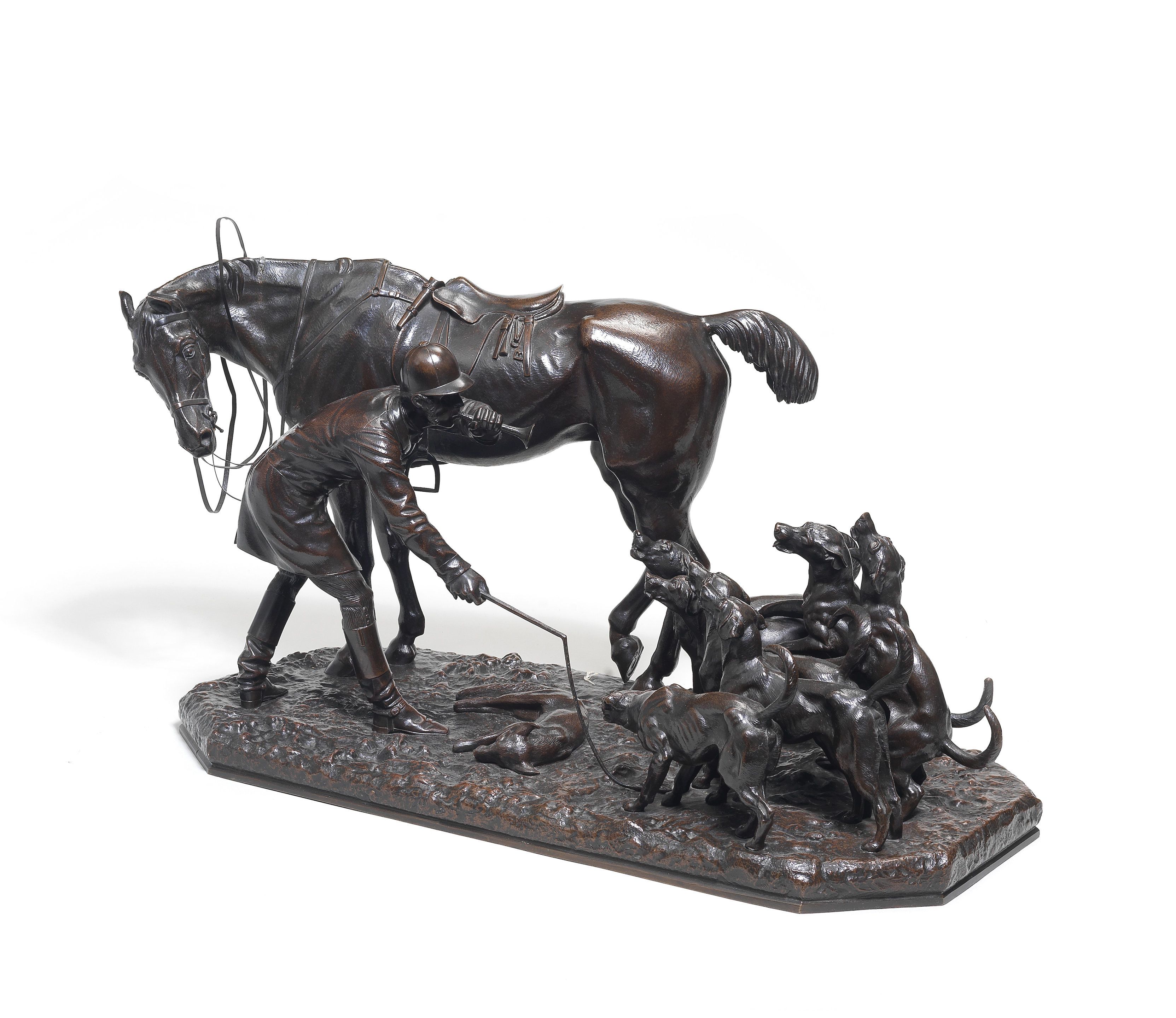
A Group of Twenty-Seven Drawings and A Group of Twenty-Six Drawings by Madge Gill (British, 1882-1961)
In our upcoming Home & Interiors sale, we are excited to be offering two large group lots of works on paper by the idiosyncratic artist Madge Gill.
Gill exhibited her work annually from 1939 until 1947 at the Whitechapel Gallery in London. She subsequently, purportedly, began turning down the opportunity to sell or exhibit her work at galleries across London, including at the renowned West End Gallery.
This was because Gill was convinced that the works, although drawn by her, did not belong to her and instead to her alter-ego named Myrninerest. Gill believed Myrninerest was her spirit guide and supposedly ‘possessed’ her from 1920 until her death in 1961. Gill would frequently sign works as Myrninerest and so did not think she had the right to sell the works, often living in fear of angering Myrninerest.
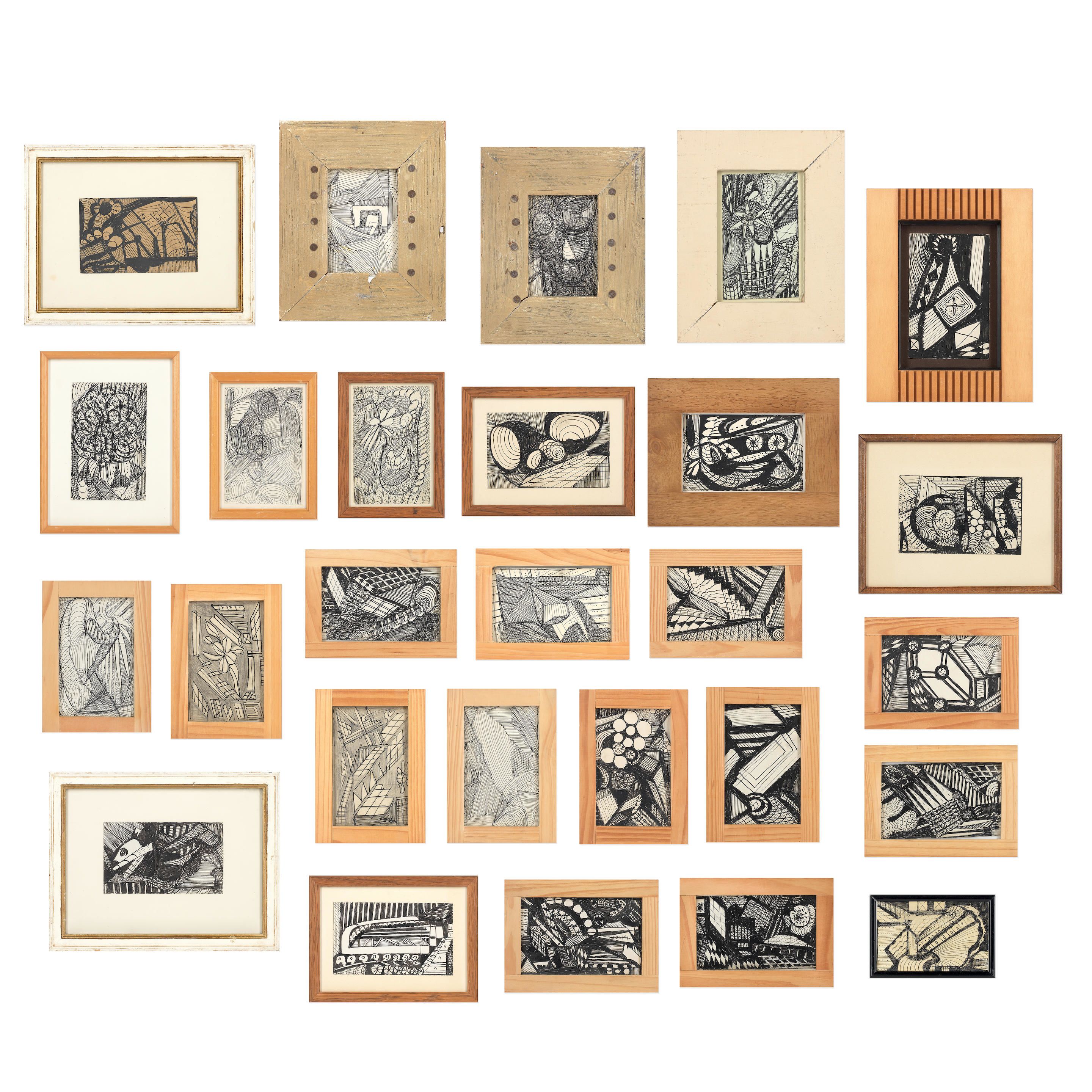
These highly detailed patterns and cross-hatched drawings are quintessential of Gill's style and give us an insight into her busy mind. It is believed that Gill created hundreds of pen and ink monochrome drawings similar to these which she hid in shoe boxes underneath her bed and in cupboards around her house.
Today Gill is celebrated as a key figure of Outsider Art, and her work can be found in both private and public collections globally, including the Collection de l’Art Brut in Lausanne, Switzerland, and the Aracine Collection in Lille, France.
- Romey Clark, Cataloguer, British and European Pictures

Lot 57. Madge Gill (British, 1882-1961) A Group of Twenty-Seven Drawings. Estimate: £2,500 - £3,500.
Lot 57. Madge Gill (British, 1882-1961) A Group of Twenty-Seven Drawings. Estimate: £2,500 - £3,500.

Lot 58. Madge Gill (British, 1882-1961) A Group of Twenty-Six Drawings, the largest pictured here. Estimate: £2,500 - £3,500.
Lot 58. Madge Gill (British, 1882-1961) A Group of Twenty-Six Drawings, the largest pictured here. Estimate: £2,500 - £3,500.

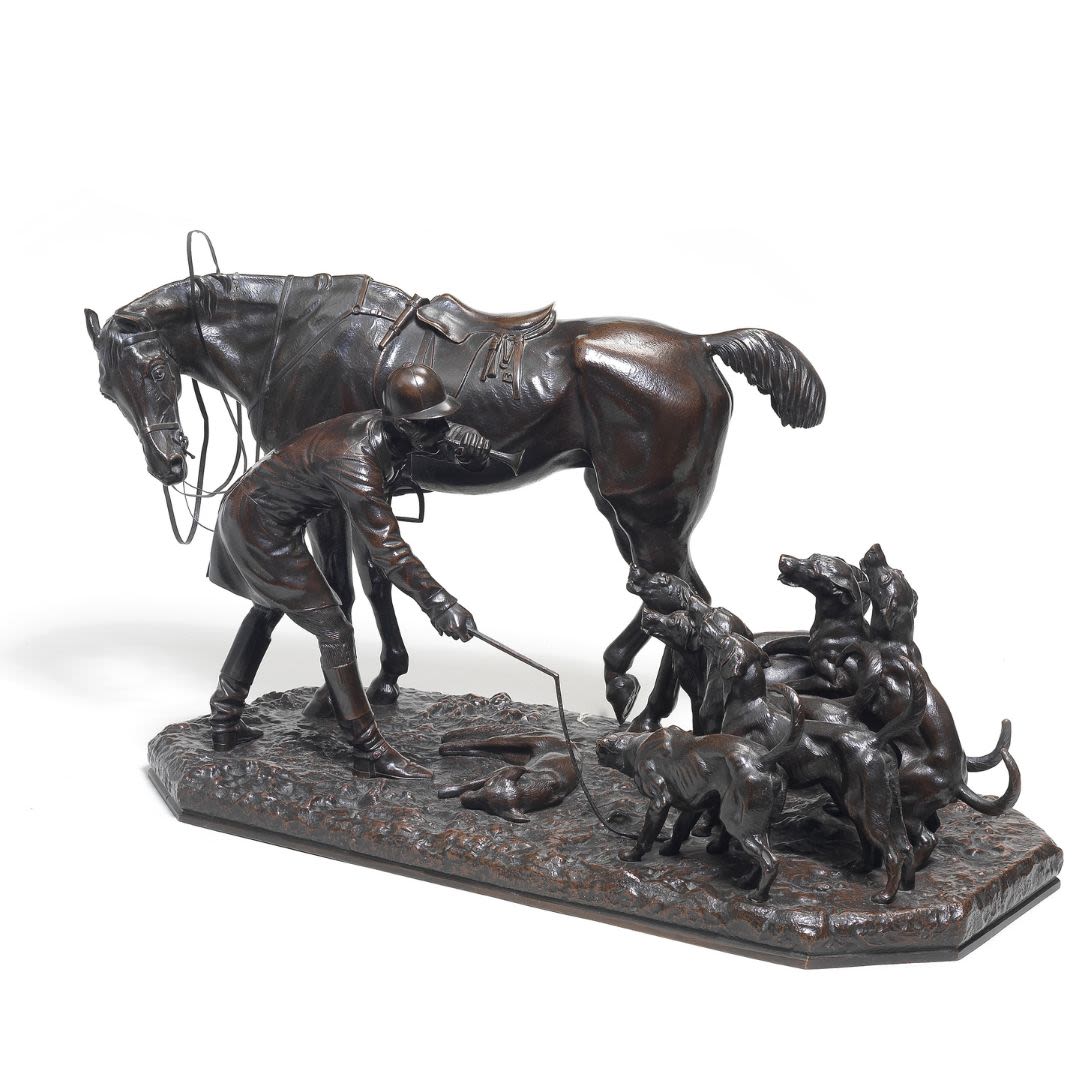
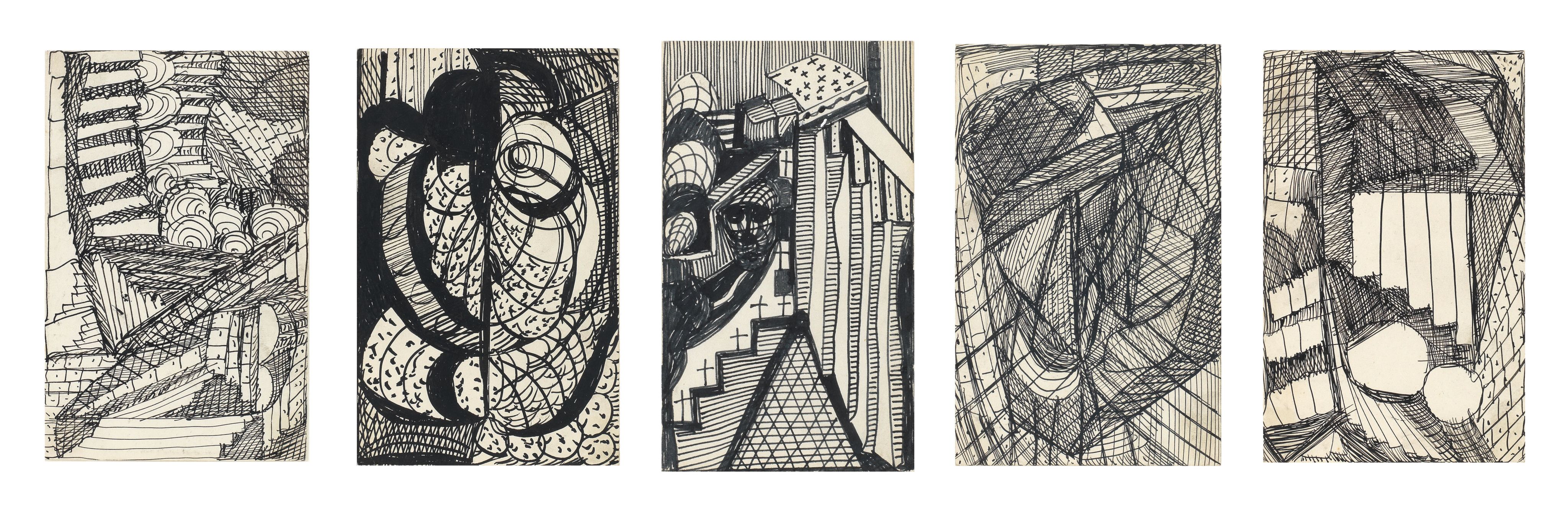
Lot 236. John Willis Good (British, 1845-1879): A Rare Patinated Bronze Equestrian Model of a Huntsman with his Hounds and a Fox. Estimate: £6,000 - £7,000.
Lot 236. John Willis Good (British, 1845-1879): A Rare Patinated Bronze Equestrian Model of a Huntsman with his Hounds and a Fox. Estimate: £6,000 - £7,000.
Lot 236
A Rare Patinated Bronze Equestrian Model of a Huntsman with his Hounds and a Fox by John Willis Good (British, 1845-1879)
John Willis Good is widely considered to be the leading English Animalier sculptor of the 19th century.
The present lot beautifully showcases Willis Good’s interest with complex composition and rich patination. During his short but prolific career, he focussed on hunting scenes. These compositions sometimes included riders but usually always horses and hounds.
Willis Good tragically shot himself in his studio on the Fulham Road in London at age 34. As such, very little is known about him today. We know that he exhibited sixteen pieces at the Royal Academy between the years 1870 and 1878 and collaborated with Charles Lutyens -a sporting painter who also produced sculpture.
- Michael Lake, Head of Department, European Sculpture and Works of Art
Lot 249
A Late Victorian Ebony, Palmwood and Ivory Inlaid Display Cabinet, Probably by Gillow and Co. or Lamb of Manchester
The modern and quasi-avant garde appearance of this chic display cabinet is remarkable, especially considering that it was made at some point during the last two decades of the 19th century. This near radical aesthetic is largely achieved through the combination and juxtaposition of a rectilinear design, inlaid geometric forms and striking quarter veneered panelling. Whilst its proto-modernism appears heightened by the use of exotic materials such as palmwood, ebony and ivory, which were exactly the type of timbers to become renowned for their use in Art Deco furniture of the 1920s and 30s.
Another important aspect of this piece is its enthralling provenance. It has remained within the same family for well over 100 years, being highly likely originally acquired by Sir Charles Alexander Innes (1874-1959), who was the great grandfather of the vendor. Innes, who was born and spent most of his life in colonial India and Burma, established himself as a significant figure in the running of the British Empire in those territories. Among the distinctions bestowed upon Innes throughout his life, perhaps the most notable were ‘Companion of the Order of the Indian Empire’ for services during World War I and ‘Knight Commander of the Order of the Star of India’.
It seems to be the case that this cabinet remained in imperial India until the country gained its independence in 1947, from which time onwards it evidently permanently returned to England with the family.
- Thomas Moore, Head of Department, Furniture and Works of Art

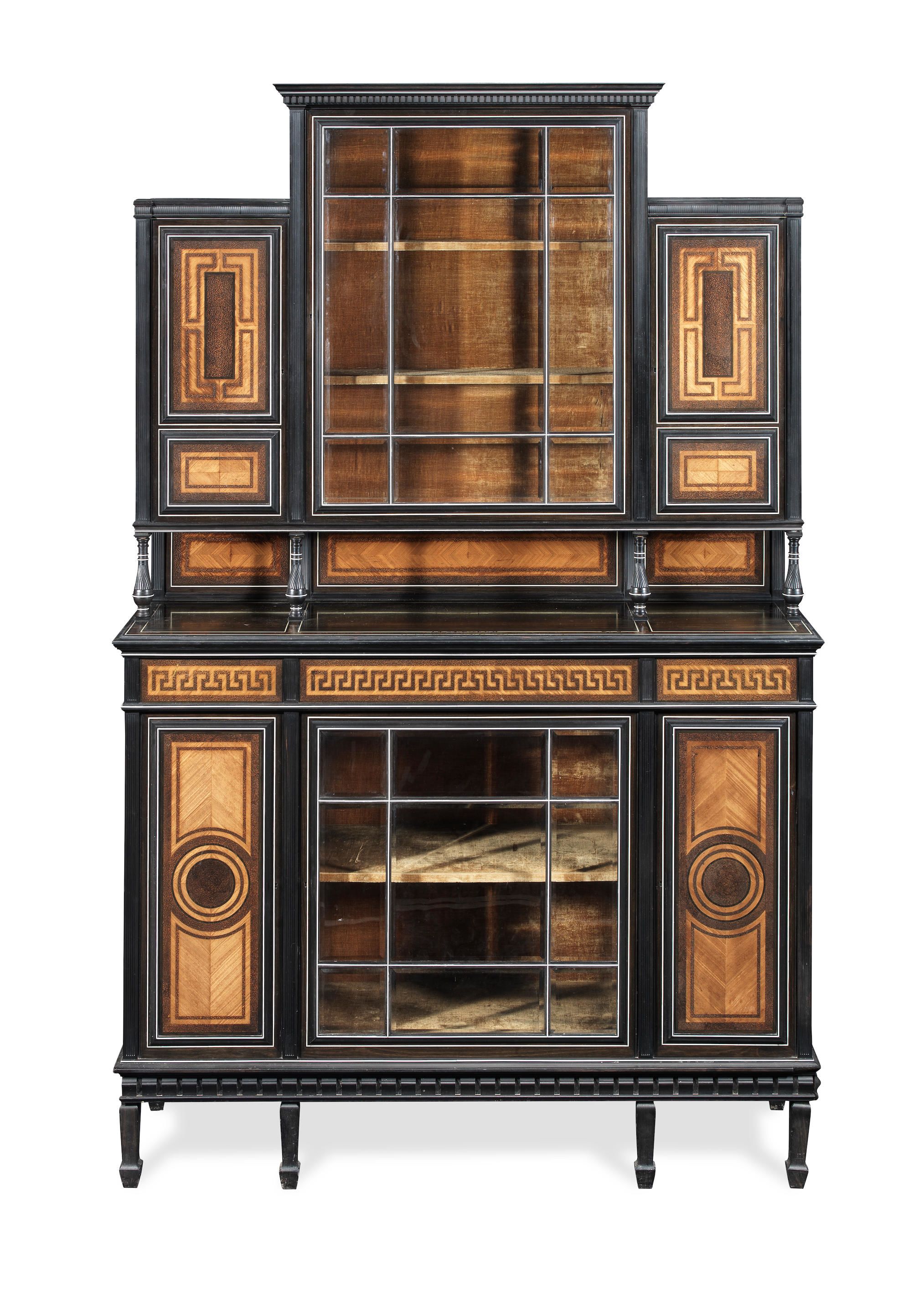
Lot 249. A Late Victorian Ebony, Palmwood and Ivory Inlaid Display Cabinet, Probably by Gillow and Co. or Lamb of Manchester. Estimate: £1,200 - £1,800.
Lot 249. A Late Victorian Ebony, Palmwood and Ivory Inlaid Display Cabinet, Probably by Gillow and Co. or Lamb of Manchester. Estimate: £1,200 - £1,800.

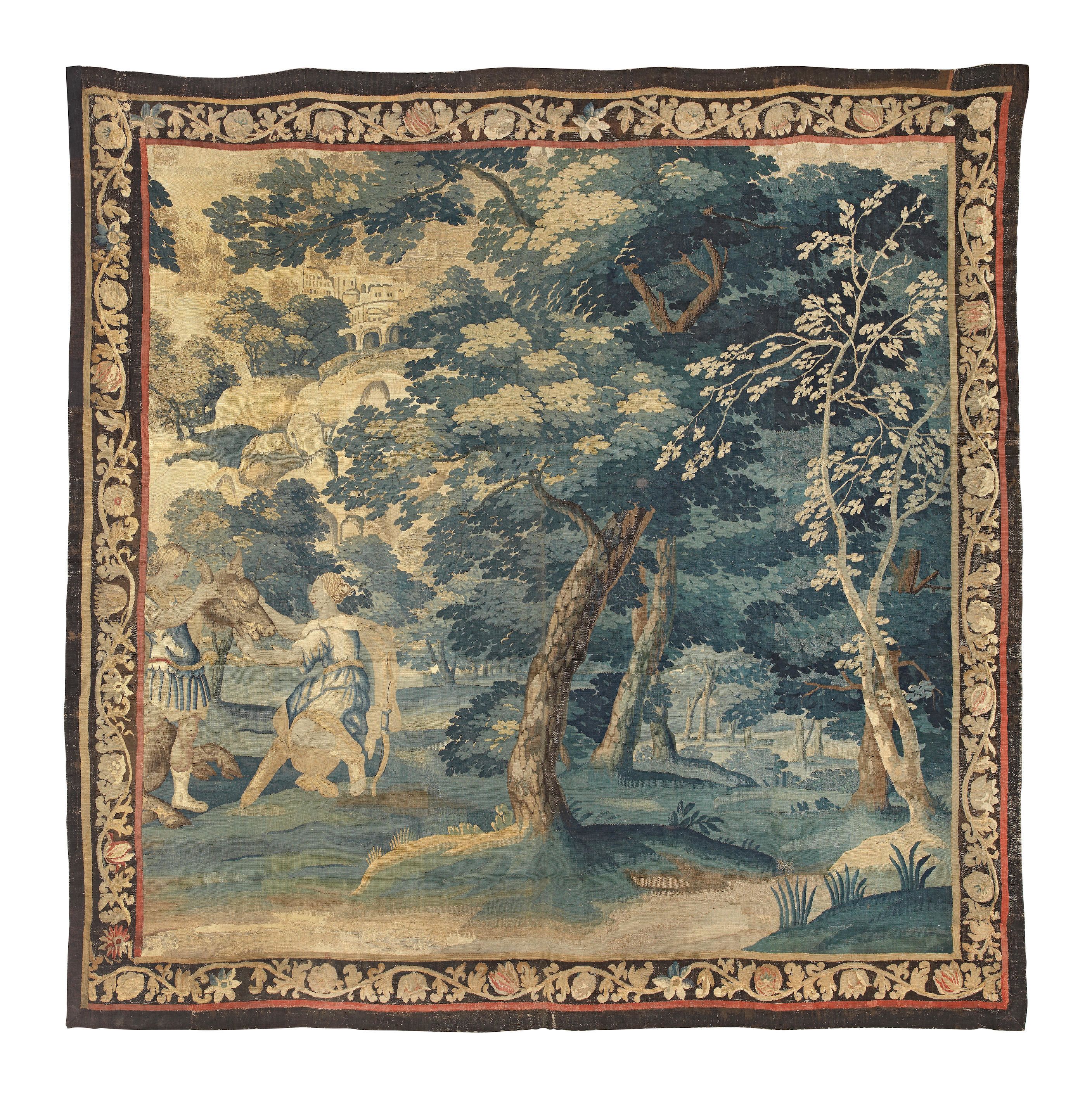
Lot 349. A Mythological Tapestry Fragment Probably Aubusson, Late 17th Century. Estimate: £2,000 - £3,000.
Lot 349. A Mythological Tapestry Fragment Probably Aubusson, Late 17th Century. Estimate: £2,000 - £3,000.
Lot 349
A Mythological Tapestry Fragment, Probably Aubusson, Late 17th Century
The present lot depicts the ancient story of Meleager, Atalanta and the Calydonian boar. To the left the figure of Atalanta can be seen in billowing robes, receiving the head of the boar which she wounded with an arrow. The hero Meleager can be seen to the very edge of the frame grasping the beast’s head.
The Aubusson factories were given a royal charter in 1665 but rose to commercial prominence in the 18th century. The factory certainly competed with the Gobelins and Beauvais factory but was never viewed equally when it came to quality. Fragmented pieces like the present lot would have originally been part of a series of tapestries showing a few episodes from an epic tale or metamorphic poem.
- Helena Gumley-Mason, Specialist, Furniture, Works of Art and Carpets
Register to bid in Home & Interiors before 7 September. For more information, contact Jade.Connolly@bonhams.com


 Built with Shorthand