
Top draw
Honoré Daumier’s ferocious, unflinching drawings landed him in jail. No wonder, writes Martin Gayford.

On Tuesday 18 September 1888, Vincent van Gogh wrote to his brother Theo. In his letter, he discussed the atmosphere of the humdrum, slightly squalid outskirts of Arles where he was living. This neighbourhood was not exactly Millet, he mused, meaning it wasn’t rustic. On the contrary, he insisted, “it’s pure Daumier, pure Zola”.
On the day that Van Gogh wrote those words, Honoré Daumier had been dead for less than a decade. He had led a curious dual career: just as Pablo Picasso could be famously described as a ‘sculptor/painter’, Daumier performed a double act as a ‘caricaturist/artist’.
Over the years, Daumier produced a huge number of drawings for humorous magazines, fine examples of which are offered by Bonhams in Paris and London this season. He made some 3,900 contributions alone to Le Charivari, the French periodical that inspired Punch. All of these were intended to make a barbed, poignant or wryly humorous point. Underneath each appeared a description or line or two of dialogue – generally not written by Daumier himself.
In British terms, Daumier was an equivalent to Gillray, Rowlandson or ‘Dickie’ Doyle of Punch. The difference was that simultaneously and – in the opinion of posterity, at least, with great success – he aspired to be a ‘serious’ artist. During his lifetime, not many observers or collectors took much notice of these efforts. The poet Charles Baudelaire was not only the first but also pretty well the only critic to discuss his work.

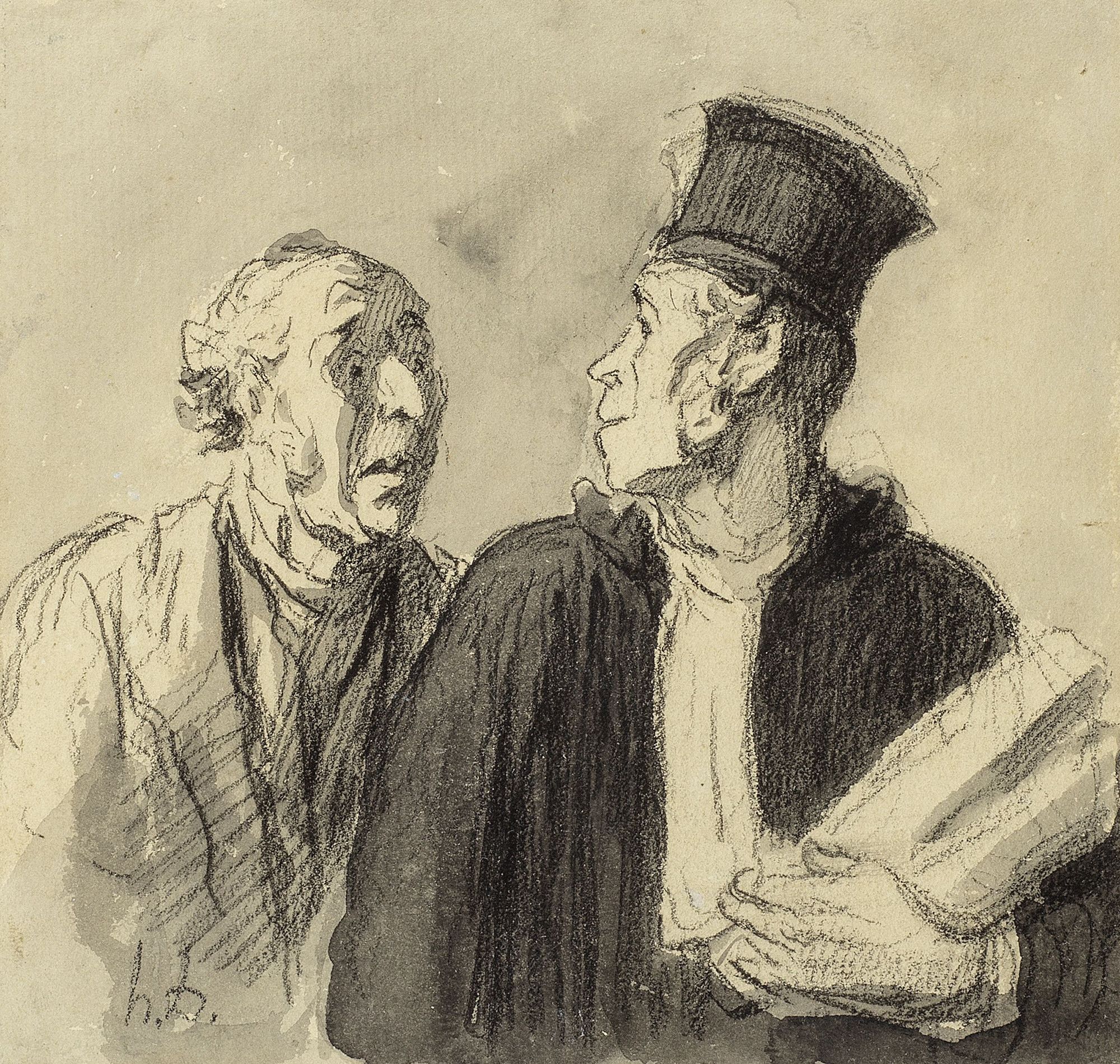
Honoré-Victorin Daumier (1808-1879), Avocat et client (L’avocat et le paysan – Défenseur et accuse). Estimate: €90,000 - 140,000
Honoré-Victorin Daumier (1808-1879), Avocat et client (L’avocat et le paysan – Défenseur et accuse). Estimate: €90,000 - 140,000
Stay updated with our auctions. Sign up to receive your weekly newsletter of global auctions, stories and more from Bonhams and our sister companies. Subscribe now

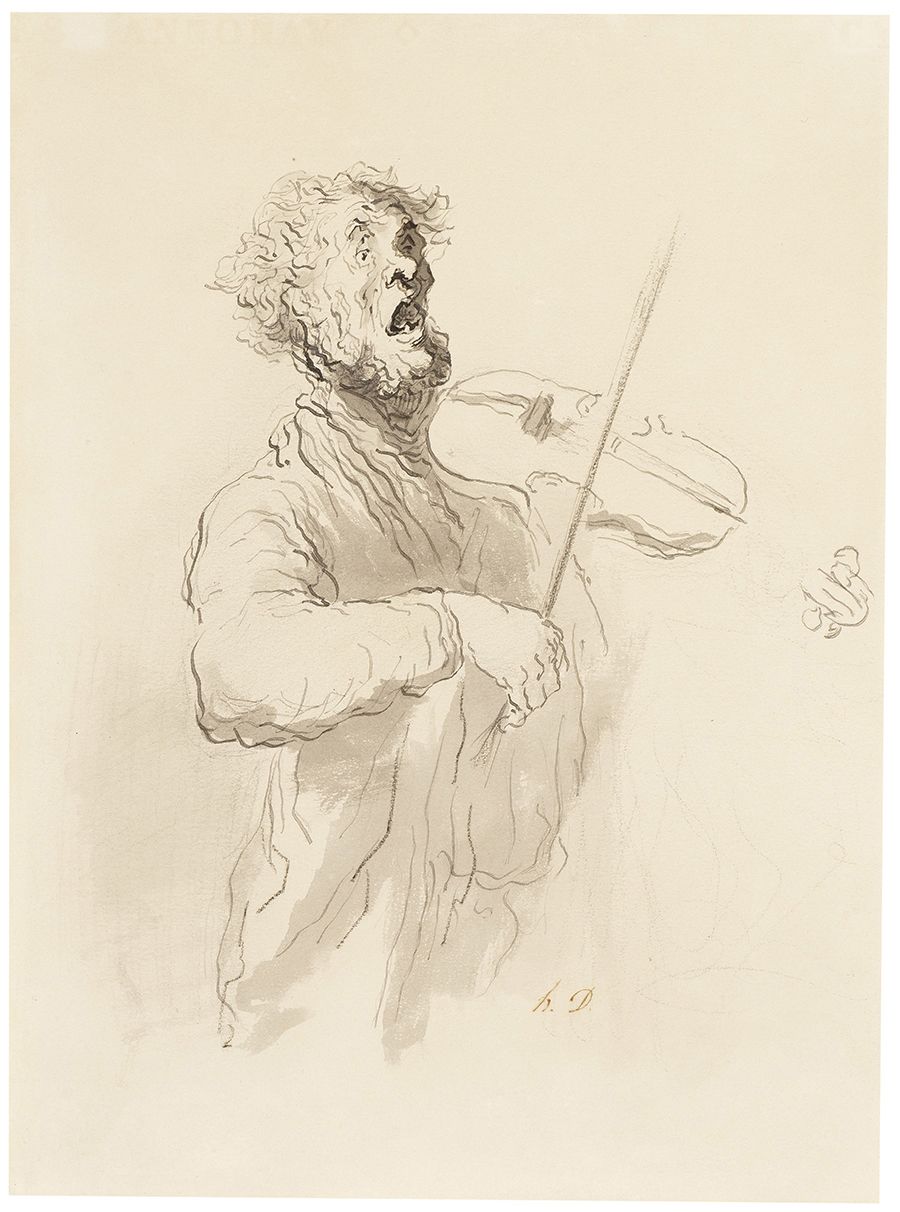
Honoré-Victorin Daumier (1808-1879), The Singing Violinist. Estimate: €35,000 - 55,000
Honoré-Victorin Daumier (1808-1879), The Singing Violinist. Estimate: €35,000 - 55,000
He also dedicated a poem to the artist: ‘Vers pour le portrait de M. Honoré Daumier’. It begins by stating that Daumier’s art was “subtler than all others”, teaching us “to laugh at ourselves”. Actually, that understated his talents: Daumier could do more than that. As Van Gogh noted, Daumier was “amusing and yet full of emotion and passion”. Art historically speaking, he was a master of romantic realism.
Consider a late drawing such as The Singing Violinist (perhaps from around 1869-73). The scholar Bruce Laughton has pointed out how everything in this character study is centred on the the street musician’s “open mouth, cavernous and exposing a single tooth”. The elderly musician’s fixed stare suggests he might be blind: you can almost hear his voice and the piercing sound of the accompanying fiddle.
Baudelaire described Daumier’s method. “He has a wonderful, almost super-human memory, from which he works as from a model.” Yet, although the artist was working from imagination rather than direct observation, “his powers of observation are such that in his work we never find a single head that is out of character with the figure beneath it”.
Both Baudelaire and Van Gogh admired the vehement energy of Daumier’s line. Baudelaire called him the “Michelangelo of Caricature”. The hair and beard of the Singing Violinist, crackling with vehemence and energy, illustrate exactly what he meant. So do drawings such as Two Heads and Quatre personnages, in which each figure is distinct and individual, as if they were characters extracted from some unknown drama.
Perhaps this is no accident. Daumier grew up in a highly theatrical milieu. His father, Jean-Baptiste, was a glazier and picture-framer from Marseilles, before he transformed himself into a poet and playwright and moved to Paris. Although Jean-Baptiste had poems published, and his tragedy Philippe II was performed in Paris, he did not make much of an income from writing (which was why young Honoré soon became his family’s sole support).

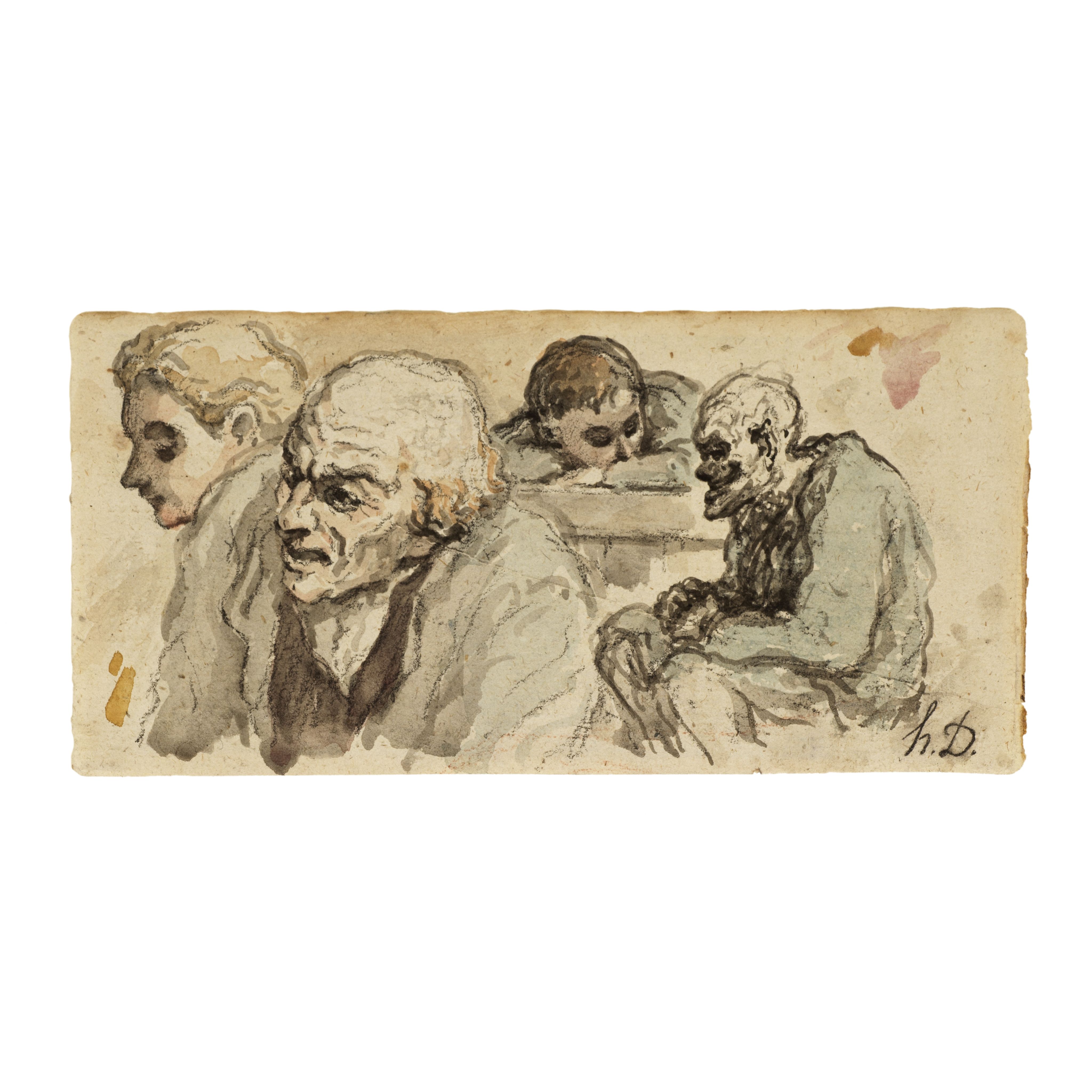
As an artist, Daumier was fascinated by performance – whether that of barristers addressing the court, clowns and acrobats busking in the street, or professional actors on stage. The counterpart to the performance was the audience, which was also a preoccupation of Daumier’s. In At the Theatre, a group of bourgeois Parisians sit placidly watching the events on stage.
Although Van Gogh bracketed him with Zola, a better literary comparison would be with Daumier’s slightly older contemporary, Honoré de Balzac (1799-1850) – or, across the Channel, with Charles Dickens (1812-70). Like Balzac, Daumier created a visual Comédie humaine encompassing contemporary society, and like Dickens he could summon up extraordinarily memorable figures as much from imagination as from observation. Like both these writers, he looked at Parisian life closely and comprehensively.
Despite the occasional ferocity of his imagery, in person he seems to have been mild-mannered. Jules Laurens, a fellow artist, called him “physically and morally a kindly lion”. Pierre Véron, editor of Le Charivari, confessed he “could never understand how Daumier, so assertive, so revolutionary when holding a pencil could be so shy in everyday life”.

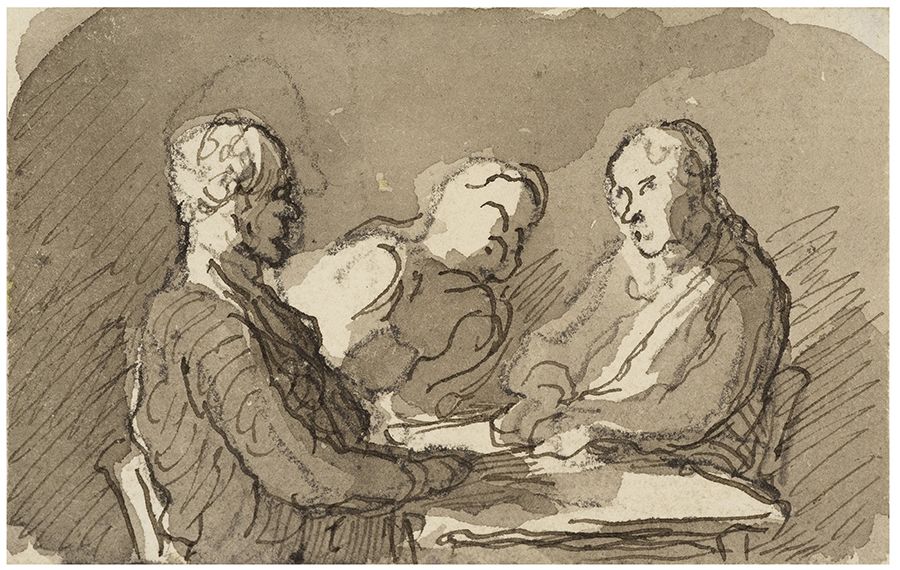
Honoré-Victorin Daumier (1808-1879), Étude pour 'Joueurs de Domino' (Les trois joueurs). Estimate: €8,000 - 12,000
Honoré-Victorin Daumier (1808-1879), Étude pour 'Joueurs de Domino' (Les trois joueurs). Estimate: €8,000 - 12,000

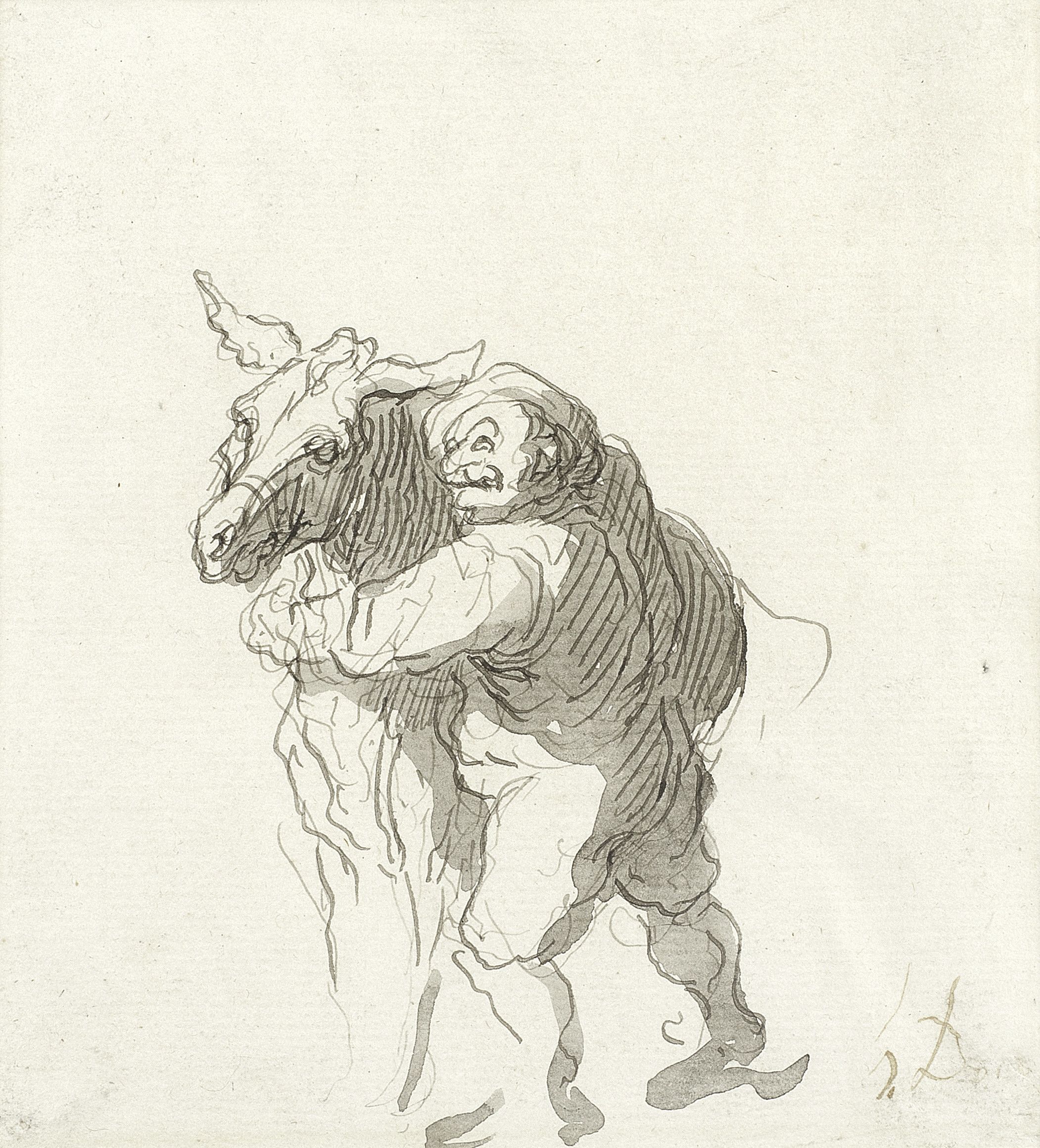
Honoré-Victorin Daumier (1808-1879), Sancho Pansa et son âne (Executed c. 1865). Estimate: €15,000 - 20,000
Honoré-Victorin Daumier (1808-1879), Sancho Pansa et son âne (Executed c. 1865). Estimate: €15,000 - 20,000
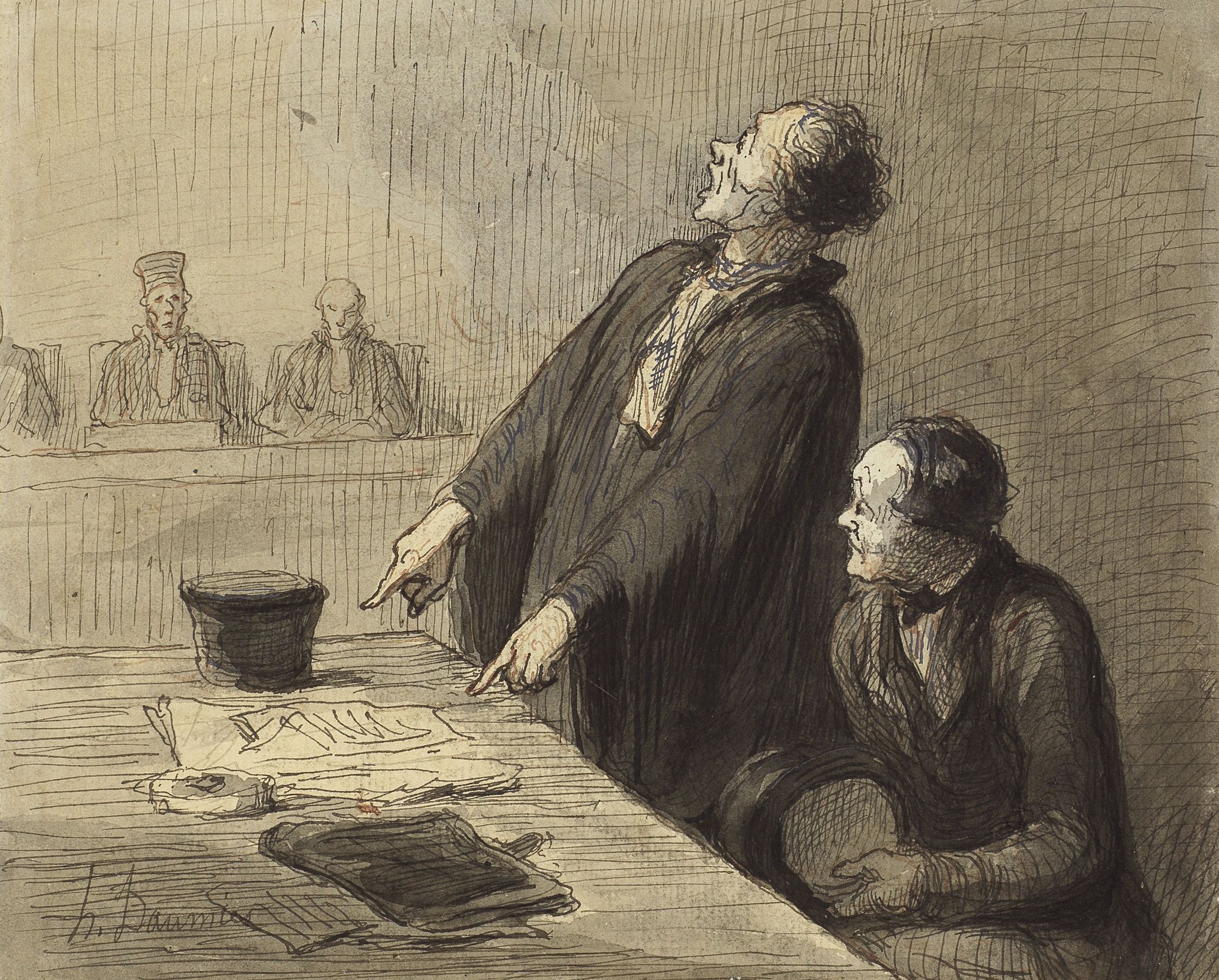
For many years the artist and his wife, Marie-Alexandrine (known as Didine), lived at 9 quai d’ Anjou on the Île Saint-Louis. Beneath their windows, washerwomen did their laundry on the shore of the Seine. These woman were a favourite motif in his work. An even more frequent subject was the lawyers who thronged the Palais de Justice on the adjoining, and much grander, Île de la Cité. These were the source for a large subdivision of Daumier’s work, including such drawings as Lawyer & Client and The Accusation.
Daumier’s experience of courtrooms and accusations was personal – and painful. In the past, he had stood in the dock, dependant (unavailingly) on the efforts of his counsel. On 30 August 1832, the magazine La Caricature, of which the 24-year-old Daumier was a star contributor, carried a dramatic announcement: “At the moment of our writing these lines, M. Daumier, sentenced to six months’ imprisonment for the caricature of Gargantua was arrested under the eyes of his father and mother, whose sole support he is”.
A drawing entitled Gargantua had earned him a suspended sentence. In this caricature, the gigantic, gross figure of King Louis-Philippe is seated on a commode while barrels of cash, extracted from the poverty-stricken citizenry, are being rolled up a ramp into his open mouth. Beneath the King, his rotund cronies gather up the honours and privileges he excretes.
Daumier followed this up with a lampoon of Louis-Philippe’s court, including an especially unflattering caricature of the chief prosecutor Jean-Charles Persil disguised as a woman. This aggravated second offence got him sent to the prison of Sainte-Pélagie, soon joined by his editor and fellow caricaturist Charles Philipon.
Fellow artists were more appreciative of his work. Camille Pissarro sent his son Lucien a set of ten lithographs, explaining that “Daumier’s whole history” was “traced” in them. “One understands well, perusing this book, that Daumier was the man of his drawings, a man of conviction, a true republican.”
Van Gogh too was a keen collector of Daumier’s lithographs. He enjoyed these so much he felt they served as a substitute painkiller: “Daumier’s drawings are so true that they almost make one forget the toothache.” Together with his own paintings and some Japanese prints, Daumier’s works formed the sole decoration of the austere, whitewashed interior of the Yellow House.
The inside of this dwelling was meant to reflect the outside. His own pictures represented Arles and the Provençal countryside which, somewhat eccentrically, Van Gogh felt resembled Japan (a place he had never seen). When he insisted the scruffy quartier around the Yellow House was “pure Daumier”, he meant that there he could see the comedy, tragedy, poignancy and meanness of everyday urban life. This was Daumier’s true subject.
Martin Gayford’s most recent book is Venice: City of Pictures.

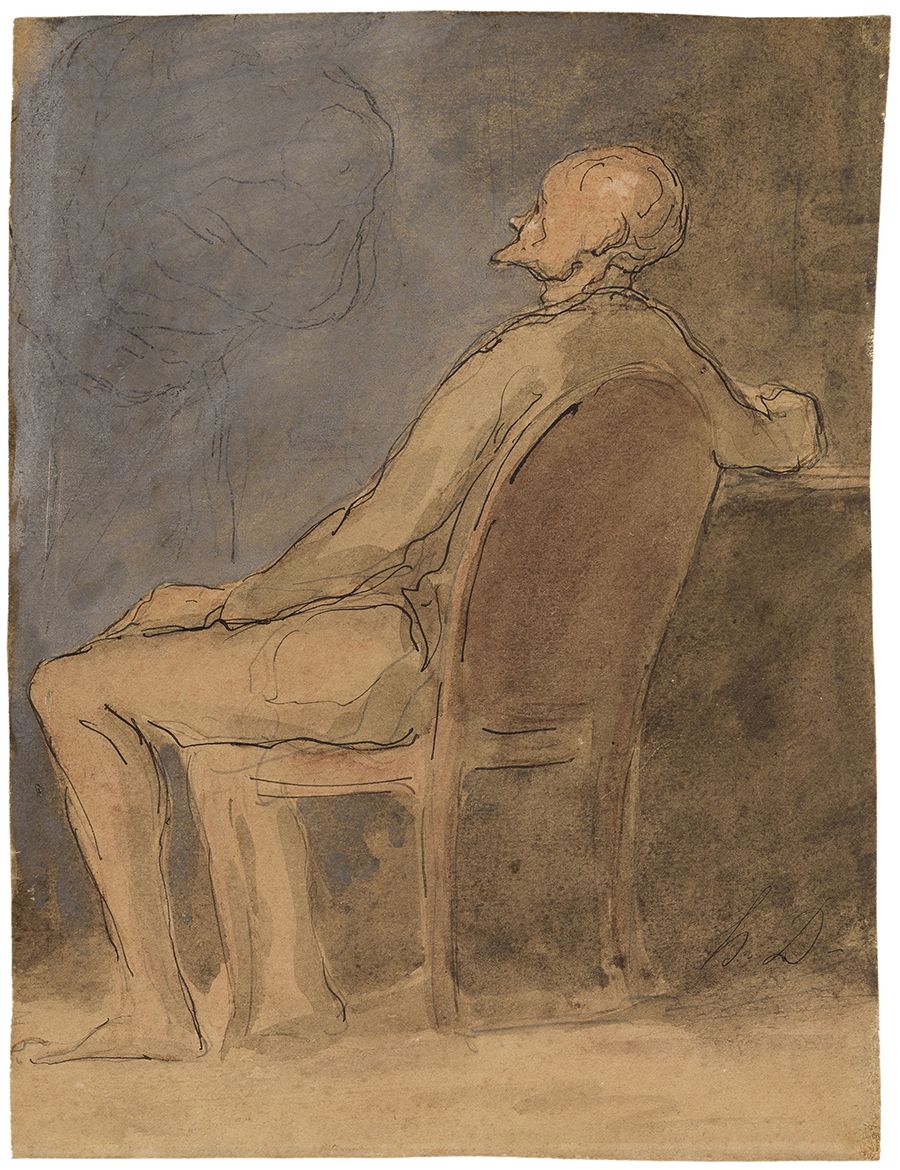
Honoré-Victorin Daumier (1808-1879), Seated Man seen in profile. Estimate: €25,000 - 35,000
Honoré-Victorin Daumier (1808-1879), Seated Man seen in profile. Estimate: €25,000 - 35,000
Find out more
Artworks by Honoré Daumier will be offered in Impressionist & Modern Art (London, 18 April), Impressionist & Modern Art (Paris, 5 June) and L’avant-garde à nos jours (Paris, 4 December).
For enquiries, contact Bénédicte van Campen on benedicte.vancampen@bonhams.com or +33 1 56 79 12 58.
 Built with Shorthand