
The Pictorial Menagerie: A Brief History of Animals in Art
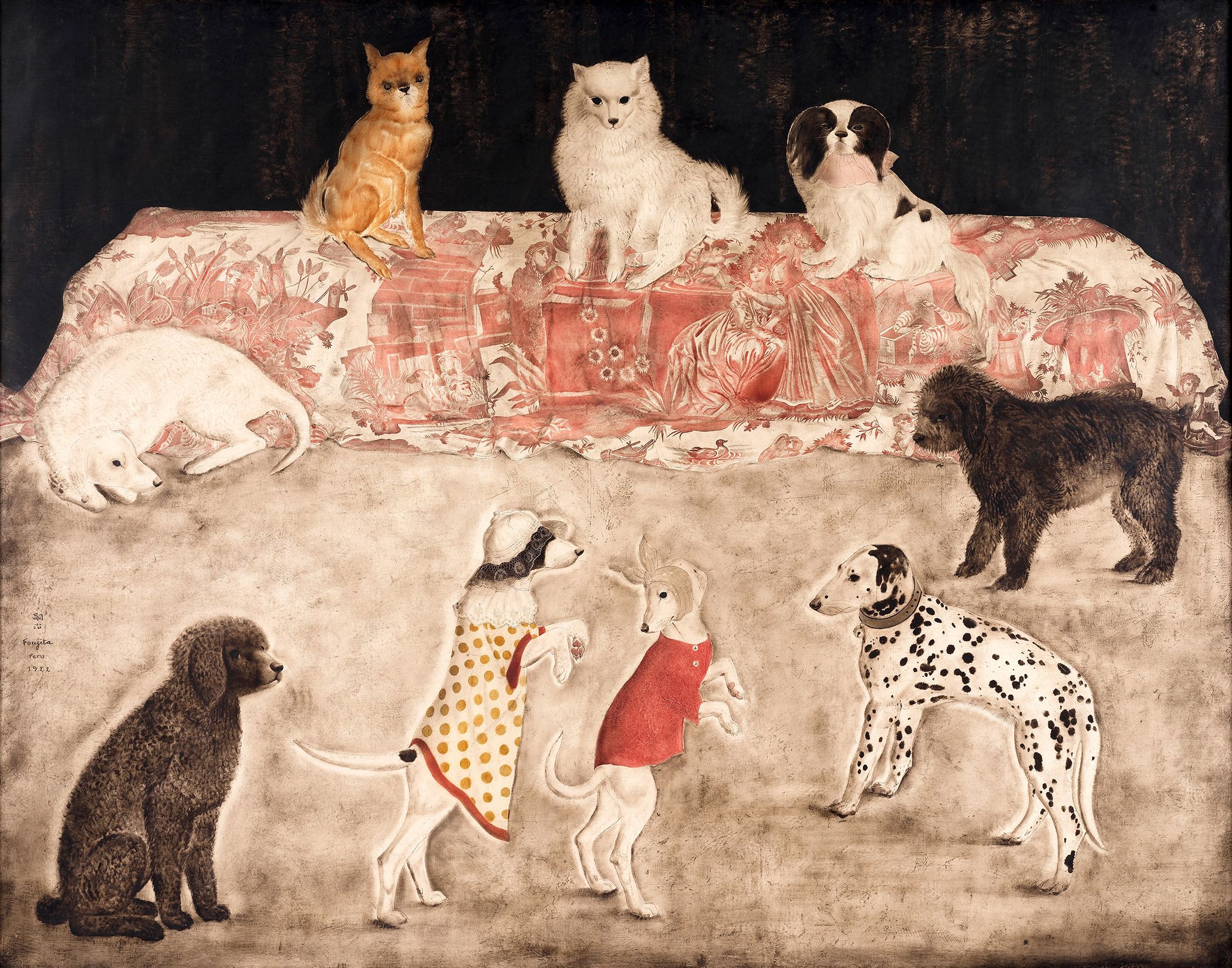

The depiction of animals in art has a long and rich history, beginning in the caves of Chauvet and spanning art movements from the Renaissance through to the present day. As a rare work by Léonard Tsuguharu Foujita is offered for auction in London, we look back at the enduring relationship between artists and their furry and feathered friends.
Léonard Tsuguharu Foujita was famously a man of cats. The Japanese-French master includes them in almost every self-portrait, or they prowl alongside his languid nudes. One particular tabby reappears, the same seemingly aghast expression on its face, peering over the left shoulder of the artist. Likely based on a real cat – for Foujita took in many throughout his life – but almost certainly a symbolic prop, as part of this eccentric dandy's meticulously manicured persona. The absurdity of the cat’s countenance, used almost as a signature or maker’s mark, implies satirical intentions but there is a delicate balance between the ludicrous and exquisite. Adroitly blending traditional Japanese techniques with European modernism, Foujita, or rather ‘Fou Fou’ as he was known to his companions, refined a singular distinctive style amongst the clamour of Jazz Age Montparnasse.
Chiens savants, ou le Carnaval des chiens (Performing Dogs, or the Carnival of Dogs) (1922) is an expression of this cultural duality, demonstrating his remarkably lactescent whites, alongside a fascination with Western fables and anthropomorphic animals. The rendering of individual hairs, using thin menso brushes, is reminiscent of Albrecht Dürer’s renowned painting Young Hare (1502); similar in execution of stroke and the result of keen observation and precision.
Beginnings
The depiction of animals in art has a long and rich history; they were amongst the first subjects portrayed on cave walls. The Chauvet Cave paintings in France reveal horses, mammoths, lions, bears, aurochs and even rhinos, painted some 36,000 years ago whilst gargantuan geoglyphs like the zoomorphic Nazca lines found in the deserts of Peru date back to 500 BC.

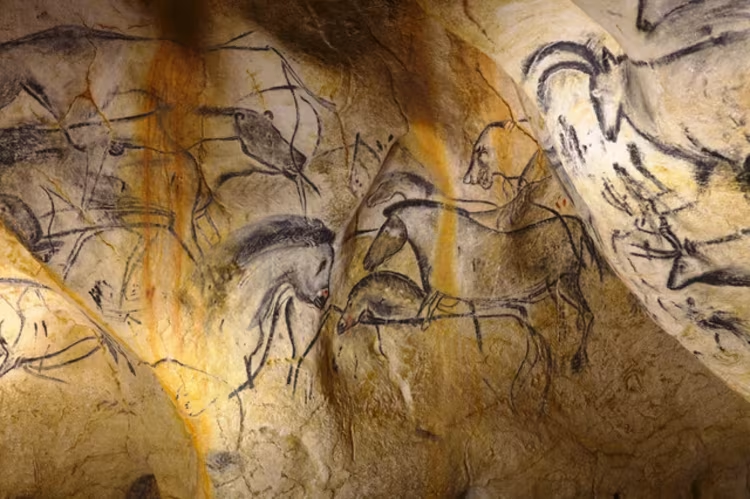
The 36,000-year-old drawings and paintings of the Chauvet cave in southeastern France.
The 36,000-year-old drawings and paintings of the Chauvet cave in southeastern France.
In the earliest civilisations animals were entwined with divinity: the Egyptian cat goddess Bastet, the ibis-headed Thoth, and the falcon Horus. Assyrians carved horses and lions, emblems of royal might, into alabaster reliefs, while Greeks populated their myths with hybrid creatures: centaurs, satyrs, minotaurs and sirens blurred the line between human and animal. Already, the symbolic and the literal coexisted: animals were both sacred creatures and allegorical mirrors of ourselves. Since then, our tools and materials have changed and evolved, but the instinct to create these pictorial menageries and imbue them with significance endures.
Symbolism
By the Renaissance, animals in art carried layered meaning and formed a layered history in artistic symbolism. In Jan van Eyck’s Arnolfini Portrait (1434), the tiny dog curled at the couple’s feet represents their fidelity. The cat, meanwhile, was still held in the claws of medieval religious stereotypes and found it hard to shake off connotations of deceit, desire and betrayal. In Domenico Ghirlandaio’s Last Supper (1476), a cat crouched behind Judas underscores treachery. Birds, too, carried rich associations in religious paintings: the goldfinch signifying Christ’s Passion, the dove the Holy Spirit and peace. Centuries later, Pablo Picasso's lithograph, Dove (1949) was used to translate his anti-war sentiments and became the poster of the World Congress of Partisans for Peace in Paris.
Seventeenth-century artist Francis Barlow illustrated the ancient Greek fables of Aesop, which form the basis of the seventeenth-century fabulist, La Fontaine’s, moralist tales. These would crucially inform the work of Foujita, hundreds of years later. The Golden Age of painting in the Low Countries also saw Dutch and Flemish artists draw on these fables, specifically Frans Synders who specialised in birds and focused on the popular theme of a ‘concert’, where a collection of birds congregate around a musical sheet to sing together. Possibly based on Aesop’s tale of The Owl and the Birds, a 1629 example of this, Concert of Birds, in the Museo Del Prado's collection, is not dissimilar in composition to that of Foujita’s Chiens savants, ou le Carnaval des chiens and Cat Fight (1940), where the animals are suspended in an almost impossible arrangement of animation.

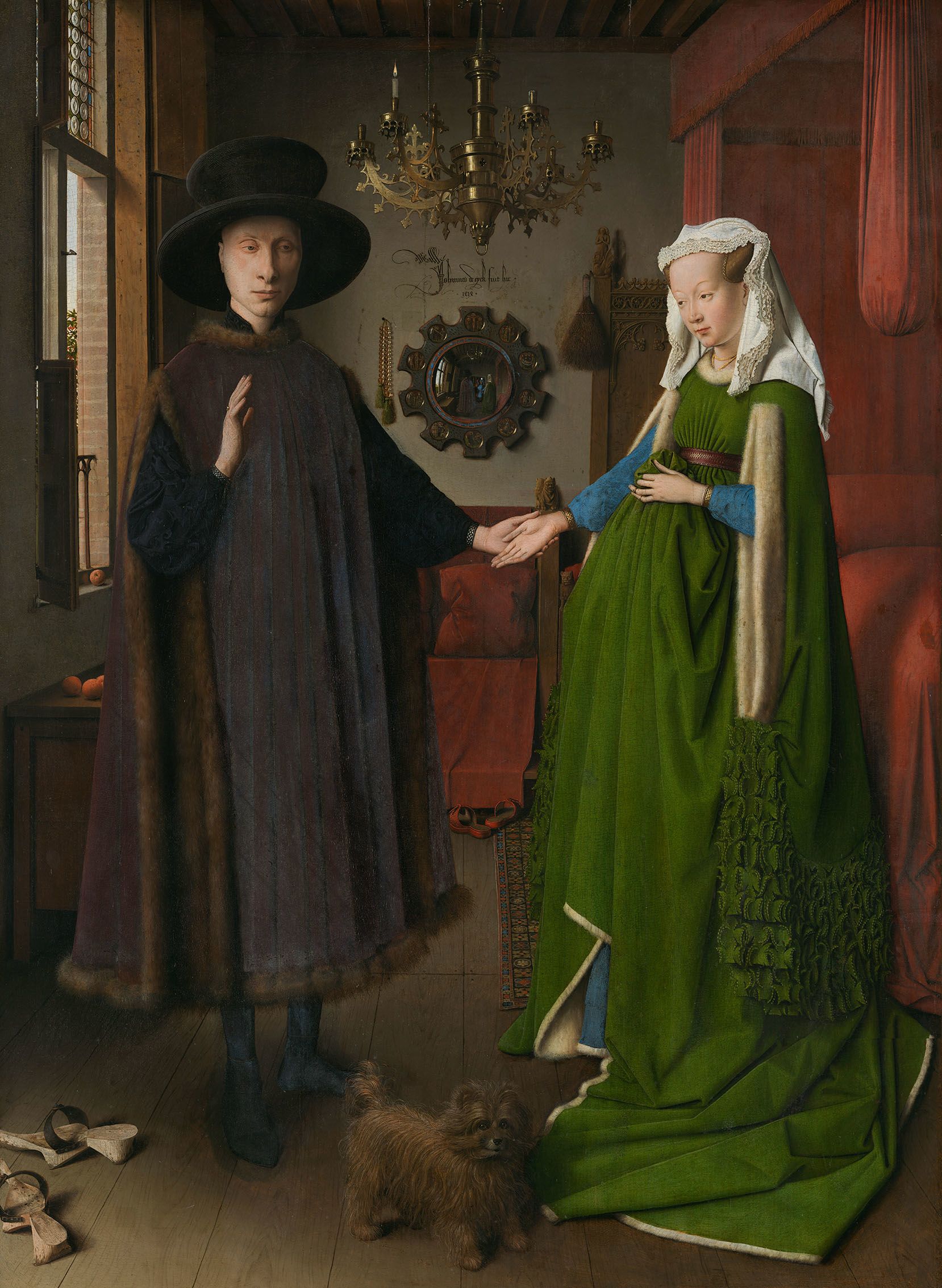
Jan Van Eyck, The Arnolfini Portrait, 1434. The National Gallery, London.
Jan Van Eyck, The Arnolfini Portrait, 1434. The National Gallery, London.
"By the Renaissance, animals in art carried layered meanings and formed a rich history of artistic symbolism."


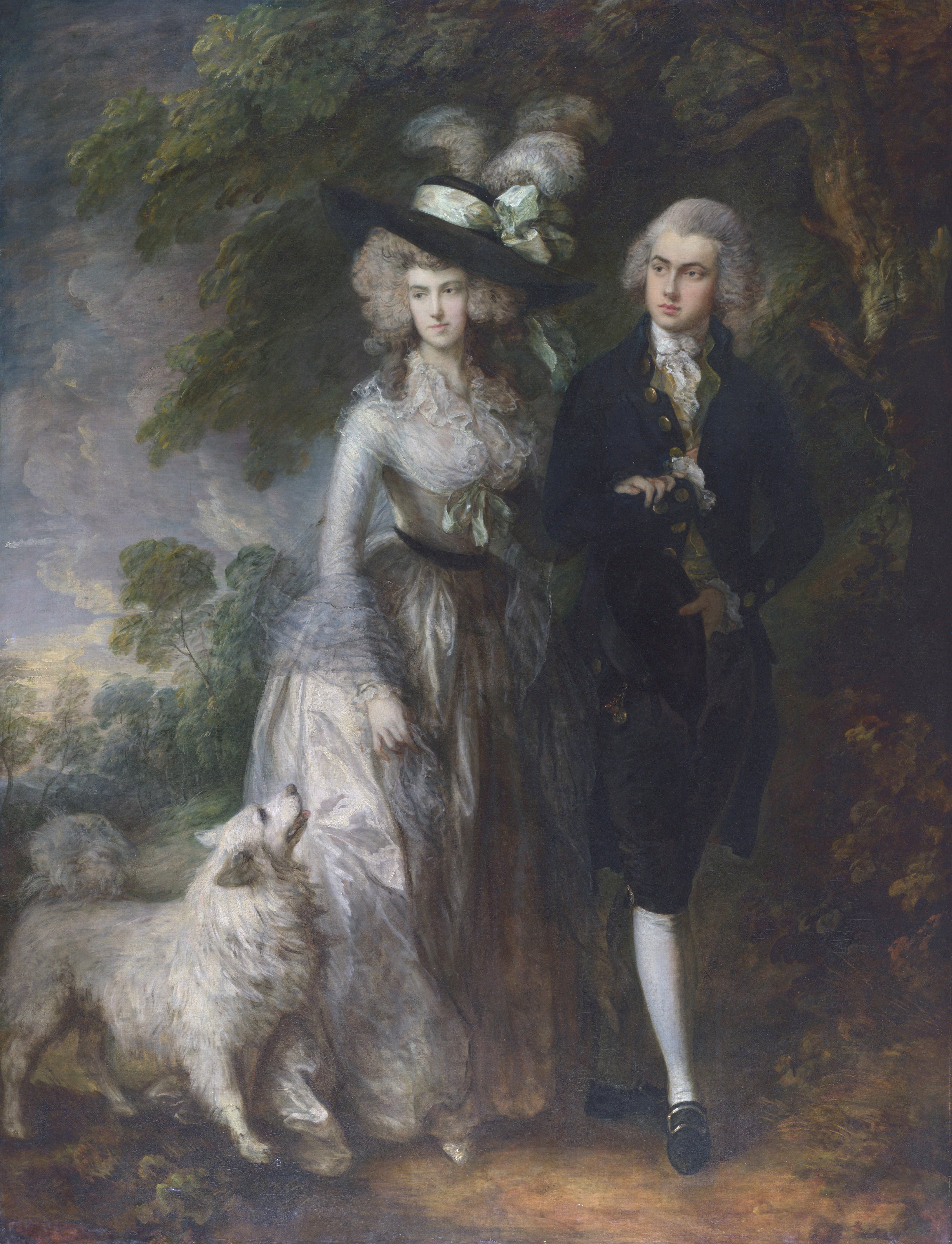
Thomas Gainsborough, Mr and Mrs William Hallett ('The Morning Walk'), 1785.
Thomas Gainsborough, Mr and Mrs William Hallett ('The Morning Walk'), 1785.
The Enlightenment period saw George Stubbs elevating the depiction of animals with scientific precision and aristocratic grandeur, using dissection to inform his understanding of anatomy, such as in Whistlejacket (1762). In contrast, his contemporary Thomas Gainsborough took the animal motif in another direction. Gainsborough loved dogs and painted his own pets, Tristam and Fox with affection and understanding of their character – a skill he applied to Mr and Mrs Hallet (‘The Morning Walk’) (1795), depicting one of the most fashionable breeds of the late-eighteenth century, the fluffy white Spitz (specifically a Pomeranian sheepdog).
It is possibly a Spitz that sits in the centre of Foujita's Chiens savants, ou le Carnaval des chiens, watching the performance of the other dogs, who include terriers, toy poodles and a dalmatian. To the right of the Spitz appears to be a Japanese Chin, associated with Japanese nobility and geishas, wearing a Yodarekake silk bib. To the left, a small dog, possibly a chihuahua, sits posed with one little paw raised in anticipation, perhaps revelling in the festivities.
The dancing dog in the foreground wears a silk and lace bonnet, reminiscent of Chinese Qing dynasty hats, and may well be a Japanese Terrier given its distinctive black and white markings and smooth coat.
"Stubbs elevated the depiction of animals with scientific precision... using dissection to inform his understanding of anatomy."

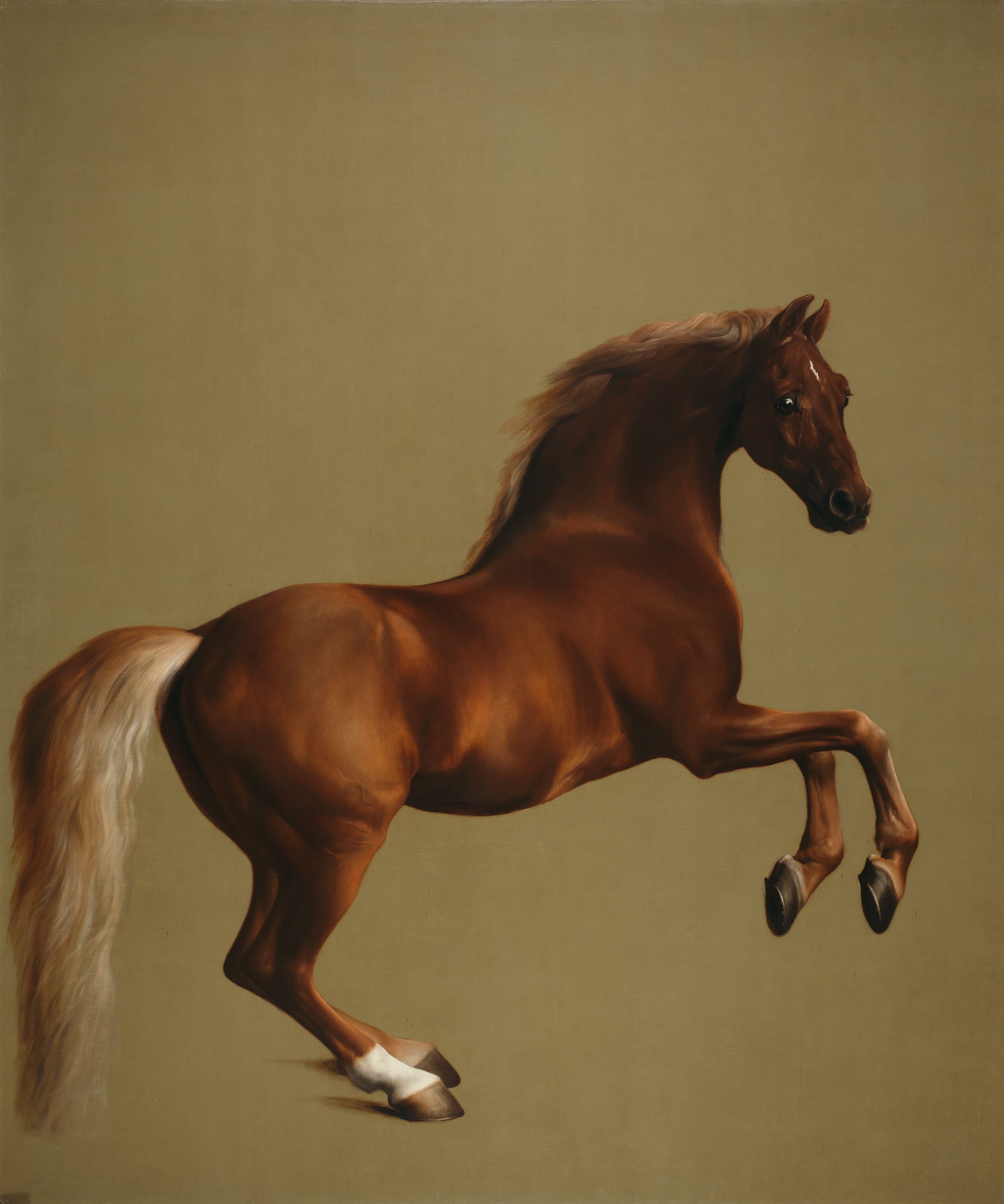
George Stubbs, Whistlejacket, 1762. The National Gallery, London.
George Stubbs, Whistlejacket, 1762. The National Gallery, London.

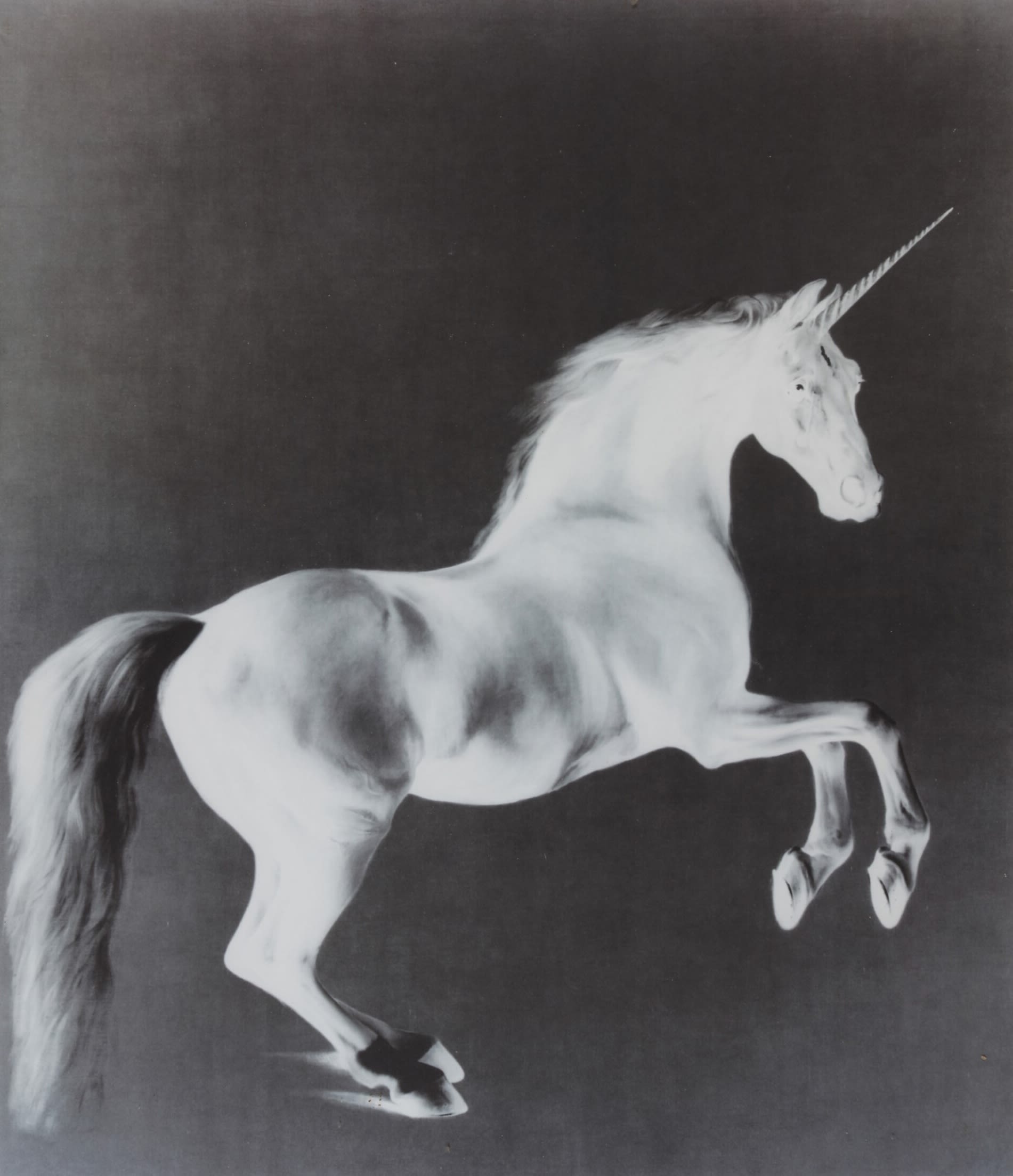
Mark Wallinger, Ghost, 2001. Tate Collection.
Mark Wallinger, Ghost, 2001. Tate Collection.
Foujita, Felines and La Fontaine
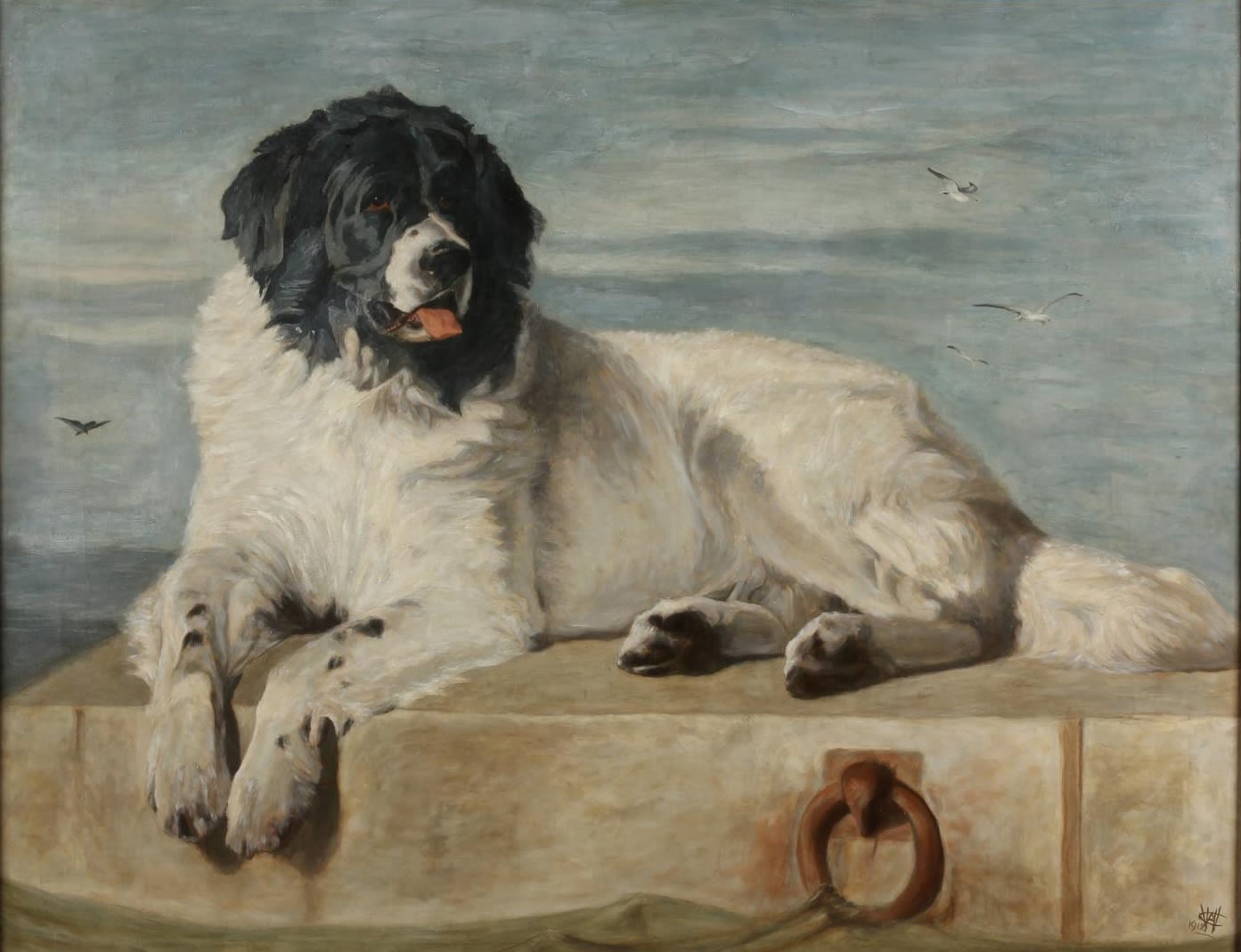
With the nineteenth century came new attitudes toward animals. The Victorians as ever, preferred sentimental works such as Edwin Henry Landseer’s A Distinguished Member of the Humane Society (1831) depicting Bob, a legendary Newfoundland who saved twenty-three lives from the Thames. The dog was rescued from a shipwreck and spent the next fourteen years living on the banks of the river, and plucking people in trouble out of the water. His heroic efforts saw him rewarded for bravery and immortalised in this painting, a favourite and much reproduced image of the time. This piebald variety was made so popular by Landseer that there is a now a strand of the breed named in his honour.
Impressionists and Post-Impressionists often depicted pets in domestic settings: Édouard Manet’s cat Zizi appears in tender portraits of his wife Suzanne, while Pierre-Auguste Renoir included lapdogs in his scenes of bourgeois leisure. Yet the symbolism persisted – Manet’s cats also hinted at erotic temptation, a theme which Foujita also explored, as he himself had two loves in his life: cats and women.

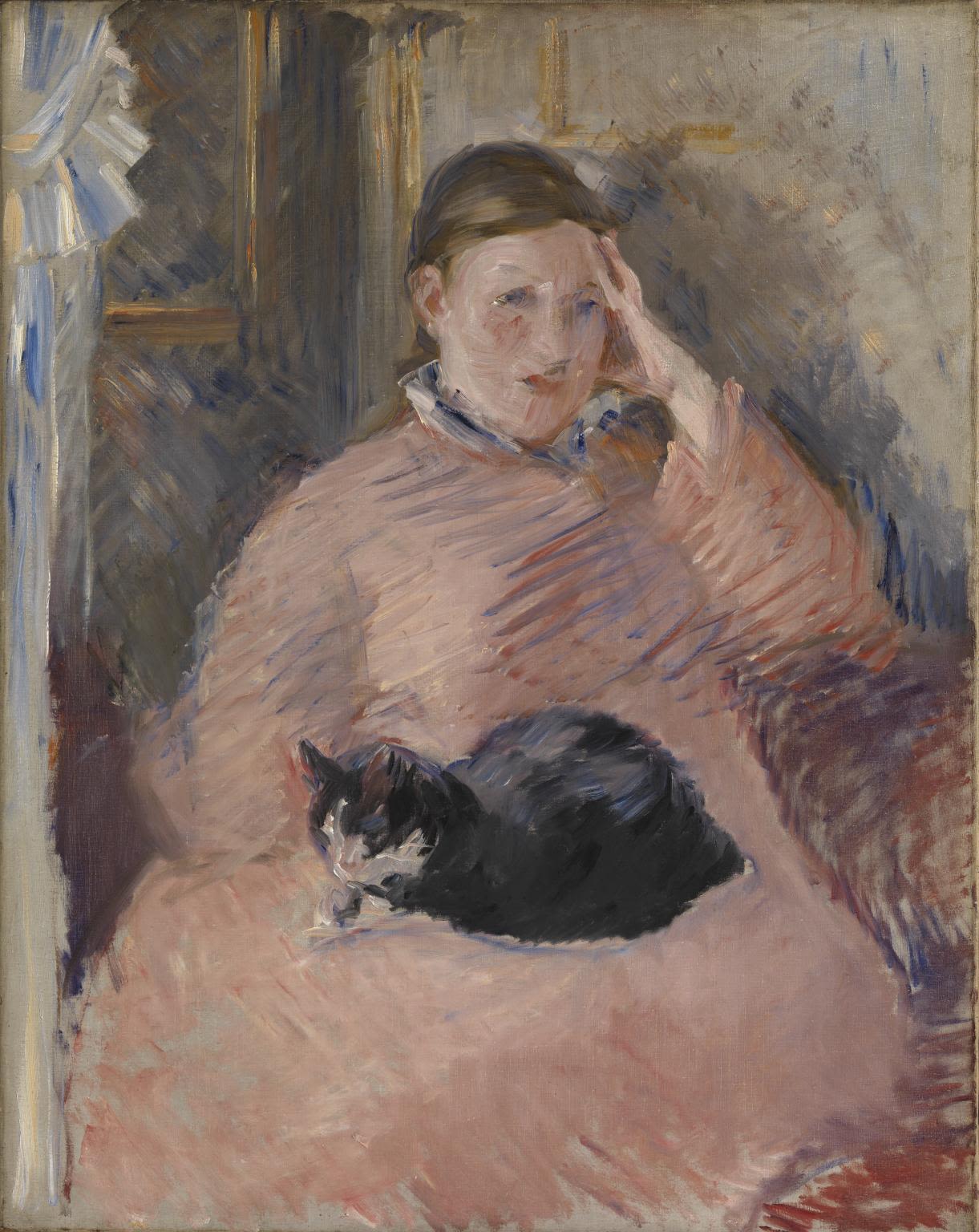
Édouard Manet, Woman with a Cat, 1880. Tate Collection.
Édouard Manet, Woman with a Cat, 1880. Tate Collection.
In the twentieth century, the cat enjoyed its status as a symbol of bohemian sexual liberation and unapologetic artistic freedom. Again, La Fontaine emerges but this time in the work of Marc Chagall who was commissioned in 1926 by Ambroise Vollard to illustrate the fables. One particular work stands out in dialogue with Foujita, that of The Cat Transformed into a Woman (1928). The story goes that a man adored his pet cat so much that he was able to turn her into a woman and marry her. Perhaps the conflation of felines and beautiful women is not such a radical thought when read in the context of Foujita’s interview given to the Milwaukee Journal in 1935, in which he insinuated that women had a lot to learn from cats in the ways of seduction.
The cats in Foujita’s paintings also often drew from Japanese symbolism, where the cat is associated with good luck, wealth and fortune. Their inclusion could therefore be read as a sly nod to his commercial success and huge popularity during his time in Paris.
Pets in the Studio
Foujita’s art formed part of a wider change toward animals during the twentieth century, whereby animals gained a new value to artists – not merely as subject matter, but as extensions of the self.
Salvador Dalí’s pet ocelot, Babou, was a living accessory to the artist’s eccentric character. Gwen John, meanwhile, kept a great many cats, including her precious Quinet who she memorialised in both paint and poetry as a substitute for the companionship of lovers and friends.
For Lucian Freud, animals were an expression of intimacy: the rendering of his whippets, Pluto and Eli, are as raw and tender as his human portraits, whilst Frida Kahlo’s pets included her monkey, Fulang-Chang and dog, Señor Xolotl, who was named after the Aztec dog-headed god of lightning and death, and was not only a cherished pet but also a proud nationalist emblem.
Artists working today still engage with animals to communicate feeling and meaning. Tracey Emin’s beloved cats, Pancake and Tea Cup, sometimes appear in her work, but poignantly she draws on the symbolism associated with birds, from seagulls to house sparrows, to harness the power of flight and its associations of transcendence, where each work conveys the human soul in flight.

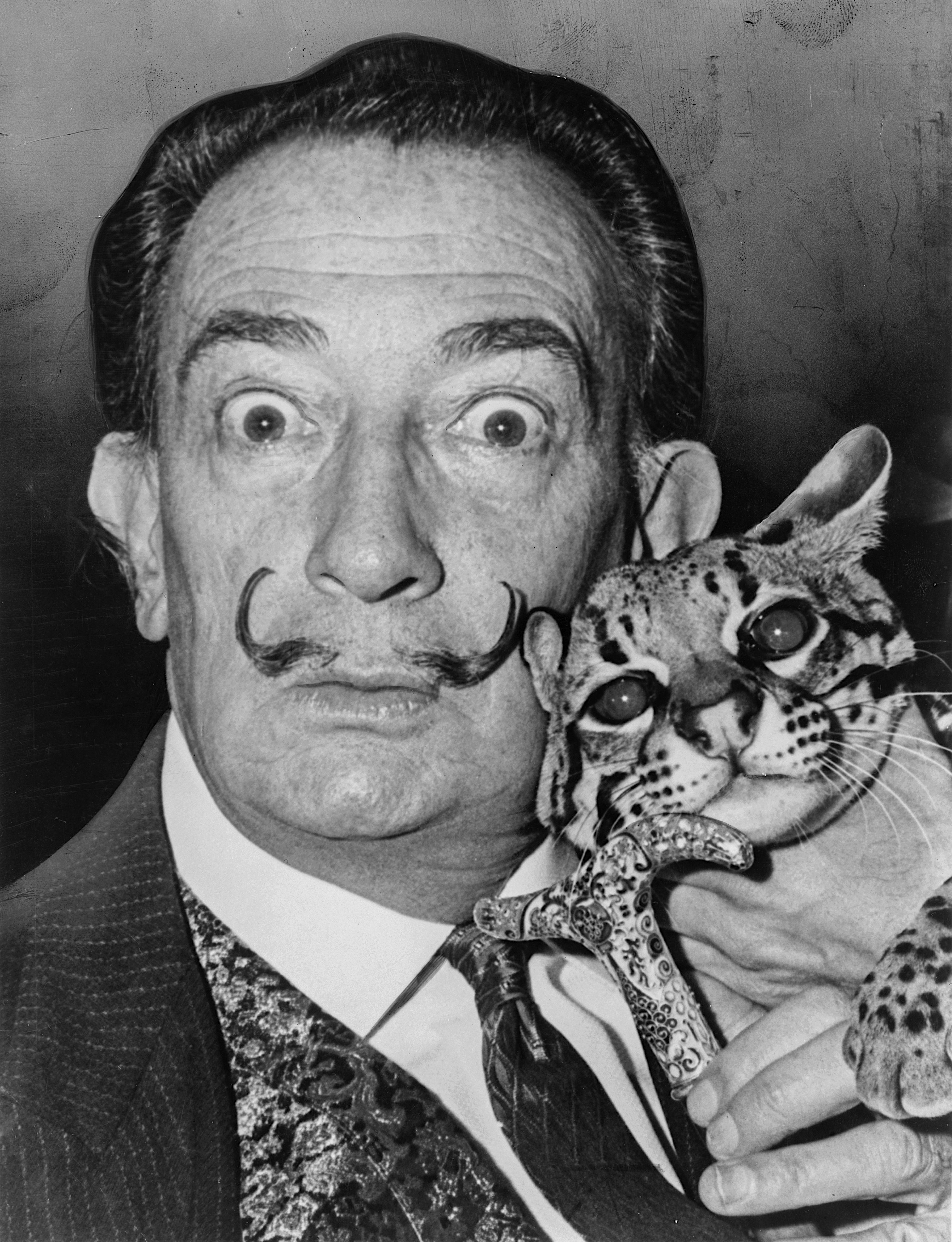
Salvador Dalí with his pet ocelot, Babou.
Salvador Dalí with his pet ocelot, Babou.
Cedric Morris and his partner Arthur Lett Haines kept many birds during the uncertainty and isolation of war. His feathery companions included Cokey, a yellow-crested cockatoo, Ptolemy a peacock and Rubio a scarlet macaw, who is immortalised in an intimate portrait of Morris by Frances Hodgkins in 1930. Morris and Lett Haines considered birds to be creatures evoking wonder and freedom during a time of great turmoil in Europe.

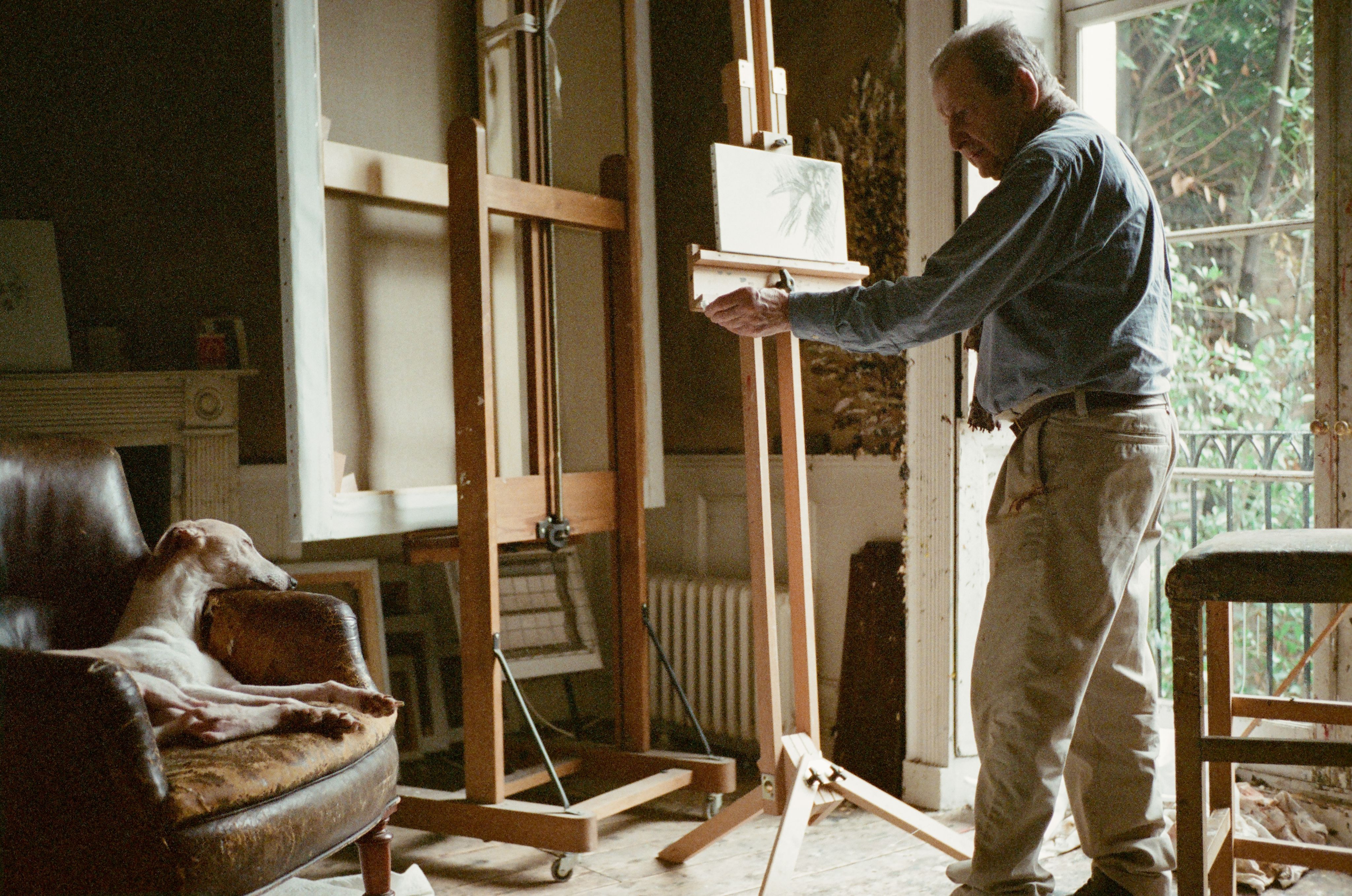
Lucian Freud in his studio sketching his dog, Pluto. Shutterstock.
Lucian Freud in his studio sketching his dog, Pluto. Shutterstock.
Immortalising the animals close to them became a central motif for many artists: Andy Warhol famously lived with twenty-six cats all named Sam (bar one called Blue Pussy), who are all lovingly rendered in a beautiful book of lithographs from 1957. Foujita himself also made an artist’s book, the Book of Cats, thirty years earlier and it remains one of the most desirable rare books ever sold, a testament to the enduring allure of his feline portraits. But here, in Chiens savants, ou le Carnaval des chiens, Foujita explores the anthropomorphism of the dog, in his unique style which drew on both his Eastern origins and Western painterly conventions. As the title suggests, it is a 'carnival', and a celebration of Foujita's fascination and deep respect for the animal kingdom.
20th & 21st Century Art Evening Sale
16 October 2025 | London, New Bond Street
Stay updated with our auctions
Register with Bonhams to follow your favourite lots and receive alerts when new auctions open for bidding. Subscribe here.
 Built with Shorthand