
The Contents of Kinsham Court
An introduction by Catherine Beale
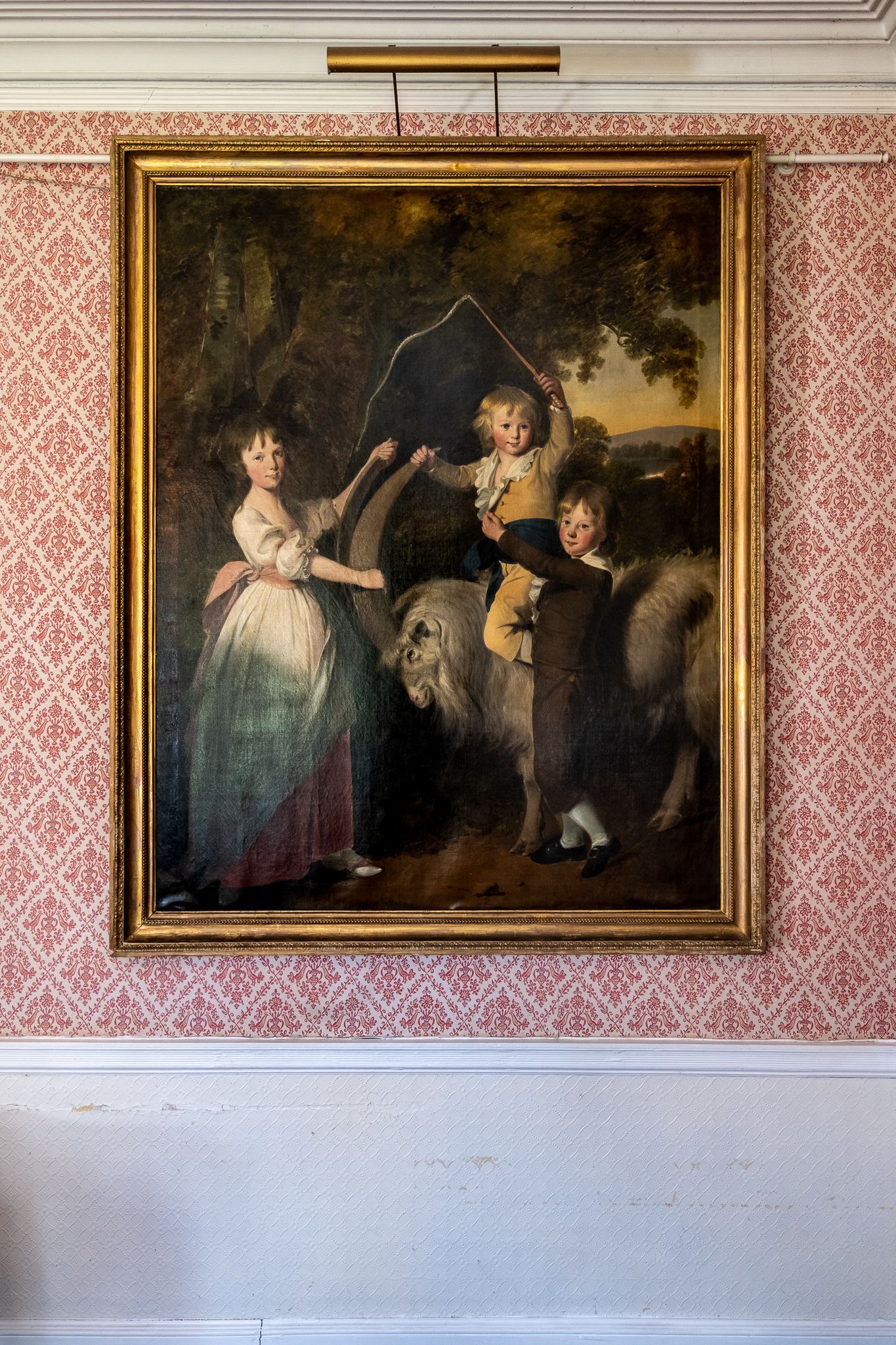

‘If Arcadia was anywhere in England, it was in Herefordshire,’ asserts the landscape historian David Whitehead. In this context the appeal of the Welsh border county to the Classical tastes of George Gordon, 6th Baron Byron, can be appreciated. Byron wrote to Lady Melbourne from Eywood, near Presteigne, in November 1812 ‘This country is very much to my taste, & I have taken a seat of Ld. Oxford’s (Kinsham Court about 5 miles off in a delightful situation) for next year.’
Herefordshire is the birthplace of the Picturesque, that landscape movement which grew from the enforced ‘staycations’ of the Grand Touring classes as a result of the naval blockades of the French Revolutionary and Napoleonic Wars (1793-1815). Rev’d William Gilpin’s accounts of being ‘sequestered from the commerce of life’ as he toured down the river Wye, and William Wordsworth’s location of ‘Deep seclusion’, a few miles above Tintern Abbey in 1798 suggest some of the region’s attractions.
Byron had been catapulted to fame by the successful publication of the first cantos of ‘Childe Harold’s Pilgrimage’, in March 1812, and thence to notoriety by the melodramas of the lover whom he jilted at the end of that summer, Lady Caroline Lamb. Seclusion therefore appealed, but that was only one of Kinsham Court’s attractions. The opportunity to explore the ‘autumnal charms’ not only of the landscape but also of Jane Harley, Countess of Oxford, was another. Byron stayed with the Oxfords at Eywood (demolished in 1954) from late October 1812 until after Christmas. In January 1813 he looked over Kinsham Court, and the following month, for fifty guineas rent, it was his.

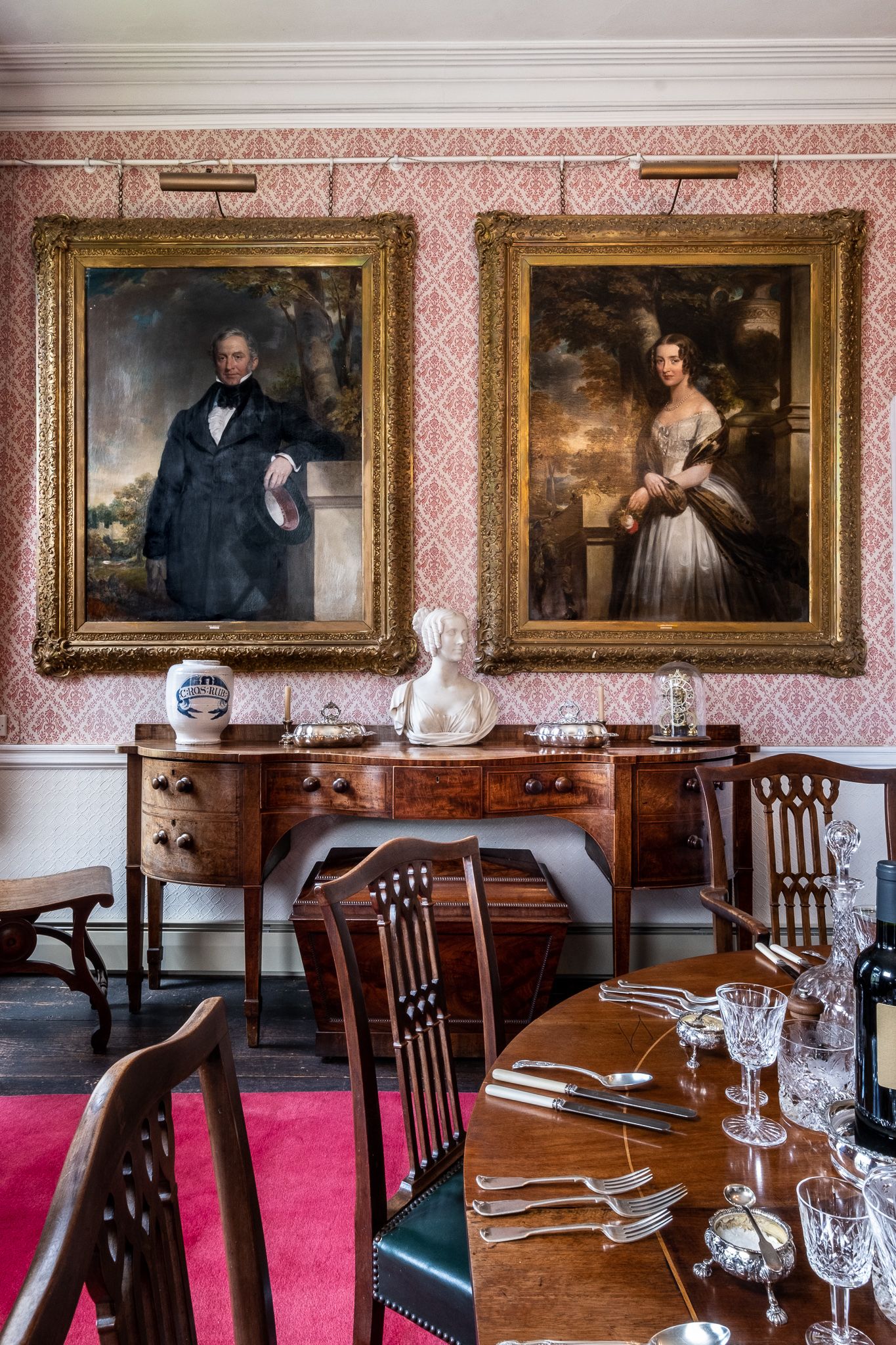
Fine Dining: The dinning room at Kinsham Court
Fine Dining: The dinning room at Kinsham Court
The early-Georgian red-brick Court with its distinctive ‘snow’ eaves (created during renovation in the late-eighteenth-century) occupies one of the most picturesque spots in Picturesque Herefordshire. The terrace between the Court and All Saints’ church falls dramatically away into a narrow gorge through which winds the River Lugg, tributary of the Wye, a hundred feet below. At night, not a single artificial light can be seen from the drawing room windows. This and the adjoining room were remodelled for Bishop Harley, Lord Oxford’s father, by Shrewsbury architect Thomas Farnolls Pritchard, circa 1760, and remain much as Byron must have known them.
The snow that fell in ‘perfect Avalanches’ in the spring of 1813 kept Byron indoors, which may account for the etching of his signature into the glass of an upstairs window. When fine days did arrive in April, ‘these I have passed on the water & in the woods – scrambling and splashing about with the children – or by myself – I always feel happier here or at Newstead than elsewhere.’ This carefree state, with ‘all my plagues… at least 150 miles off,’ continued until, as he confessed, his affections wandered from Lady Oxford to her daughter, Lady Charlotte, ‘whom I should love forever if she could always be only eleven years old.’ The Oxfords went abroad in June, and Byron gave up his tenancy.
Two years before Byron came to Kinsham Court, another of Herefordshire’s most evocative houses had been bought by Richard Arkwright (1755-1843) son of the industrialist, perfector of the water-powered spinning frame, and inventor of the factory system, Sir Richard Arkwright (1732-1792). Hampton Court, a medieval manor-house for which licence to crenellate was granted by Henry VI in 1434, also lies on the Lugg, around twenty-seven miles downstream from Kinsham Court. It was the home, from 1781 of George, Viscount Malden, until he inherited in 1799 as 5th Earl of Essex, and moved to the family seat of Cassiobury, Hertfordshire. Hampton Court estate was allegedly milked to fund improvements to Cassiobury, and those completed, it was no longer wanted. Arkwright, ‘the richest commoner in Europe’, had been trying to buy Hampton Court since late 1808 - agriculture was making a good return during the blockades. Despite the property being offered with ‘Timber and everything without exception. Wine Books Plate &c &c &c’ the wrangling over what Lord Essex termed ‘trifles’ continued until completion in July 1810.
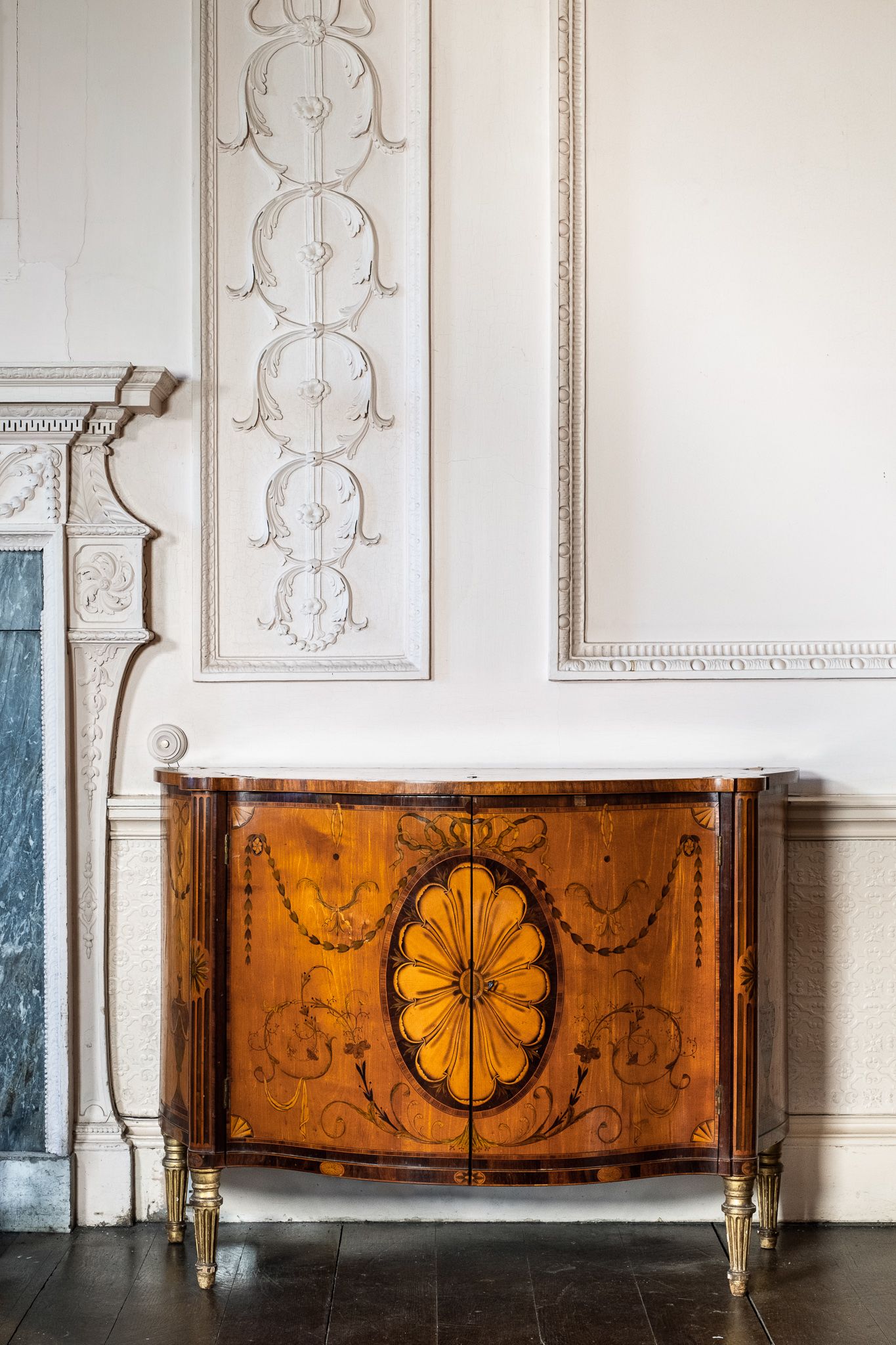
One of two George III satinwood, burr elm, and purple heart marquetry commodes. Estimate: £50,000 - 80,000.
One of two George III satinwood, burr elm, and purple heart marquetry commodes. Estimate: £50,000 - 80,000.
Having paid £226,535 for the house and 6,220 acres (equivalent to about 30% of the annual investment in the British cotton industry at the time) Arkwright sent his Matlock agent to manage Hampton Court. A request for Lucien Bonaparte, Napoleon’s captive brother, to rent it was declined. It was Arkwright’s eldest unmarried son, John (1785-1858, a contemporary of Byron at Trinity College, Cambridge) who asked for permission to move to Herefordshire. ‘Of all the situations I know,’ John wrote to his father in 1814, ‘there is none which suits my taste so well as Hampton Court.’
John was the first of three generations of John Arkwrights at Hampton Court, Herefordshire. He was succeeded by his eldest son John H Arkwright (‘Johnny’ 1833-1905) and by his grandson John S Arkwright (‘Jack’ 1872-1954). Only Johnny would spend all his life on the estate; John came to Hampton Court from Derbyshire, and Jack sold Hampton Court and moved to Kinsham Court in 1911. Johnny borrowed heavily to fund improvements to the estate farms, but was then hard hit by the Agricultural Depression of the 1870s-1890s. By the turn of the twentieth century, Johnny had been obliged to mortgage some of the farms to enable him to remain until his death in 1905. Jack bowed to the inevitable, and having paid off the mortgages and death duties, sold up and downsized to Kinsham.
As the financial pressures of the Agricultural Depression began to tell, Johnny had successfully sought reimbursement from the House of Lords for his expenditure on the Hampton Court estate (Arkwright Estate Act, 1887). In preparation for his petition, Johnny’s counsel, George B Rashleigh of Lincoln’s Inn advised that ‘Mr Arkwright is the owner of curious manuscripts, china & other valuable articles said to be worth such sum as £50,000. I think a valuation should be made of this property. Parliament may be induced to settle more on him because of the ready convertability of this capital to money.’
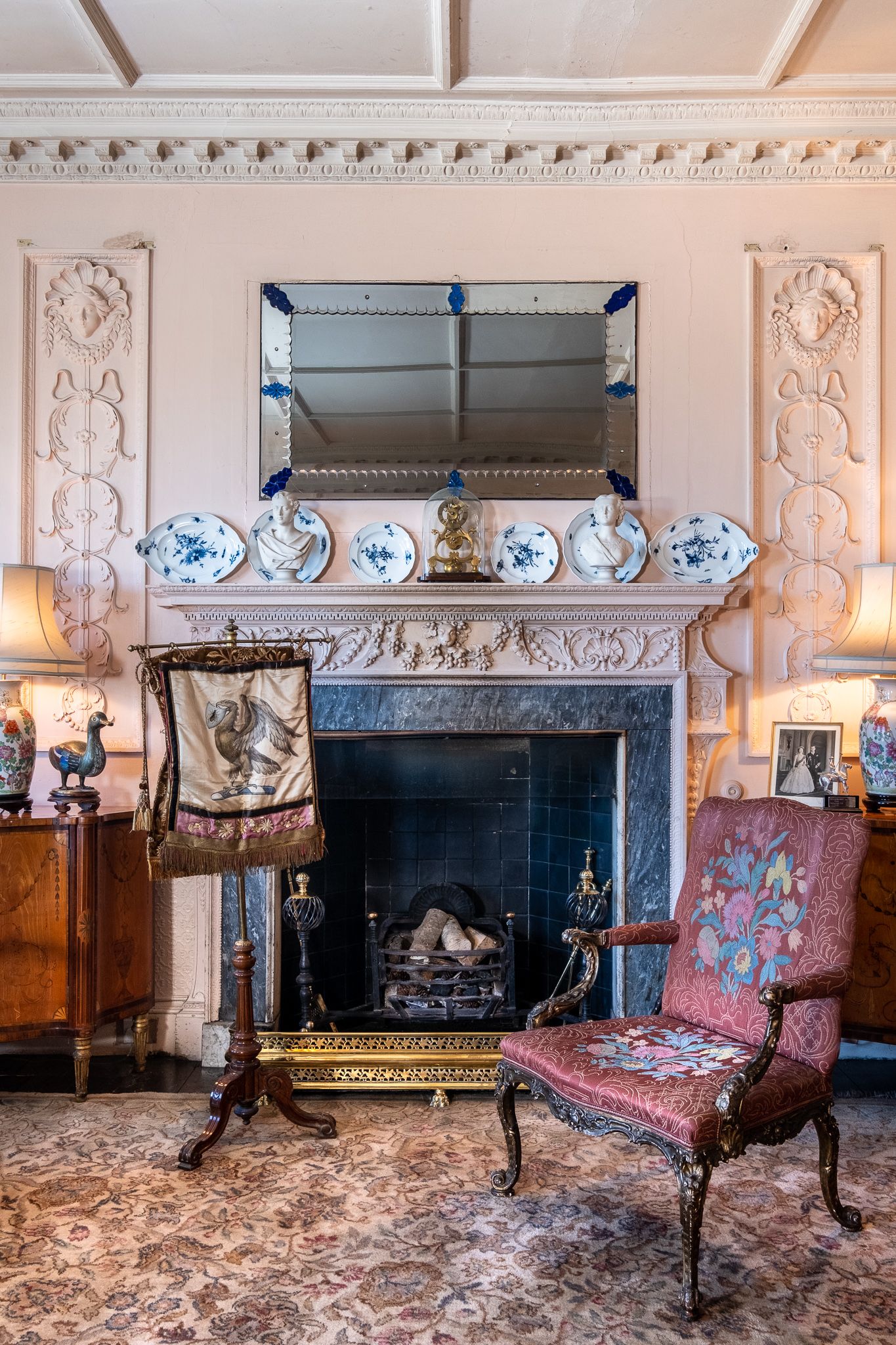
The sitting room at Kinsham Court
The sitting room at Kinsham Court
When Jack left Hampton Court, some of Essex’s ‘trifles’ and Rashleigh’s curiosities went with him to Kinsham Court. The Earl of Essex’s ancestors on his mother’s side, the Coningsby family, had owned Hampton Court since 1510, and over three hundred years had amassed some remarkable artefacts. To these, the Arkwrights added other pictures, furniture and books of a quality consistent with their wealth, during their century at Hampton Court. These collections form the core of this sale, but a few lots are germane to Kinsham Court, such as the Court Rolls dating back to 1750; further lots relate to the Arkwrights’ seventy years at Kinsham, including some from other historic Arkwright houses, most notably Sutton Hall, Derbyshire.
To the category of ‘trifles’ belong some of the manuscript lots. Hampton Court had reached its zenith under Lord Essex’s great-grandfather Thomas, first Earl Coningsby (c1656-1729) an outspoken supporter of the Glorious Revolution of 1688 who was rewarded with the role of joint-Receiver and Paymaster-General of the army during William III’s campaign in Ireland (1688-90). After this, Coningsby undertook extensive work to Hampton Court in parallel with his sovereigns’ new apartments at Hampton Court Palace. Connected with these events must be the manuscripts relating to army and navy payments, Campbell’s Vitruvius Britannicus (Campbell designed alterations to Hampton Court’s north front), Kip’s Britannia Illustrata of garden engravings (featuring Hampton Court), works on garden design (including the first edition of The Nobleman, Gentleman, and Gardener's Recreation by Stephen Switzer, whom Coningsby consulted), contemporary furnishings (the William and Mary cushion-framed mirror, chest on chest, and coffre-fort) and the Verbrugghen the Younger painting of flowers, including tulips.

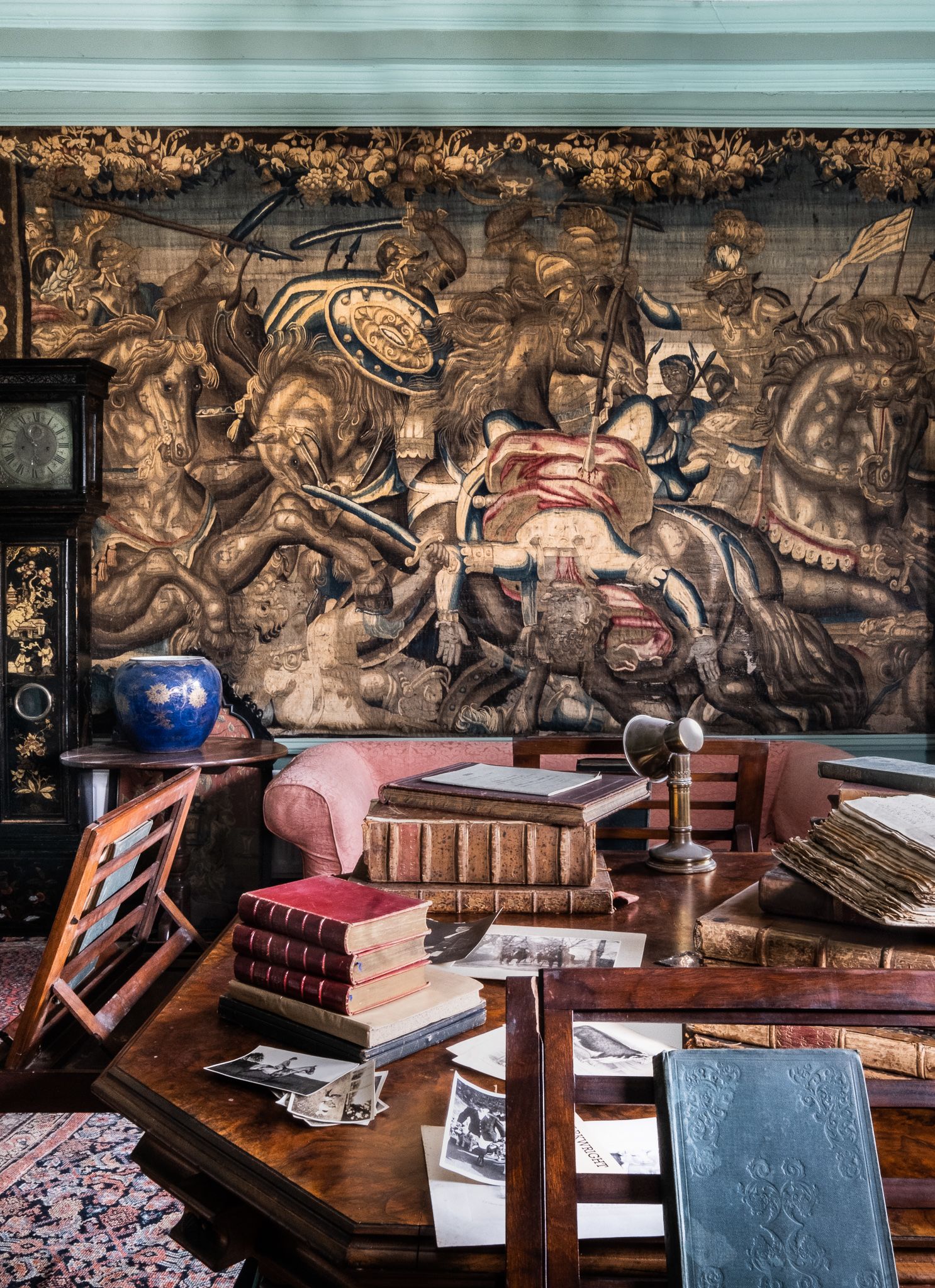
Items from the house include an extensive collection of books
Items from the house include an extensive collection of books
Viscount Malden commissioned Humphrey Repton to sweep away Lord Coningsby’s gardens a century later, while living at Hampton Court prior to his inheritance and removal to Cassiobury. (JMW Turner captured the results in watercolours in 1795.) To Malden’s gardening enthusiasm of this period may belong John Hill’s Gardener’s New Calendar of 1777 and William Mason’s The English Garden of 1781. Perhaps he ‘borrowed’ Sylva by John Evelyn from the Cassiobury library and left it at Hampton Court where it remained when the house was sold.
To the ‘trifles’ that Richard Arkwright bought in 1810 were added, during the century of Arkwright ownership of Hampton Court, the wedding portraits of John and his wife Sarah Hoskyns; the portraits of John’s parents and siblings after Joseph Wright of Derby, which John acquired from Dunstall, Staffordshire, after his brother Charles’s death in 1850; items related to Joseph Paxton, who designed the conservatory for John at Hampton Court, and to Thomas A Knight promoter of fruit growing in Herefordshire and second President of the London Horticultural Society, whose family were close personal friends of John; the Hall and Wheeler paintings of horses and hunting sketches relating to John’s passion for riding and Johnny’s period as joint-Master of the North Herefordshire Hunt; the Wheeler picture of the pedigree Hereford Cattle that were the favourite occupation of John and Johnny on the estate; the music table given to Johnny by Herefordshire Philharmonic Society (which he founded); the busts of Johnny and his wife Lucy (née Davenport of Foxley estate, Herefordshire, bought by her father from Uvedale Price, co-founder of the Picturesque) made on their honeymoon in Rome in 1868; and the Edward Taylor portrait of young Jack. David Cox had close connections with Herefordshire and we know that the remarkable collection of his watercolours offered at this sale hung at Hampton Court. Johnny informed Lucy in a letter of 19th May 1876 ‘I have got all the Coxs on the Morning Room wall even yours & they look very fine.’
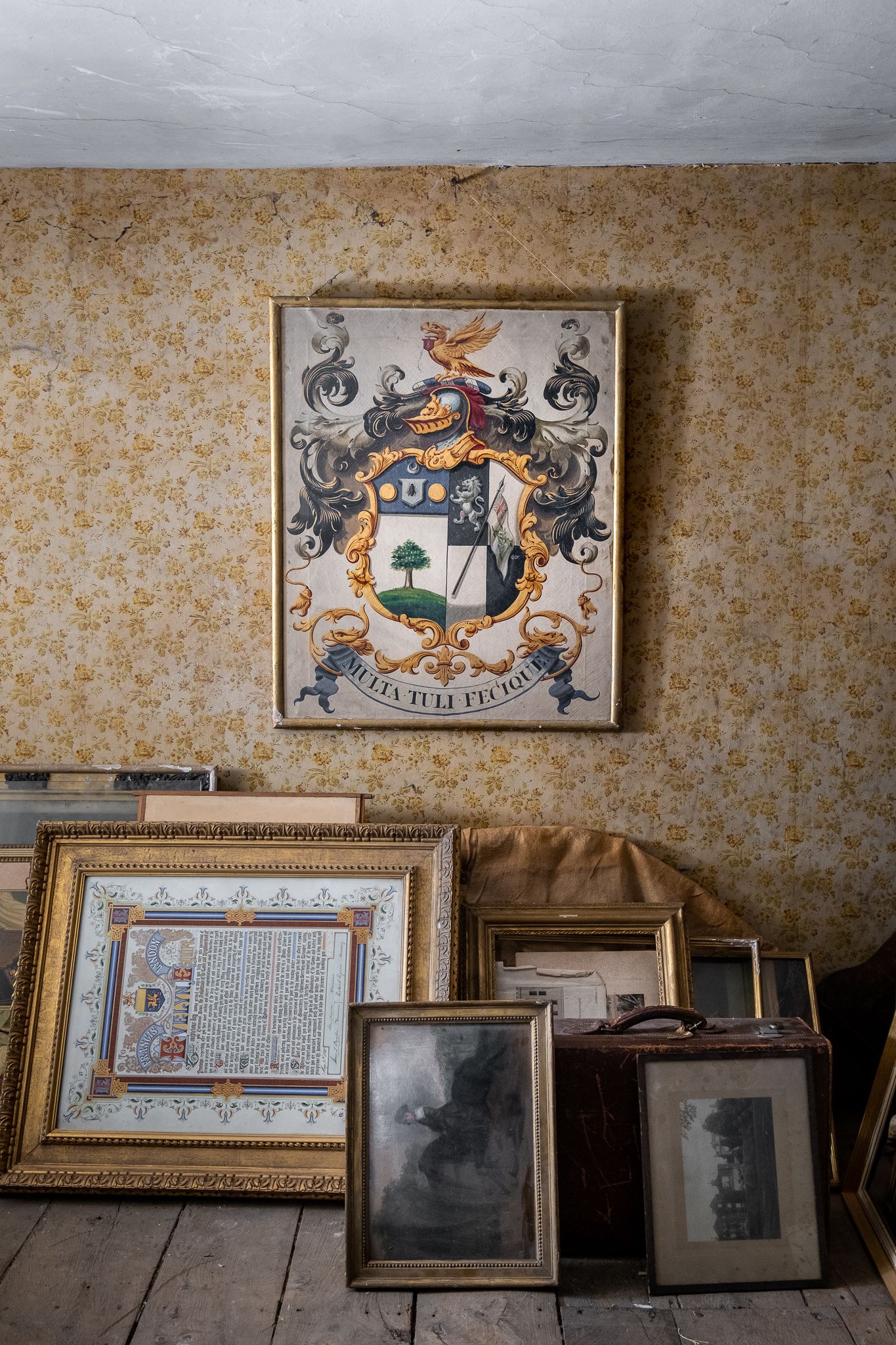
The impaled arms of Richard Arkwright (1835-1918). Estimate: £1,000 -1,500.
The impaled arms of Richard Arkwright (1835-1918). Estimate: £1,000 -1,500.
Most representative of Hampton Court under Arkwright ownership is JH Brown’s large picture of the celebrations for Johnny’s coming of age, painted on Thursday 3rd August 1854. This occasion saw a rare reunion of John and his surviving siblings and their families at Hampton Court. Brown depicts the morning after a ball, when the young enjoyed archery on the south lawn before luncheon for four hundred friends in the combined marquees of Leominster and Hereford Horticultural Societies. In July, on the heir’s actual birthday, a mile long procession of 2,000 local tradesmen and tenantry had processed from Leominster to Hampton Court (probably behind the banner in the sale, bearing the Arkwright crest, featuring the bee, for industry) to present an address, before 1000-1400 people were fed on roast beef. Commemorative china bowls and cups were given to guests and tenants.
All of these items moved with Jack to Kinsham Court, to which he there added portraits of his wife, Stephanie with their elder son John, and a drawing of younger son David by Frederick Beaumont. Jack’s success as a poet (at Oxford he won the Newdigate Prize with ‘Montezuma’) is reflected in the copies of his published works. The First World War poster ‘Missing!’ relates to his poem of that title in The Supreme Sacrifice, written in memory of Red Cross Nurses lost at sea, which is illustrated by an almost identical image. Jack is best remembered today for his poem ‘O Valiant Hearts’ which became the national hymn of remembrance after being sung at Westminster Abbey in 1917, at a service to mark the outbreak of war.
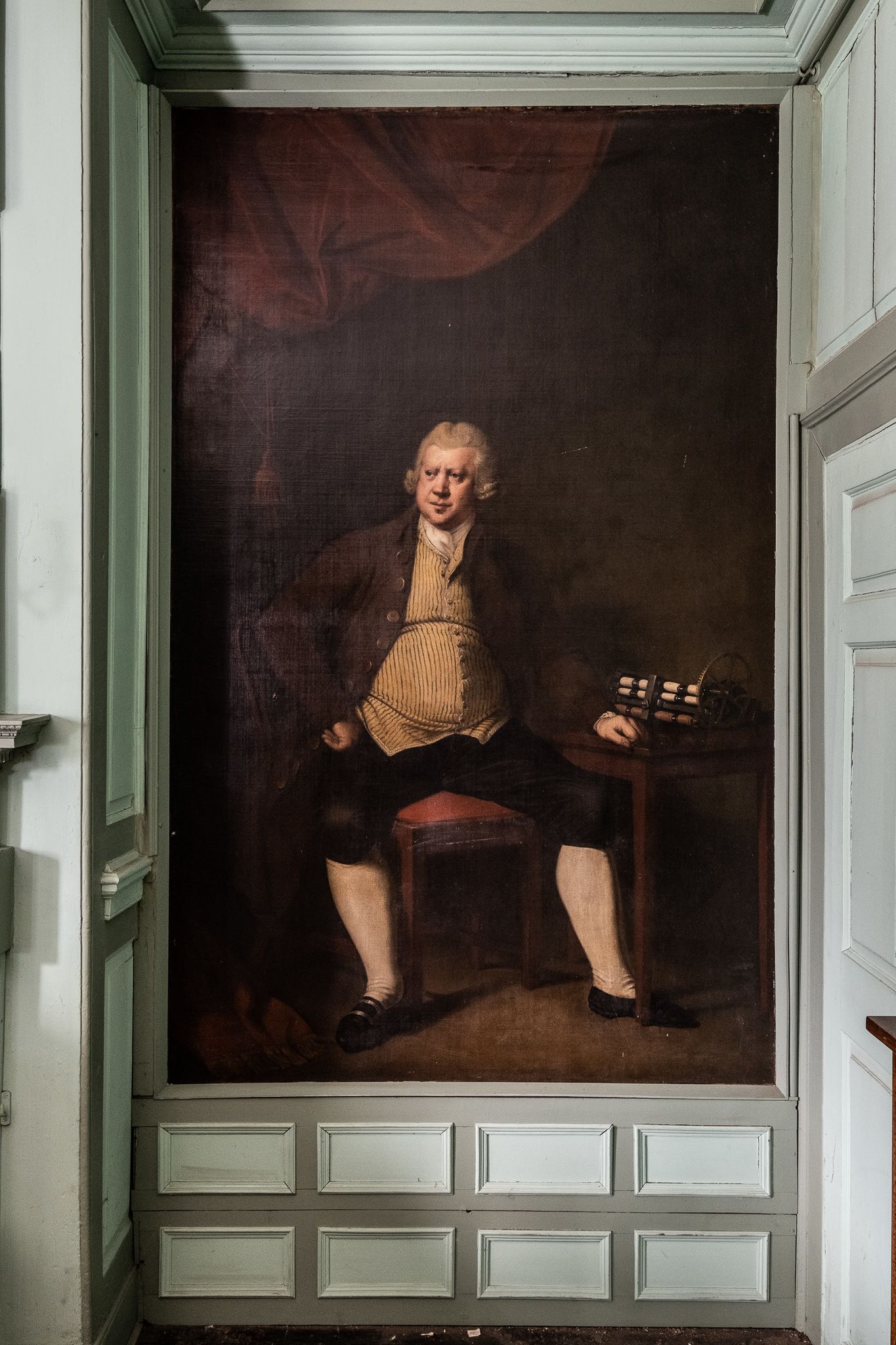
Portrait of Sir Richard Arkwright from the Studio of Joseph Wright of Derby (British, 1734-1797). Estimate: £40,000 - 60,000.
Portrait of Sir Richard Arkwright from the Studio of Joseph Wright of Derby (British, 1734-1797). Estimate: £40,000 - 60,000.
In 1925, Jack’s son John was a beneficiary of the will of his Arkwright cousin William who, in 1920 had sold Sutton Hall, Sutton Scarsdale in Derbyshire and retired to Devon. Willie is best known for his interest in the development of the sporting dog in Britain, which he researched extensively. He bred and trialled Pointers at Sutton Hall, was elected to the Kennel Club in 1876 and was in demand internationally as a judge of the Pointer type. Volumes of his research, published as The Pointer and His Predecessors are offered in this sale, as are Maud Earl’s magnificent portraits of ‘Largo’ and ‘White Light’.
Young John was killed in a wartime submarine accident in 1943. David never married, and his death in 1983 ended the Arkwrights’ direct male line in Herefordshire. Kinsham Court had been bought privately by Jack from his wife’s widowed sister, Grace Evelyn. The Evelyn family had acquired Kinsham from Lord Oxford just over a decade after Byron left, soon after it was vacated by Florence Nightingale’s family in 1823. Florence’s father thought the house ‘very picturesque, but not very habitable.’ Grace’s husband Francis L Evelyn renovated the house in the 1880s. David Arkwright bequeathed Kinsham Court to Grace’s granddaughter, Susan Wood, whose death, aged 102 years in 2020 precipitated this sale.
The late Mrs Wood was a careful curator for nearly forty years of the treasures of Kinsham Court, generously making them available to those interested. Bonhams’ London sale of 12th October therefore offers items of superlative quality, from the collections of the Coningsby and Arkwright families. They are little known, after a century ‘sequestered from the commerce of life’ in rooms frequented by Lord Byron. Like the poet who found such happiness at Kinsham Court, they may cause a stir.
Catherine Beale is the author of Champagne & Shambles: The Arkwrights and the Country House in Crisis
 Built with Shorthand