
Pedigree Chums


In the mid 1760s, that consummate anatomist and painter of the horse, George Stubbs, turned his attention to making portraits of single dogs. He had already risen to the challenge of more exotic species – Queen Charlotte’s zebra, for one, the first of its kind seen in England, which on Her Majesty’s orders had been installed in a paddock near the royal menagerie in St James’s Park, London, in 1762 to “entertain the populace” (the painting, incidentally, sold at Bonhams in 1960). For the Queen’s physician and imminent natural historian Dr William Hunter, he duly scrutinised the nylghau, the blackbuck, the moose and the cavy; for the scientist’s younger brother Dr John Hunter, two species of monkey and a rhinoceros. The hounds, sporting dogs and lapdogs also owned by the royal family, aristocracy and landed gentry were an altogether less taxing prospect for an artist with, as the inimitable late Judy Egerton framed it, “a deep and unaffected sympathy for the country life and the English countryside”.
Not all the artist’s canine portraits have been traced or identified: the artist unhelpfully listed such paintings exhibited at the Royal Academy between 1776 and 1782 simply as Portrait of a Dog. Hardly surprisingly, and thrillingly, they occasionally turn up on the market. Now in the Tate collection, for instance, A Couple of Foxhounds – commissioned by the fox-hunting Lincolnshire vicar Thomas Vyner in 1792 – returned from Australia in 1970. Two years later, Stubbs’s refined and well-groomed King Charles Blenheim spaniel was found, more plausibly, in a sale in Cirencester. This July, Bonhams’ sale of Old Master Paintings will offer A Black and White Spaniel Pointing in a Landscape that had been lost on the West Coast of America – and was recently rediscovered.
She is of the lighter, more elegant type of 18th-century black and white springer-type spaniel, with a snipy muzzle and exuberant feathering that the artist has delighted in recording. The soft light that bathes the foreground of the canvas has accentuated not only her coat but the apparent keenness of her eye (Stubbs no doubt did not know that dogs have poor vision) and certainly her rapt concentration, for the spaniel stands as alert as any of the artist’s pointers. On scenting birds, sporting dogs stand rigid, with muzzle stretched toward the game and usually one foot raised.
The background of the picture echoes those of an early series of portraits dating to the 1770s of black and white or brown and white pointers following a scent, nose to the ground. This kind of composition evidently pleased the artist or his patrons, probably not least because the diagonals they formed, emphasised by a backdrop of trees and the dropping away of ground, conveniently allowed for a particularly good view of the distant family seat. Here, Stubbs allows for a recognisable landscape, with a glimpse of church spire set against distant hills.
George Stubbs was not to the manner born. Extraordinarily, for an artist whose career was to revolve around the rolling parkland, the stables and the kennels of English landed estates, he grew up in urban poverty in Liverpool. This largely self-taught artist moved to York around 1745 to study anatomy at the city’s hospital, using his drawings of dissections to illustrate Dr John Burton’s Essay towards a Complete New System of Midwifery. He moved on to study the musculature and skeleton of horses in order to paint them convincingly. There were to be no more wooden-legged dobbins. The publication of his magisterial The Anatomy of the Horse in 1766 brought him commissions from just about every grandee involved in breeding and racing, almost all of them members of the newly formed Jockey Club. His clientele was delighted that he was prepared to treat their hounds, working dogs and lapdogs with equal individuality, dignity and respect.
Stubbs painted all kinds. Several defy classification, like the peculiar pet following his or her mistress in the artist’s equestrian portrait of the Countess of Coningsby, but then breed standards were only set down by the Kennel Club in 1877. Outside the highly competitive hunt kennels, where great care and considerable expense were taken to breed the most effective foxhounds, the mongrel prevailed. Stubbs deployed a wide range of the more-or-less recognisable in his large set-pieces to suggest the easy informality of everyday life on even the grandest country estates, where master and servant and their various working and domestic dogs commingled. For The Grosvenor Hunt of 1762, he raises his game and ambitiously – and convincingly – captures the convulsing, clamouring pack, as the hounds noisily give chase, leaping into the brook, splashing and swimming eagerly towards their prey.
In Five of Lord Rockingham’s Hounds in a Landscape, also from 1762, the canine is no longer mere staffage of open-air genre scenes but the subject of the painting itself. This frieze-like group may be less famous than the artist’s rightly celebrated series of mares and foals, but they are remarkable individual portraits none the less. By profiling the hounds in sharp relief against a dark middle ground, Stubbs is able to present their precise form and particular acuity. Illuminating them in a soft band of light allows him to reveal the textures of the delicate ears and silken coats of each dog and bitch, as well as their distinctive markings. His near life-size Water Spaniel of 1769 broke with convention by placing a single dog against a plain dark ground, just as he had painted Whistlejacket and Mares and Foals for the Marquess of Rockingham. There were to be no distractions for his bravura handling of this intriguing creamy-coloured, tightly curled and water-resistant coat that made the animal so ideally suited to work in water or marshland to ‘start’ and retrieve ducks and other waterfowl. It was from such dogs that the modern-day poodle evolved.

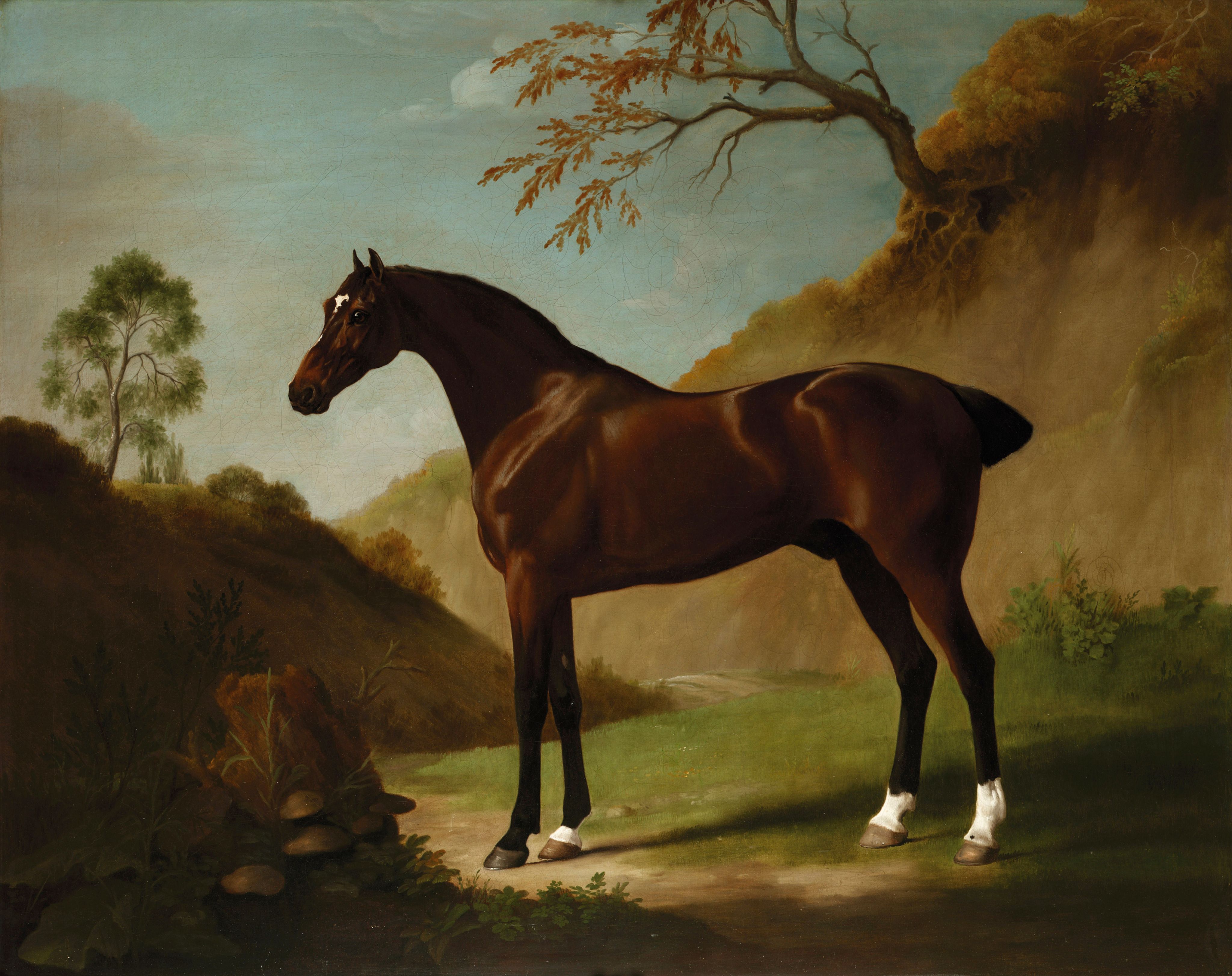
Stubbs’s oil painting A Dark Bay Thoroughbred in a Landscape was sold by Bonhams for £1,931,650
Stubbs’s oil painting A Dark Bay Thoroughbred in a Landscape was sold by Bonhams for £1,931,650

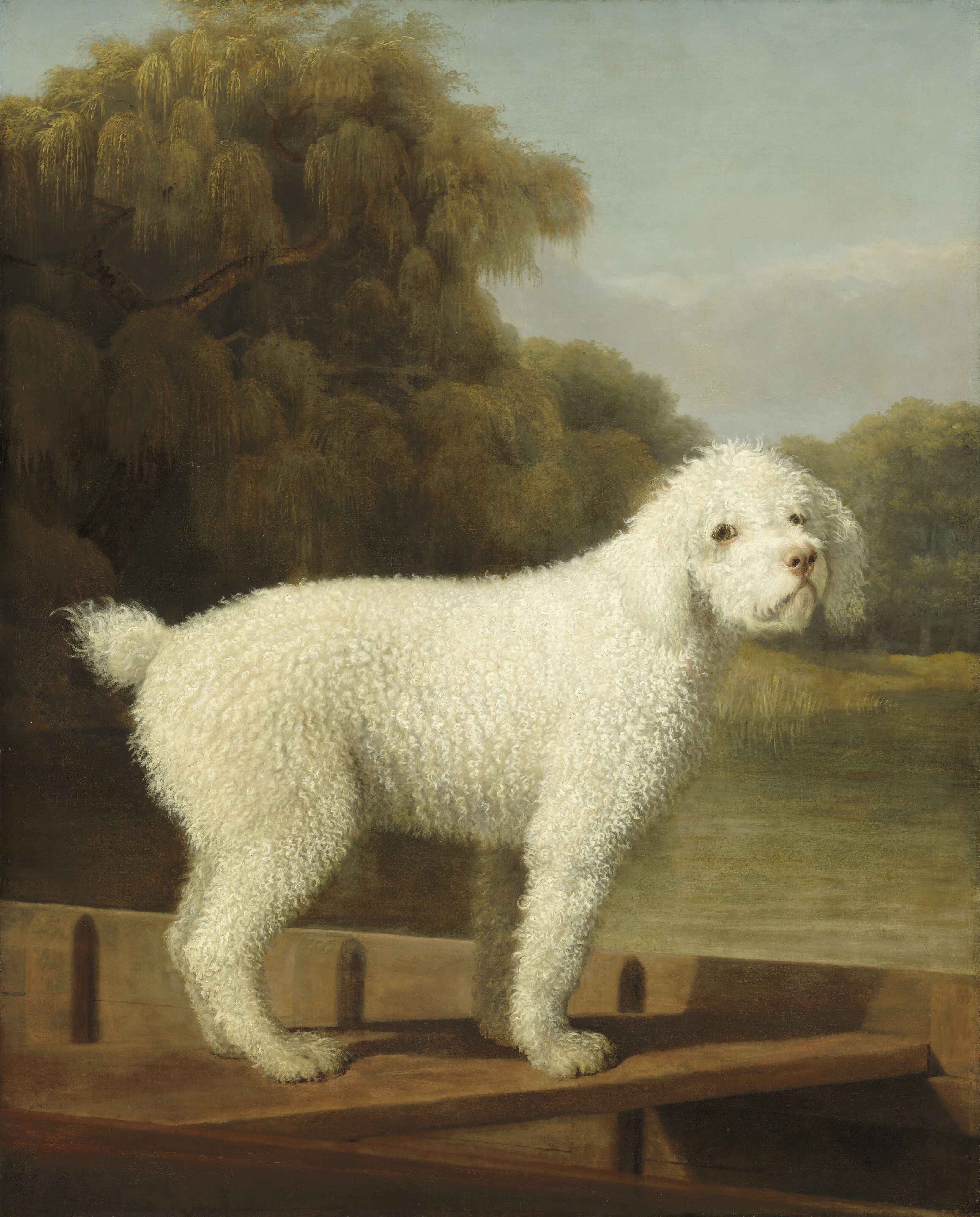
Stubbs’s White Poodle in a Punt captures a rather unenthusiastic passenger
Stubbs’s White Poodle in a Punt captures a rather unenthusiastic passenger
Perhaps Stubbs felt a particular affinity for these shaggy breeds, for arguably his most extraordinary dog picture is known as White Poodle in a Punt. Here it is not only the dog’s outward appearance that he captures so eloquently, but a sense of the beast’s apprehension as he stands more precariously than he would like on a gently rocking boat. The painter’s empathy is perhaps highlighted in the backdrop of weeping willows, a conventional symbol of melancholy or anxiety. It was not unknown for Stubbs to make such visual puns – he had depicted foxgloves besides his foxhounds, and added a white butterfly to his portrait of fellow artist Richard Cosway’s dog Papillon.
Of all Stubbs’s dogs, however, the most frequently painted were pointers, setters and spaniels. According to the study of 18th-century hounds and domestic dogs as seen through the artist’s paintings, these were not initially considered distinct breeds but were simply named after the job they did. If a spaniel set to game, for instance, it was a setter. These dogs often crop up communing with man and horse; pointers were more often than not painted accompanying their masters, shotgun in hand, in the field. We know the names of several of these often exceedingly valuable and beloved dogs – Hector, Tinker, Phillis, Faddle, among them – although many appearing on prints after Stubbs’s paintings are fanciful additions. Perhaps this newly discovered spaniel will recover her name, too.
Susan Moore writes for the Financial Times and Apollo. Her biography of Baron Hans Heinrich Thyssen-Bornemisza is due out next year.
 Built with Shorthand