
Kadhim Hayder
A Love Deeper than All Love (Wa hawa aemaq min kuli hawa)
The exhibition of The Epic of the Martyr took place in circumstances that were politically and culturally complicated; it turned the idea of martyrdom into a modern symbol that cried out in tragedy apart from any religious interpretation.
One of the artist's most touching and tender compositions, A Love Deeper than All Love is a seminal painting by Iraq's most enigmatic modern artist, Kadhim Hayder. Part of Hayder's major body of work focusing on the Battle of Karbala and death of Imam Hussein known as the "Martyr's Epic", the present painting was exhibited at the artist's landmark shows in the National Museum of Modern Art in Baghdad and Beirut in 1965 as well as being one of the most heavily featured works from the cycle, appearing in no less than three major press reviews at the time
Being offered in the market for the first time, the work comes from the prestigious private collection of one of Hayder's oldest friends; Professor Abdul Aziz Hameed. The two became acquainted during their studies at SOAS in the 1950's, subsequently becoming colleagues at the Baghdad Faculty of fine Arts in the 1960's, Hameed then went on to become President of the Iraqi State Board of Antiquities and Heritage, the painting has been in his collection for over half a century.
Extremely rare and possibly unique within the Martyr's Cycle, Hayder's composition in A Love Deeper than All Love, focuses on a romantic and deeply personal subject matter rather than the bloody battle of Karbala itself or the martyrdom of its protagonist, Imam Hussein. In the present work, Hussein is depicted as an anthropomorphised horse together with his Persian wife Shahbanu as the two are rendered standing affectionately side by side, in perhaps what is Hayder's most intimate take on the fabled story.
Legend states that Shahbanu was present during the battle of Karbala, but includes a miraculous aspect to the story. It states that prior to his death, Hussein gave Shahbanu his horse and bid her to escape back to her homeland in Persia. She was closely pursued by Yazid's soldiers and as she approached the mountains surrounding Rey, she tried to call out to God in desperation. However, in her exhaustion she misspoke and rather than saying "Yallahu!" (Oh God!), she said "Ya kuh!" (Oh mountain!). The mountain then miraculously opened and she rode into it, leaving behind only a piece of her veil which had gotten caught as the chasm closed behind her. This became an object of veneration, with the area becoming a shrine as well as a popular pilgrimage site.
Browse our upcoming sale taking place on 23 November and register to bid now

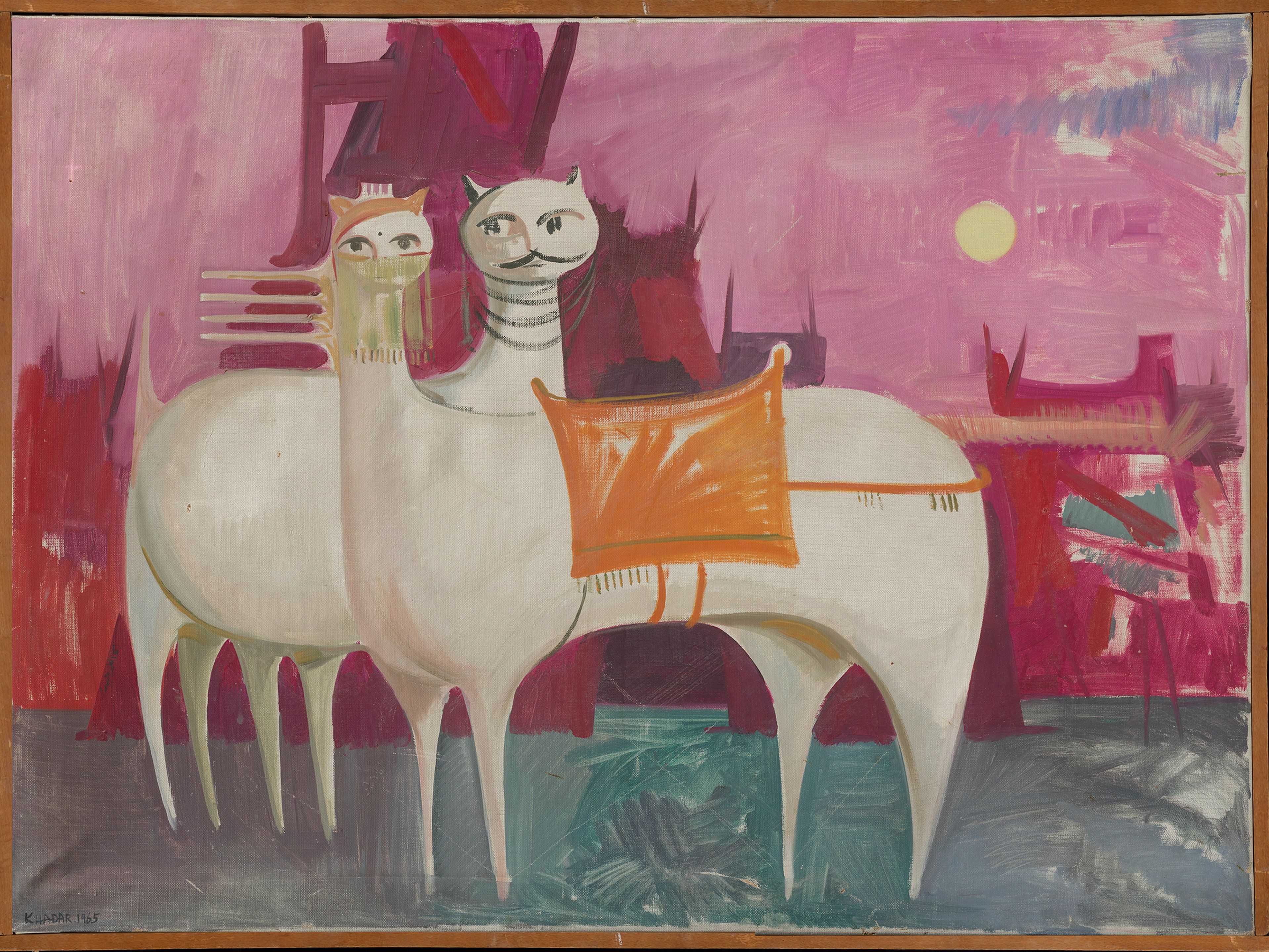
Kadhim Hayder, A Love Deeper than All Love (Wa hawa aemaq min kuli hawa) , from the Epic of the Martyr Series. Estimate: £100,000 - £120,000.
Kadhim Hayder, A Love Deeper than All Love (Wa hawa aemaq min kuli hawa) , from the Epic of the Martyr Series. Estimate: £100,000 - £120,000.
 Built with Shorthand