
Forest fire
Vlaminck was not promising material to be an artist. He wrote pornographic novels and loved cycling. Then he met André Derain and his life changed. Claire Wrathall tells what happened next


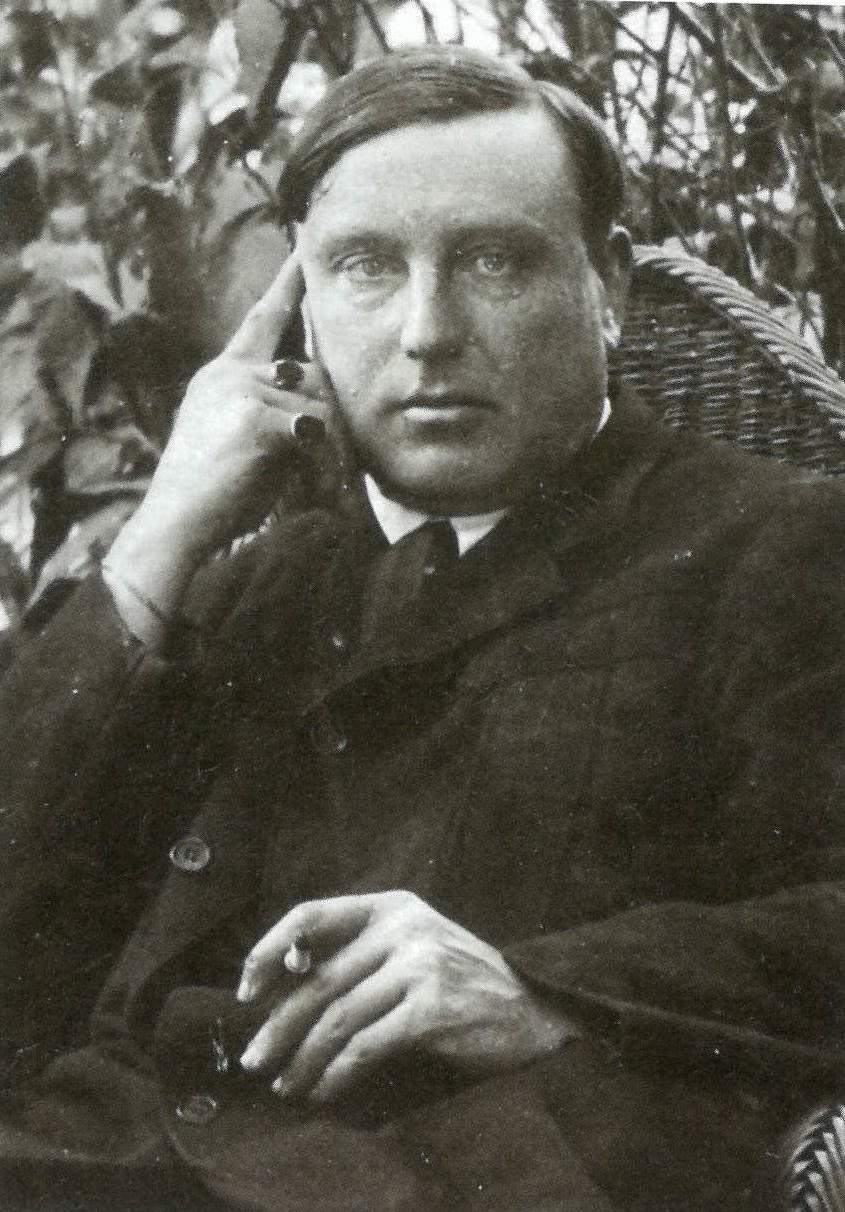
The young Vlaminck, c.1902
The young Vlaminck, c.1902
To chance meetings determined the course of Maurice de Vlaminck’s career as an artist. The first, in June 1900, was an encounter with André Derain, when the railway carriage they were travelling in was derailed. En route from Paris’s Gare de Lyon, they walked on to Chatou, the small town (now an affluent suburb) where both men were living. They struck up a friendship and as soon as Vlaminck was discharged from his military service, the two men began to share a studio on the Île de Chatou in the Seine.
The second strike of good fortune came six years later. Vlaminck, by now a leading member of the Fauves, along with Derain and Henri Matisse, met the pioneering dealer and patron Ambroise Vollard through these artists. Vollard later visited his studio for which Vlaminck donned a wooden necktie that he would paint different colours according to his mood or the rest of his outfit. Vollard was impressed – perhaps more by Vlaminck’s paintings than his dress sense – and offered him 6,000 francs in exchange for his entire body of work. Vollard also promised him a solo exhibition and, crucially, gave him the confidence to devote himself entirely to painting, as until then, Vlaminck had worked very much in Derain’s shadow, making more of a living from writing, notably pornographic novels that Derain illustrated.
Born in Paris in 1876, Vlaminck took art classes as a boy but did not train formally. The son of two musicians, one French, one Flemish, he earned a living teaching the violin and freelancing in orchestras.
At 18, he married his first wife and soon had children to support, and insofar as he had other ambitions, they were to box and win bicycle races. He might even have cycled professionally had typhoid fever not forced him to quit the same year. “The admiring looks of the girls and women, the bravos and cheers of the excited spectators... never, anywhere, had I felt such utter and complete satisfaction as I did in the days when I was nothing more than the winner of a simple bicycle race,” he recalled in his colourful 1929 memoir Tournant dangereux (Dangerous Corner), one of a dozen volumes of autobiography he published over the course of his life, his prose as colourful as his Fauvist landscapes.
But in 1901, he went to Van Gogh’s first Paris exhibition at Bernheim-Jeune and, struck by the Dutch artist’s radical use of undiluted colour and impasto, realised that painting was both his true vocation and the way to conquer his demons, coming to see it as “the abscess that drained off an evil in me. Without a gift for painting, I would have gone to the bad. What I could only have achieved in a social context by throwing a bomb, I have tried to express in art.”
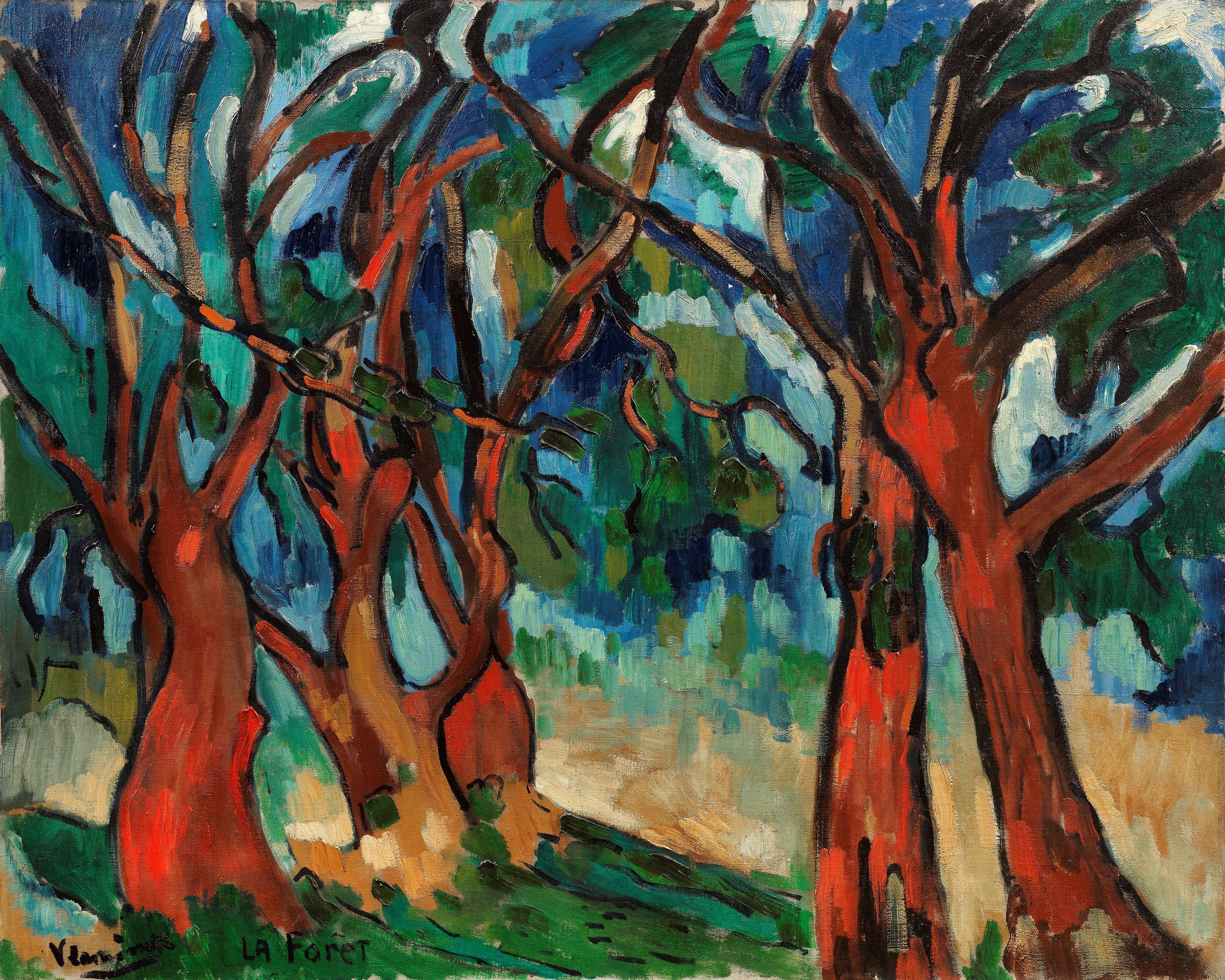
Like Van Gogh, Vlaminck painted en plein air, working “out in the sunshine”, and finding inspiration in “the raw, harsh colours of grass, the ultramarine and cobalt of the sky, harmonised to extravagance at a sensual, musical pitch. […] I wanted to burn down the École de Beaux Arts with my cobalts and vermilions,” he wrote. Look at the way he paints the grass and the sky, and the reds he uses on the tree trunks of La fôret, c.1907-08, which Bonhams is offering in London’s Impressionist & Modern Art sale in October, and he might have been talking about this very scene.
In the first phase of his career, Vlaminck was classified as one of Les Fauves (wild beasts), the group that included André Derain, Kees Van Dongen, Henri Matisse and Georges Rouault among others. Their work had been hung together at the 1905 Paris Salon d’Automne and was defined by its use of vivid, often unnaturalistic colour and distorted forms. However, in 1907, it was a visit to a memorial exhibition in honour of Paul Cézanne, who had died the previous year, that prompted Vlaminck to change his style – something that is presaged in La fôret.
“Cézanne opens a door to point out a road and invites you to take a walk with him into the world of art,” he wrote. If in his earlier paintings – works such as Autumn Landscape at MoMA or the portrait of Dérain at the Metropolitan Museum of Art, both in New York, or Tugboat on the Seine, Chatou at the National Gallery of Art in Washington D.C. – Vlaminck’s use of colour was consciously unnatural, his vigorous short-stroked brushwork almost expressionistic, his Cézanne-period paintings have a more sombre, if no less vibrant palette and more formally structured compositions.
Looking at La fôret, one can’t help being reminded of, for example, Cézanne’s 1904 painting Trees and Rocks in the Park of the Château Noir (now in the Langmatt Museum in Baden, Switzerland) and Monte Sainte-Victoire Seen from Les Lauves (now in the Kunstmuseum in Basel, 1902-06), both of which were among the 56 paintings displayed in the 1907 Memorial Exhibition for Cézanne.
“The play on pure colour and the extravagant orchestration into which I had thrown myself body and soul no longer sufficed. I suffered from not being able to strike harder and to have reached maximum intensity, limited as I was by the blues and reds of commercial colours.” These colours he would squeeze from the tube unmixed and directly on to the canvas.

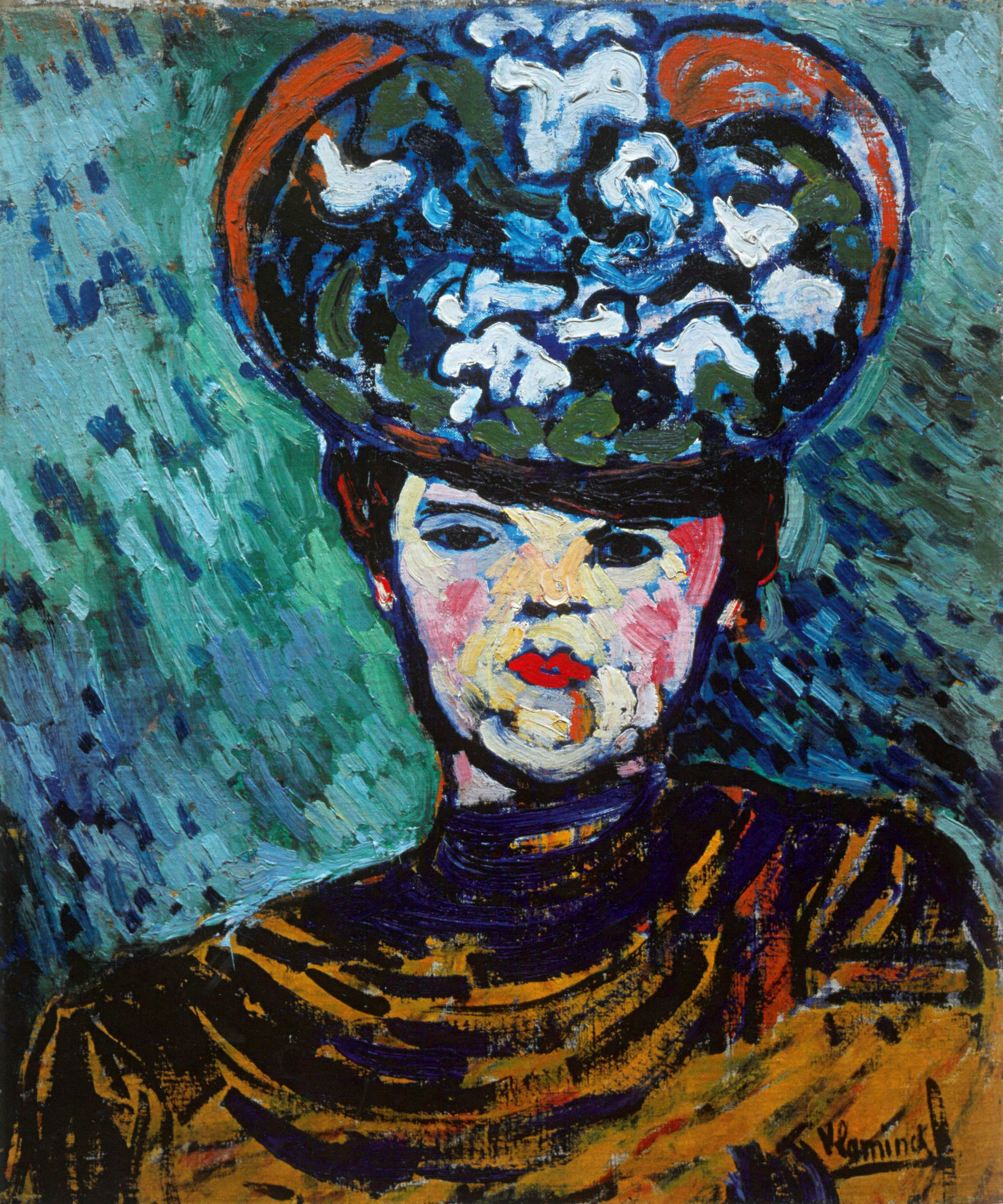
Maurice de Vlaminck, Femme au Chapeau, 1906, oil on canvas
Maurice de Vlaminck, Femme au Chapeau, 1906, oil on canvas
Vlaminck’s ‘Cézanne period’ lasted till 1915, after which his resolutely figurative landscapes became darker and more detailed and realistic in deliberate opposition to Cubism, by then the style of the day. It was also, perhaps, a response to the First World War, during which he was called up, but avoided active service in favour of munitions-factory work. “For me the Cubist uniform is very militarist,” he wrote. “And you know how little I am the ‘soldier type’. Barracks make me neurasthenic, and Cubist discipline reminds me of my father’s words: ‘The army will do you good. It will give you character.’”
Vlaminck’s antipathy towards it may also have been a manifestation of his loathing of Picasso, whom he saw as “a trickster and an imposter”, thereby excluding himself from the Paris art scene.
Indeed, although a number of his Fauvist paintings were listed as Entartete Kunst on the inventory of degenerate art seized by the Nazis in 1937 (one of them, a watercolour called Town Street, was subsequently acquired by Hildebrand Gurlitt for 60 Swiss francs), Vlaminck’s work avoided such classification.
Poet Guillaume Apollinaire – a close friend and the subject of an early portrait – called Vlaminck “one of the most talented painters of his generation”, a violinist whose musicianship inspired him, at least in his youth, to “heighten all the tones [and] transpose in an orchestration of pure colours all the feelings I could grasp”.
Claire Wrathall is writes for the FT among other publications and is a former editor of Art Quarterly.
 Built with Shorthand