
Collecting 101
Alan Turing
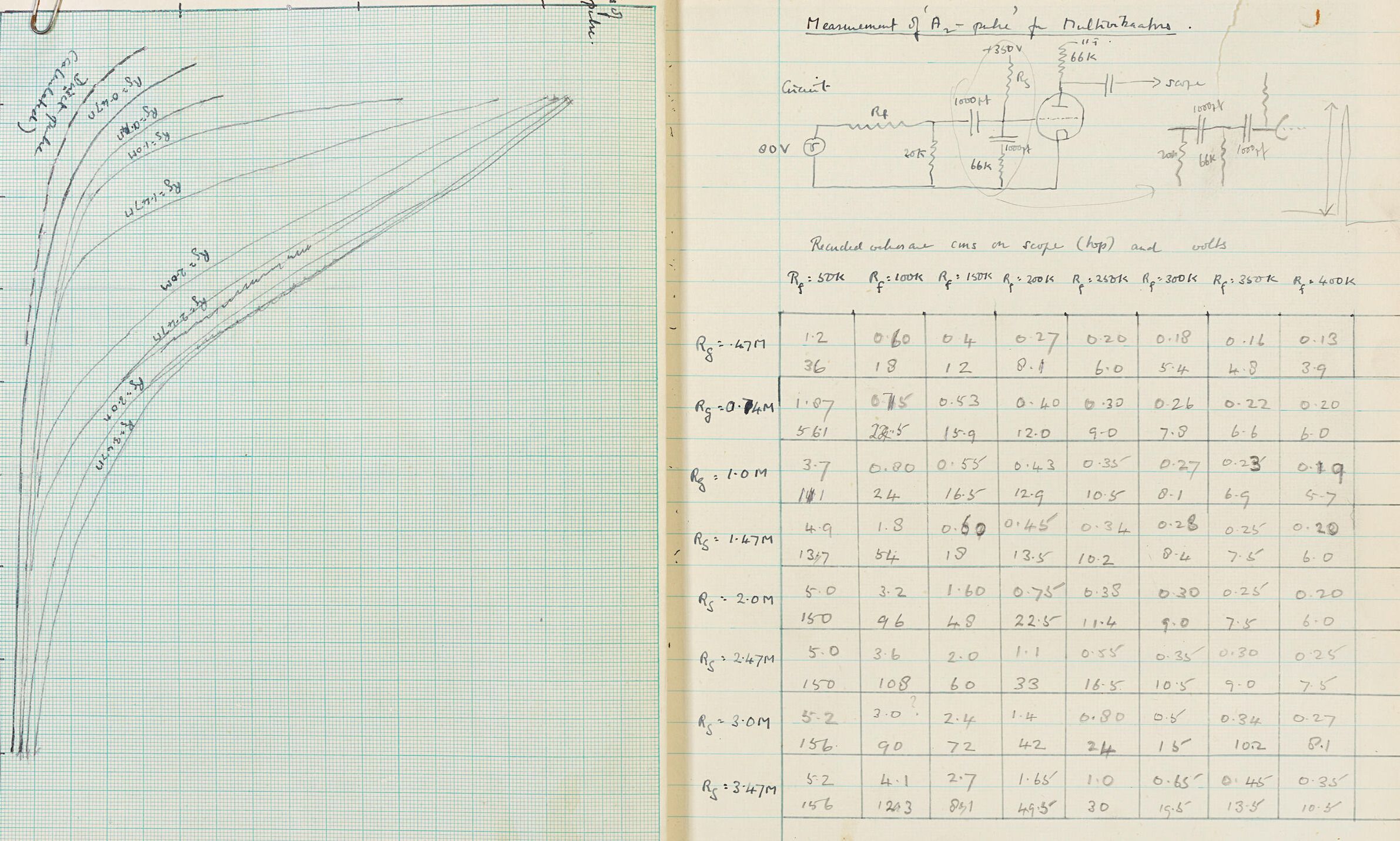

It is difficult to overstate the influence of Alan Turing. Mathematician, scientist, logician and codebreaker, he was famed for breaking Nazi codes and making a significant impact on modern computer science during his lifetime. Today, his work paves the way for contemporary computer science, artificial intelligence (AI), and future discoveries that we cannot yet imagine.
Here, we learn more about Turing’s life, work and legacy, illustrated with lots sold at Bonhams.
Thinking of selling your Alan Turing book or collectable? Submit it online for a free auction estimate
1.
Early Life & Education
Born in 1912 in London, Turing was raised with his brother by foster parents in Britain while his father worked in the civil service in colonial India. He was eventually sent to boarding school at the age of 13, where his immediate interest in mathematics and science singled him out in a traditional public school, whose ethos was still based on the teaching of classics and the rigours of the sports field.
Despite difficult school years which were clouded by the death of his great friend Christopher Morcom, he went on to study mathematics at King’s College, Cambridge, graduating in 1934. He completed his Masters three years later, by which time he was already elected a Fellow of his college on the strength of his undergraduate dissertation.
His paper "On Computable Numbers, with an Application to the Entscheidungsproblem" was published in Proceedings of the London Mathematical Society in 1936 and has been called the most influential mathematics paper in history. He received his PhD from Princeton University in 1938, where he studied under Alonzo Church, who had also worked on the decidability of problems, publishing similar conclusions to Turing with different methods. Turing’s methods were simpler and more intuitive than Church’s and included the foundations of his ‘Turing machine,’ which is still a key idea in the theory of computation.

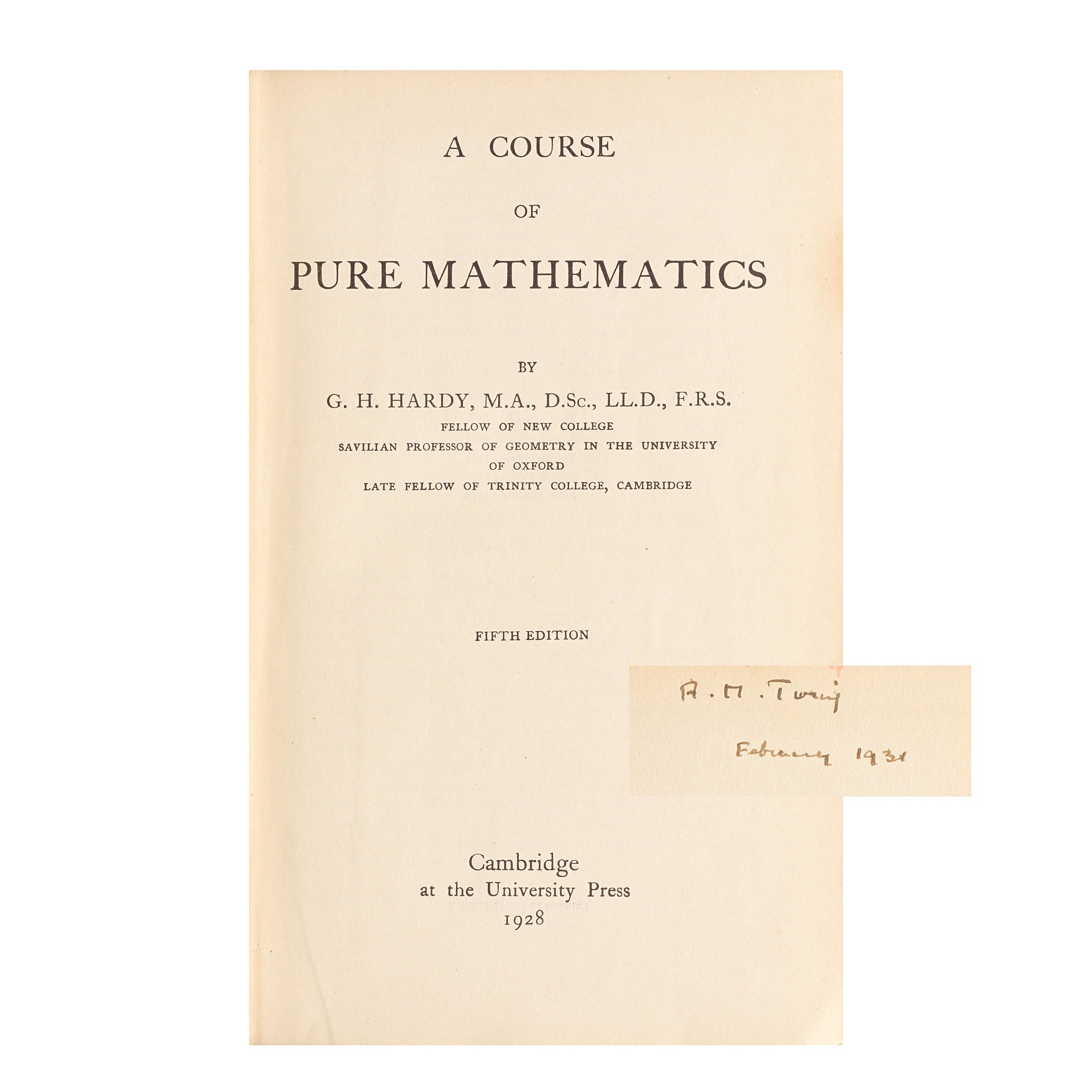
Turing (Alan), A group of ten influential mathematical and computing books from the collection of Alan Turing, all with his ownership inscription. Sold for £76,600 inc. premium.
Turing (Alan), A group of ten influential mathematical and computing books from the collection of Alan Turing, all with his ownership inscription. Sold for £76,600 inc. premium.
Stay updated with our auctions. Create an account with Bonhams to follow your favourite collecting categories and get email alerts when new auctions are open for bidding. Register now
2.
Bletchley Park, The Enigma Machine & The Bombe
The second phase of Turing’s career began in 1938 when he returned to the UK from Princeton. He joined the Government Code and Cypher School that year and was immediately recruited to join the team at Bletchley Park, Buckinghamshire, when war broke out in 1939. The goal of the Bletchley Park team was to understand and decode messages sent by the German Enigma Machine, invented for civilian use in 1918 by Arthur Scherbius but used by the Nazi government to send encrypted messages during the war.
Turing and his team began their work with material provided by the Polish government. A Polish team, led by Marian Rejewski, had already deduced the internal wiring of Enigma and created a code-breaking machine called Bomba. However, after a change in the German operating procedures on Enigma in May 1940, Bomba no longer worked. Turing and his team revised and redesigned a code-breaking machine based on the Polish one, retitled ‘Bombe’, that could be adjusted to react to changes in Nazi procedures of using Enigma. It was used throughout the war to provide critical intelligence to the Allied forces.
Turing continued to refine the Bombe throughout the war, developing a statistical procedure called Banburismus that made it more efficient. At nearby Hanslope Park, he also worked with Donald Bayley to develop a portable secure voice scrambler called ‘Delilah’. After the war, Turing was made an Officer of the Most Excellent Order of the British Empire (OBE) for his work at Bletchley Park.

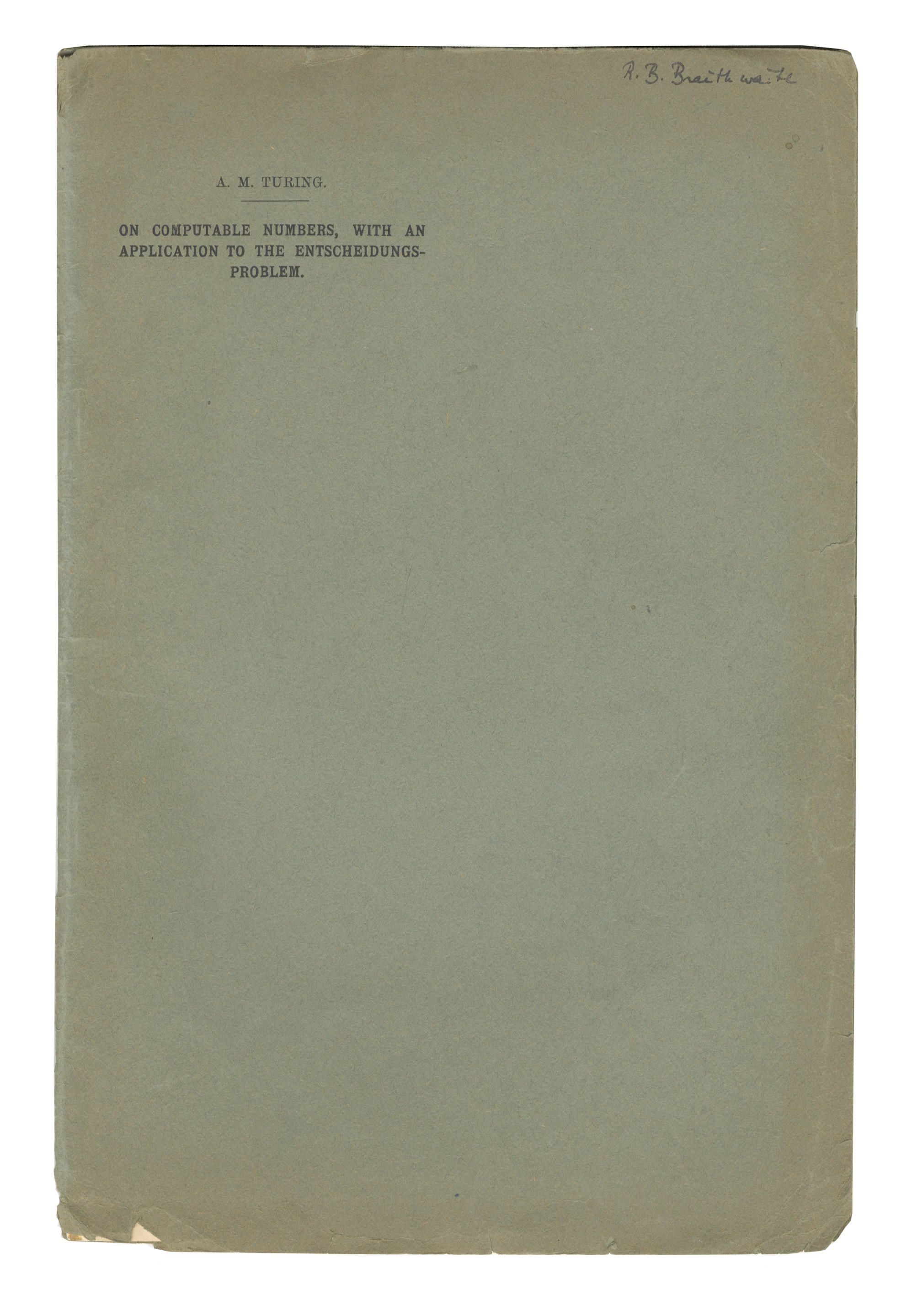
Turing (Alan. M), 'On Computable Numbers, with an Application to the Entscheidungsproblem'; 'On Computable Numbers... A Correction' [Extracted from the Proceedings of the London Mathematical Society, ser. 2, vol. 42 and 43, 1937]. Sold for £205,250 inc. premium.
Turing (Alan. M), 'On Computable Numbers, with an Application to the Entscheidungsproblem'; 'On Computable Numbers... A Correction' [Extracted from the Proceedings of the London Mathematical Society, ser. 2, vol. 42 and 43, 1937]. Sold for £205,250 inc. premium.
3.
Computers & Artificial Intelligence
After leaving Bletchley Park, Turing turned his attention to what would become known as artificial intelligence. In 1945, he was recruited by the National Physical Laboratory (NPL) in London. He worked on the design of what would become the Automatic Computing Engine (ACE), the first electronic all-purpose digital computer. His plans imagined a fast computer with vast memory, but the engineering required to build it was considered too difficult and a much smaller computer was built instead.
The Turing Test
Turing eventually left the NPL to join the Computing Machine Laboratory at the University of Manchester, which was moving much faster to build innovative machines. While at Manchester, Turing created what has become known as the Turing test. In a paper published in Mind in 1950, he rejected the classic question “Can machines think?” and instead argued that a more useful metric was determining whether a machine was “intelligent” enough to fool a human into thinking it is a fellow human. This reframing of how we conceptualise intelligence—and the relationship between machines and humans—continues to guide discussions about artificial intelligence today.

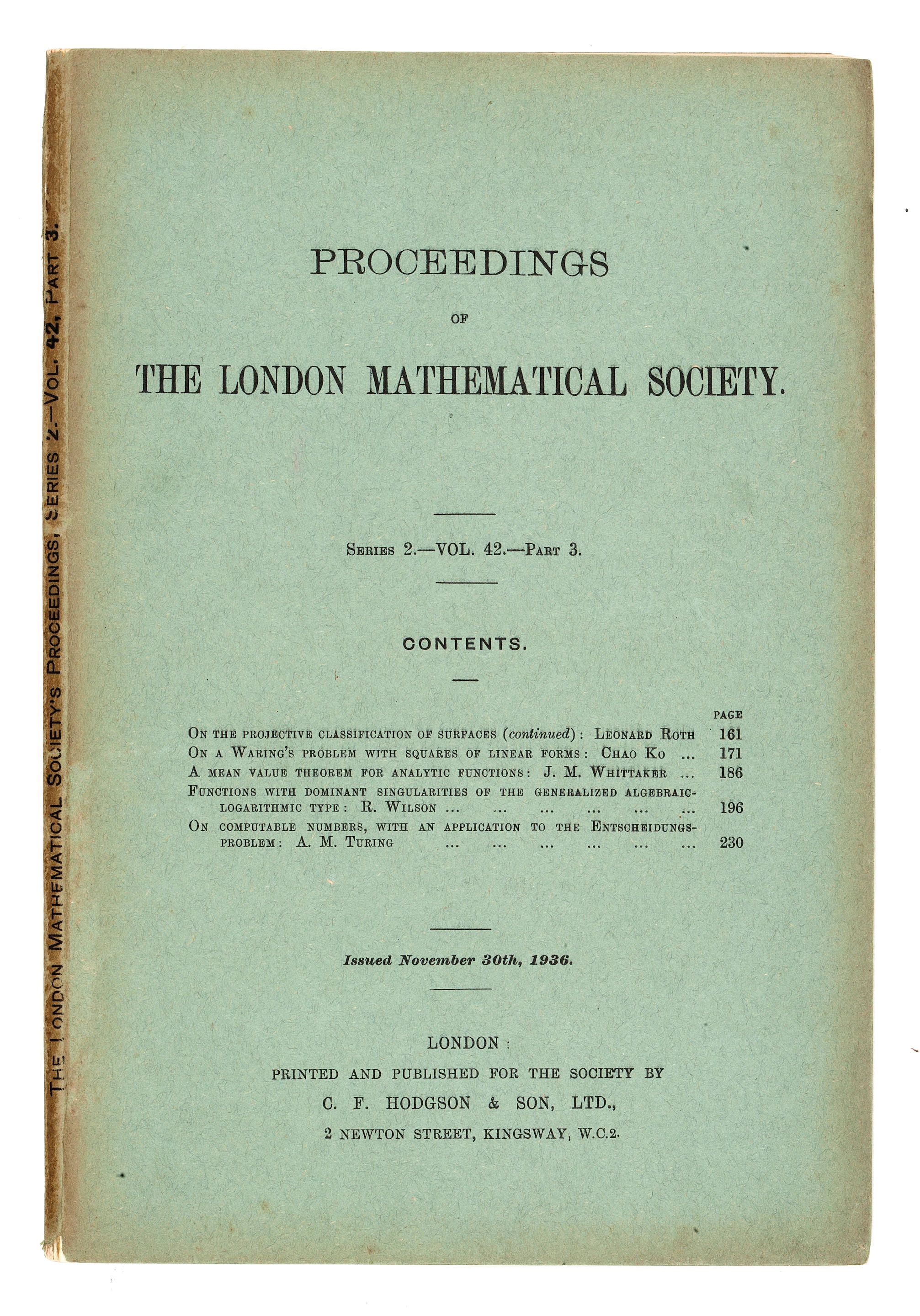
Turing, Alan Mathison. 1912- 954, "On Computable Numbers, with an Application to the Entscheidungsproblem.". Sold for £50,000 inc. premium.
Turing, Alan Mathison. 1912- 954, "On Computable Numbers, with an Application to the Entscheidungsproblem.". Sold for £50,000 inc. premium.
4.
Death & Legacy
Turing’s life was thrown off course when his house was burgled in January 1952. During the police investigation, he mentioned to police that he was in a relationship with a man named Arnold Murray, who was acquainted with the burglar. Both men were charged with gross indecency under Section 11 of the Criminal Law Amendment Act of 1885, which criminalised homosexuality. Turing’s own solicitor and his brother convinced him to plead guilty, which he did. Turing was ordered to undergo imprisonment or chemical castration; he chose the latter. He was given injections of oestrogen for one year, which were intended to reduce his libido and caused various side effects.
A further consequence of this sequence of events was the removal of Turing’s security clearance, which was the general practice for known homosexuals at the time. He was unable to contribute to government work or to travel to the United States again. In June 1954, Turing was found dead in his home. The cause of death was cyanide poisoning, possibly from a half-eaten apple found nearby, which the inquest ruled as suicide. The true nature of his death, whether suicide or a tragic unintentional consequence of his experiments at home, is still ambiguous.
In 2009, after an online petition to Parliament received over 30,000 signatures, Prime Minister Gordon Brown formally apologised to Turing for his treatment in the 1950s. In 2013, Queen Elizabeth II granted Turing a royal pardon. Turing’s work in mathematics, artificial intelligence and computing remains relevant to this day. He became more widely-known upon the release of the critically acclaimed film, The Imitation Game, starring Benedict Cumberbatch, in 2014.

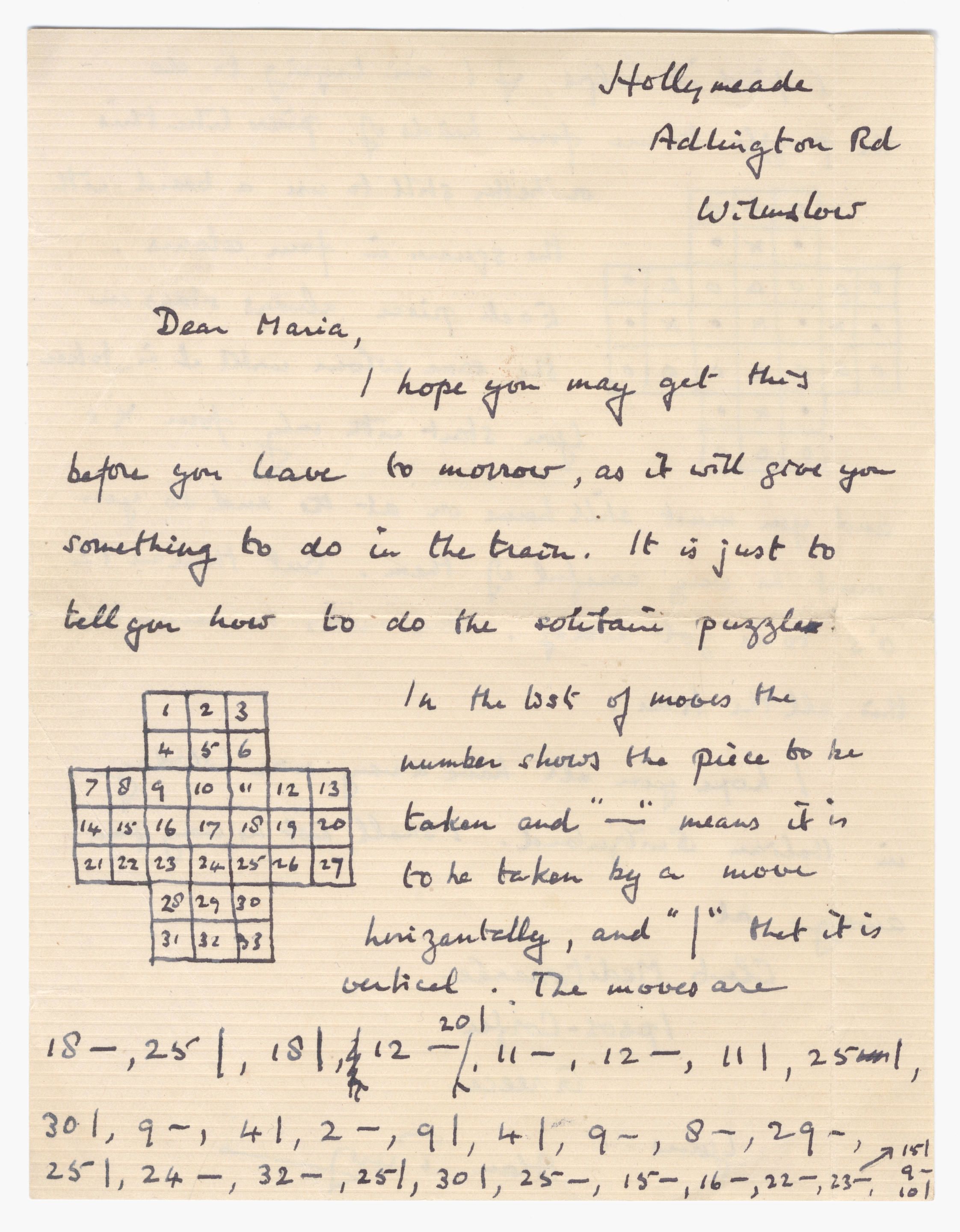
The Famous 'solitaire Letter' Sent By Alan Turing To The Daughter Of His Analyst Less Than A Year Before His Death. Sold for £40,000 inc. premium.
The Famous 'solitaire Letter' Sent By Alan Turing To The Daughter Of His Analyst Less Than A Year Before His Death. Sold for £40,000 inc. premium.
5.
On the Market
Turing’s enduring fame has fostered a strong market for Turing-related objects and documents in the UK and the US. The Imitation Game helped spread his story beyond the academic world to a mass audience. Most Turing-related items sell for over £5,000. Because he only published in niche academic journals and remained unknown outside the academic world during his lifetime, materials related to him are rare. Even a copy of the programme to the “Manchester University Computer Inaugural Conference, July 1951”, which Turing helped organise and contributed towards, makes £2,000 upwards. Books by other authors that were owned by Turing have made between £4,000 and £15,000, each depending on how significant they are deemed to be in relation to his career.
The quality of the item and closeness of its relationship to Turing make a big difference in its valuation. Bonhams has seen some fantastic results in this market. One copy of an autograph letter signed ("Yours Alan") to Alfred William Beuttell, returning his notes on the Monte-Carlo system " was sold at Bonhams for £94,000. Another copy that was inscribed and a specifically printed “off-print” with good provenance sold for £205,250. One of his composition notebooks sold for $1,025,000 in 2015. In 2017, an autograph letter signed ("A.M. Turing"), to his former mathematics teacher D.B. Eperson sold for £75,000.

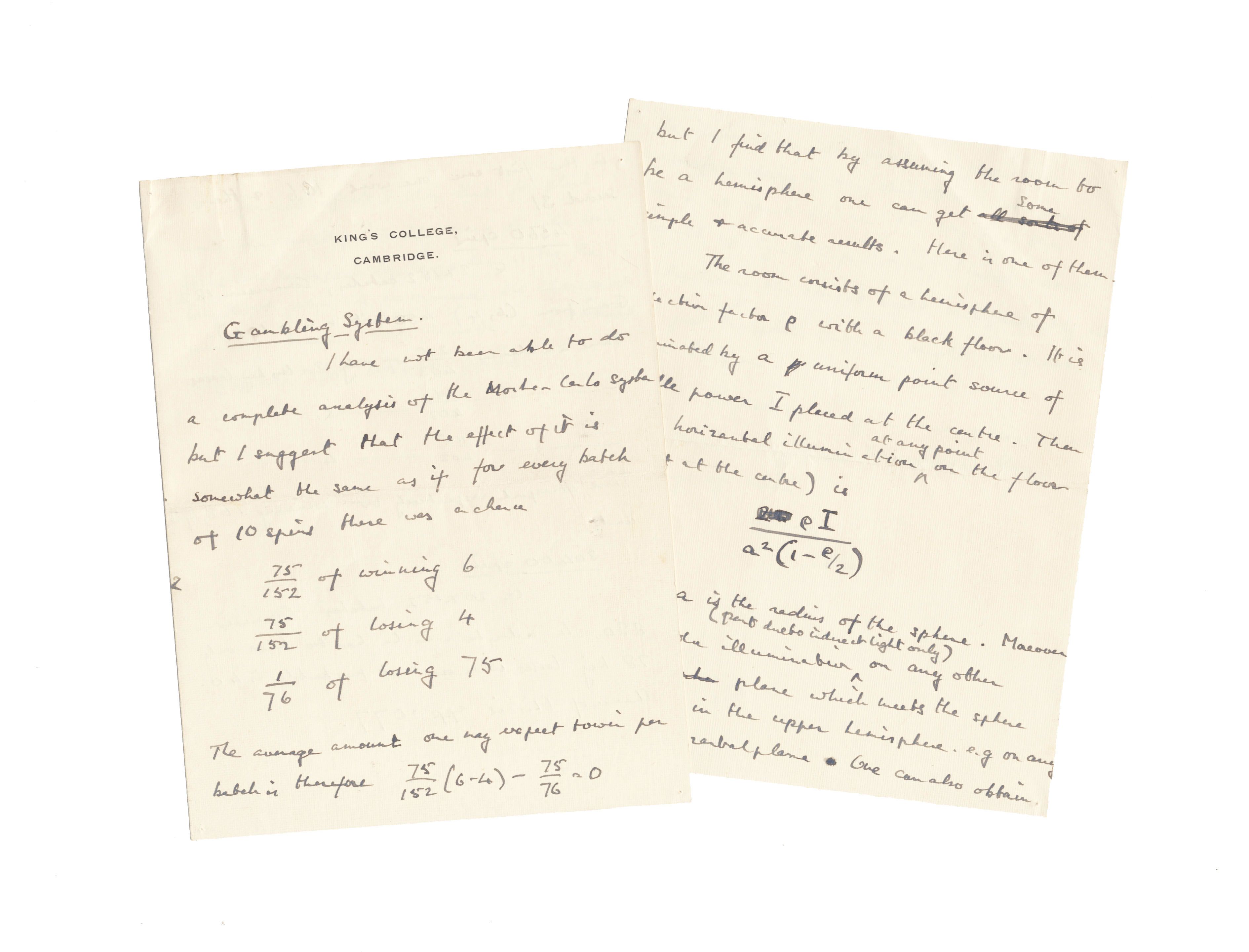
Turing (Alan), Autograph letter signed ("Yours Alan") to Alfred William Beuttell, sending a four-page analysis of the Monte-Carlo betting system and offering a solution to a technical lighting problem, Cambridge, 2 February [19]33. Sold for £94,000 inc. premium.
Turing (Alan), Autograph letter signed ("Yours Alan") to Alfred William Beuttell, sending a four-page analysis of the Monte-Carlo betting system and offering a solution to a technical lighting problem, Cambridge, 2 February [19]33. Sold for £94,000 inc. premium.
The Delilah Project
In our Fine Books and Manuscripts auction on 14 November, we had a group of exciting Turing-related material coming under the hammer—including the important newly discovered papers of Turing and his collaborator Donald Bayley relating to the Delilah project, a wartime speech encryption system, which achieved £381,400.

Stay updated with our auctions
Create an account with Bonhams to follow your favourite collecting categories and get email alerts when new auctions are open for bidding.
 Built with Shorthand