
Eternal space
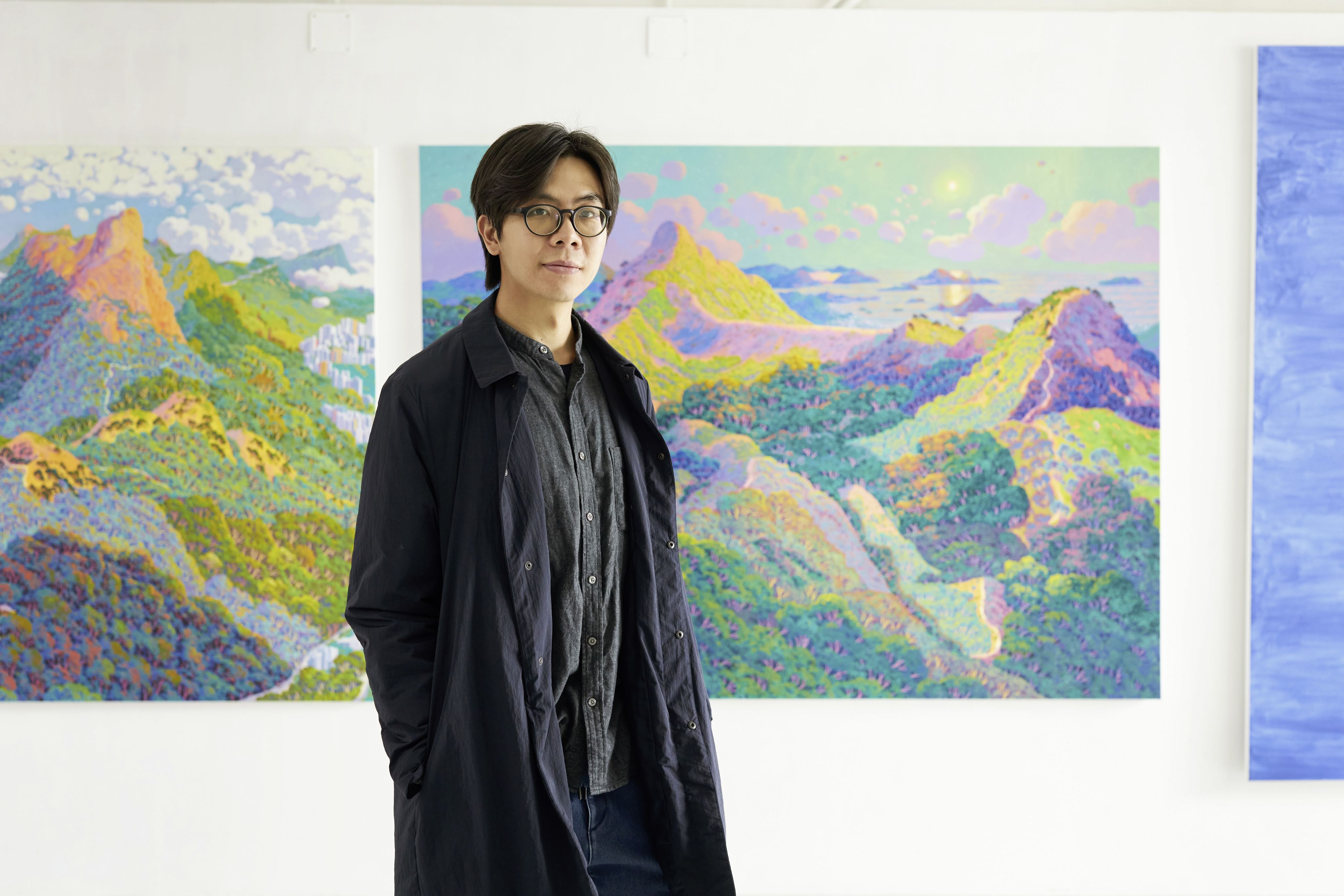

In Stephen Wong Chun Hei’s six-metre-wide triptych of Jat’s Incline (2020), depicting a popular hiking route in Hong Kong, trees with peacock-hued leaves and magenta trunks line a path that extends along the foreground. Rising majestically in the central panel’s background is the Lion Rock summit, brightly rendered in peach, ochre, and turquoise. Here, one of the city’s iconic landmarks is turned dazzlingly strange.
Seldom exhibited abroad, Wong’s landscape paintings have won critical and commercial acclaim in his native Hong Kong for their meticulous compositions and phantasmagorical palettes. An avid hiker, Wong assiduously documents Hong Kong’s many country parks and coastal areas, sketching the sights en-route and subsequently re-envisioning them on canvas.
Wong’s fondness for nature is apparent from his subject matter (and the plants in his studio), but he didn’t develop an affinity for the great outdoors until his early 20s. Born in 1986, the artist grew up in the bustling neighbourhood of Sham Shui Po, keeping himself entertained as a child by drawing characters from manga and cartoons. “I always thought of the page as an eternal space where I could explore and accomplish anything,” he confided, when we met on a grey January afternoon. Warm and mild-mannered, with a keen gaze beneath his black plastic-framed glasses, the artist walked me through his practice and the works in his studio, a neat, boxy space overlooking garages and warehouses in industrial Fo Tan.
During his undergraduate study in fine arts at the Chinese University of Hong Kong, Wong put his painting practice on hold. “I mostly created conceptual works and installations,” he explained. “No one was painting landscapes at the time. It was seen as too traditional.”
Only after Wong graduated in 2008 did he pick up his paintbrush again, starting with recreations of video game screencaps. The Torii (Playstation 3: Initial D) (2008) renders the hermetic perspective of a virtual street-racer in large scale, the roadside vegetation reduced to low-res smudges. “I still had a conceptual art mindset,” Wong said of these works, which have more to do with ideas of nature and artifice than with landscape painting as such. These virtual settings soon felt too “distant” for the artist: “I needed to experience a real place.”

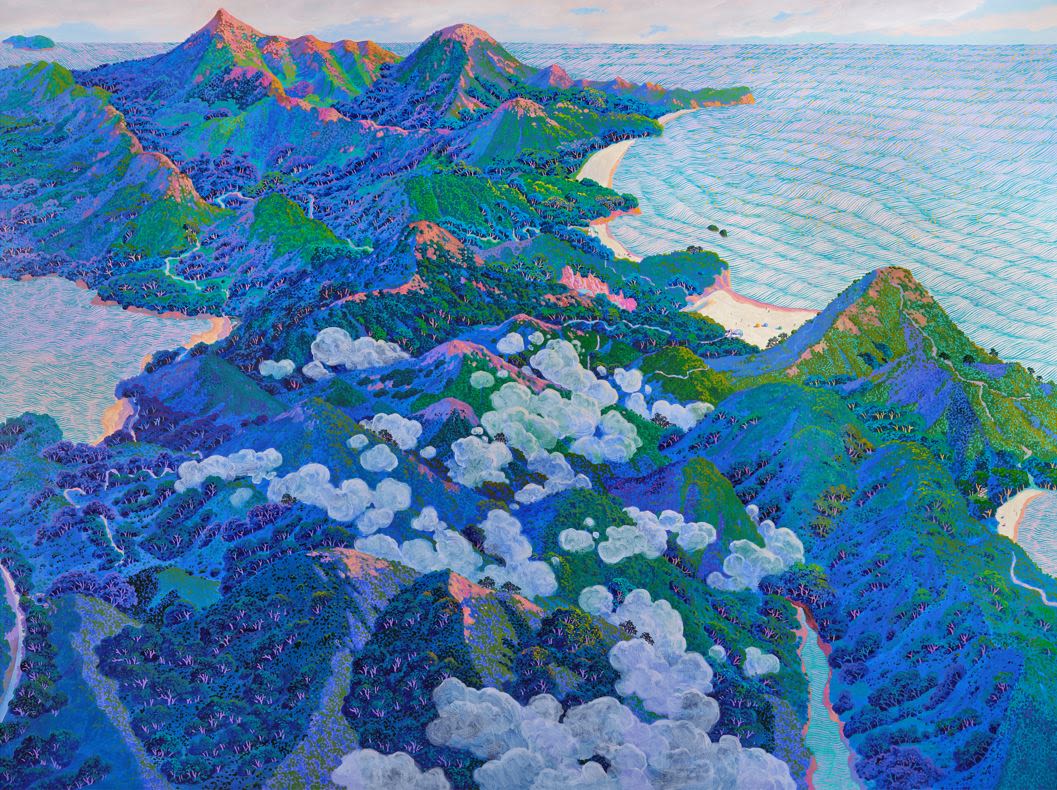
MacLehose Trail Section 2, 2022. Acrylic on canvas 150 x 200cm (59 x 79in). Price on request
MacLehose Trail Section 2, 2022. Acrylic on canvas 150 x 200cm (59 x 79in). Price on request

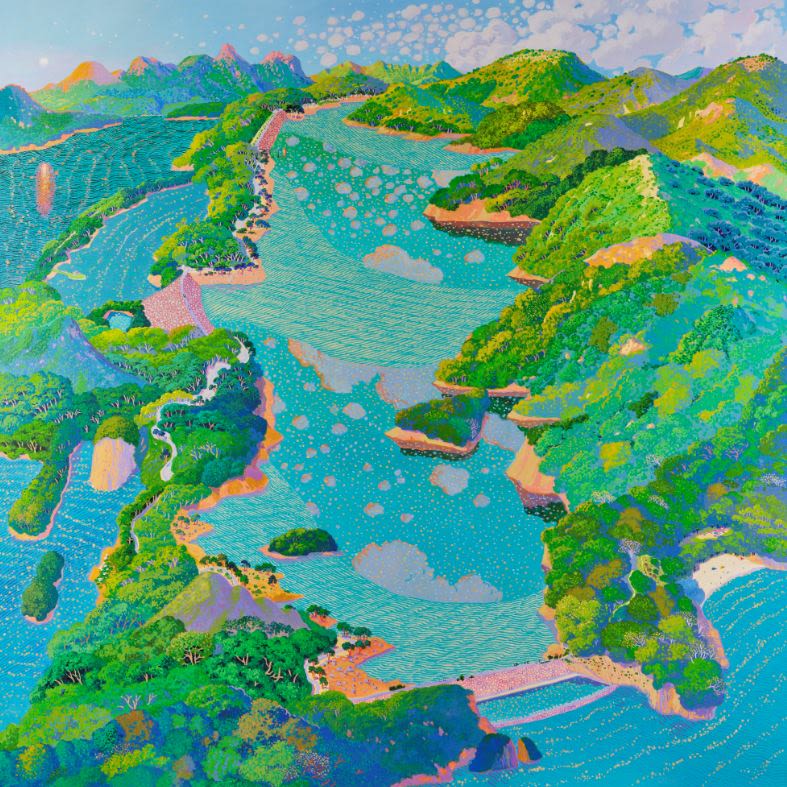
MacLehose Trail Section 1, 2022. Acrylic on canvas 150 x 150cm (59 x 59in). Price on request
MacLehose Trail Section 1, 2022. Acrylic on canvas 150 x 150cm (59 x 59in). Price on request

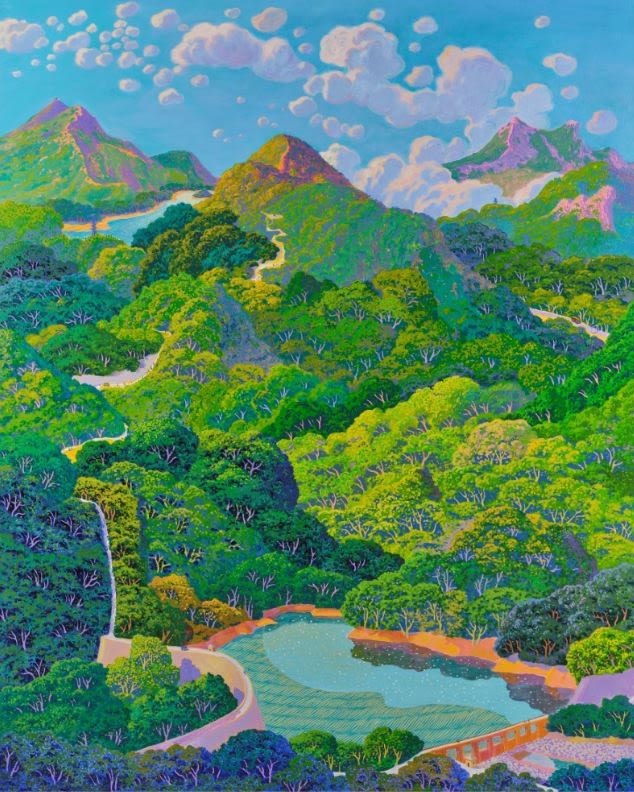
MacLehose Trail Section 6, 2022. Acrylic on canvas 120 x 150cm (47 x 59in). Price on request
MacLehose Trail Section 6, 2022. Acrylic on canvas 120 x 150cm (47 x 59in). Price on request
Wong turned to his hometown’s many hiking trails for inspiration, although initial attempts at painting outdoors were unsatisfying. “I would bring a large easel, acrylics, other heavy materials. Then when it got windy everything would fall down,” he recalled, with a smile.
It was more practical to create pencil sketches of his route at regular intervals, with the finished paintings always more fantasy than faithful reproduction. Many incorporate recognisable elements of Hong Kong’s geography that are recombined and exaggerated, seen from off-kilter perspectives. In The Waterfall Mountain (2016), a small-scale oil painting of a waterfall plunging into the sea, fluffy clouds float in a cornflower-blue sky like stage scenery. The natural motifs, meandering lines, and compositional harmony are reminiscent of shan shui, so I was surprised to learn that Wong wasn’t always an admirer of traditional Chinese painting. “I realised later that my work echoed some of the concepts in shan shui, and then I became interested,” he remarked, noting the style’s poetic focus on conveying an inner reality rather than an outward facsimile.
In 2017, Wong began painting daily sky studies, a framed suite of which hangs in his studio. The year-long series pays tribute to the English painter John Constable, whose cloud studies Wong encountered at London’s Victoria & Albert Museum. He was struck by Constable’s devotion to painting where he lived, whether capturing the skies over Hampstead or the Suffolk countryside. “This resonated with me,” Wong said. “In the past, I tried to paint during trips in Europe, but I didn’t understand the landscapes.”
Wong redoubled his efforts at painting his home turf, portraying renowned sights in sharp, saturated hues. Dragon Back (2018) is a panorama of a mountain ridge in nine panels, each at a different time of day, the sky changing from dusky violet to Hockney-esque pool blue.
“I didn’t like David Hockney’s paintings as a student, but I was later drawn to his Yorkshire landscapes, the way he put them together in sections,” Wong explained. “When I first started sketching on hikes, I struggled to fit everything I wanted on the page. I would piece together many sheets to include more of the landscape. Eventually I realised that a picture need not capture just one moment or angle. I’m driven by a sense of greediness towards the space.”
The Light House at Cape D’Aguilar (2019) expresses this sensibility in a single canvas, depicting the promontory stretching into the distance from an aerial perspective, with a neighbouring islet and headland on either side directing the eye towards the focal tower. The landforms appear closer here than in real life, subtly compressed by the artist.
Largely confined to his flat during the pandemic, Wong found a new way to continue painting landscapes: Google Earth. After wandering around in the program, he relies on memory and flights of fancy to complete his works. In A Grand Tour in Google Earth, Machu Picchu (2021), the Andes are shown at a slight forward tilt, emphasising their vertiginous grandeur. A parallel series, Road Trip in Google Earth, features his collection of toy cars, which are painted into various landscapes and playfully installed on top of the canvases. These works enabled the artist, who can’t drive, to imagine speeding past the Multnomah Falls at night in a yellow sports car, or through the Dolomites in a Volkswagen Beetle.
During a dip in Covid-19 cases, Wong embarked on a project to paint the MacLehose Trail, a 100km trek named after Hong Kong’s longest-serving colonial governor. The series, exhibited at Bonhams Hong Kong in March, features one canvas for each of the Trail’s ten segments. “I had been considering this challenge for a long time, but it was only in the last year that I really felt a sense of urgency,” he divulged. “Hong Kong changes so quickly. I don’t know what the landscape will look like in the future, or if the MacLehose Trail will still go by this name.”
One composition is bisected by a ridge, with patches of gold foliage and blue buildings in the middle distance. “As I was hiking this section, I saw Shatin on the left and Kowloon on the right. I immediately knew I wanted a composition with a central ridge and the city on either side. Hiking for me is a bit like drawing, because in my mind’s eye I’m continuously reconstructing the scene.” Segment eight is set at twilight, with a confetti-like smattering of pink and white stars over an elevated trail with shoreline views. Minuscule hikers and paragliders appear to help viewers position themselves in the image. Wong had hiked and painted parts of the Trail before, but this project for Bonhams marked his first complete trek. “All the fragmentary impressions and memories are consolidated here to visualise the entire terrain.”
And now? Amid another Covid-19 wave, Wong plans to revisit Google Earth, enhancing his adventures with VR goggles and crafting landscapes he can ‘enter’. For him, every painting is a fantastical voyage. “The focus is always how far I can immerse myself in the scenery.”
Ophelia Lai is a writer and editor in Hong Kong.

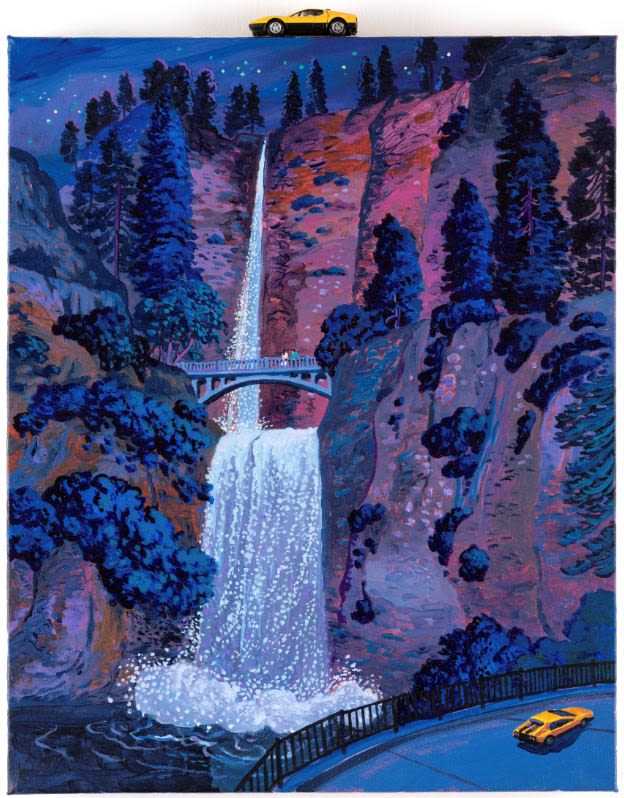
A Road Trip in Google Earth: Multnomah Falls, USA, 2021. Acrylic on canvas 40 x 50cm (16 x 20in)
A Road Trip in Google Earth: Multnomah Falls, USA, 2021. Acrylic on canvas 40 x 50cm (16 x 20in)

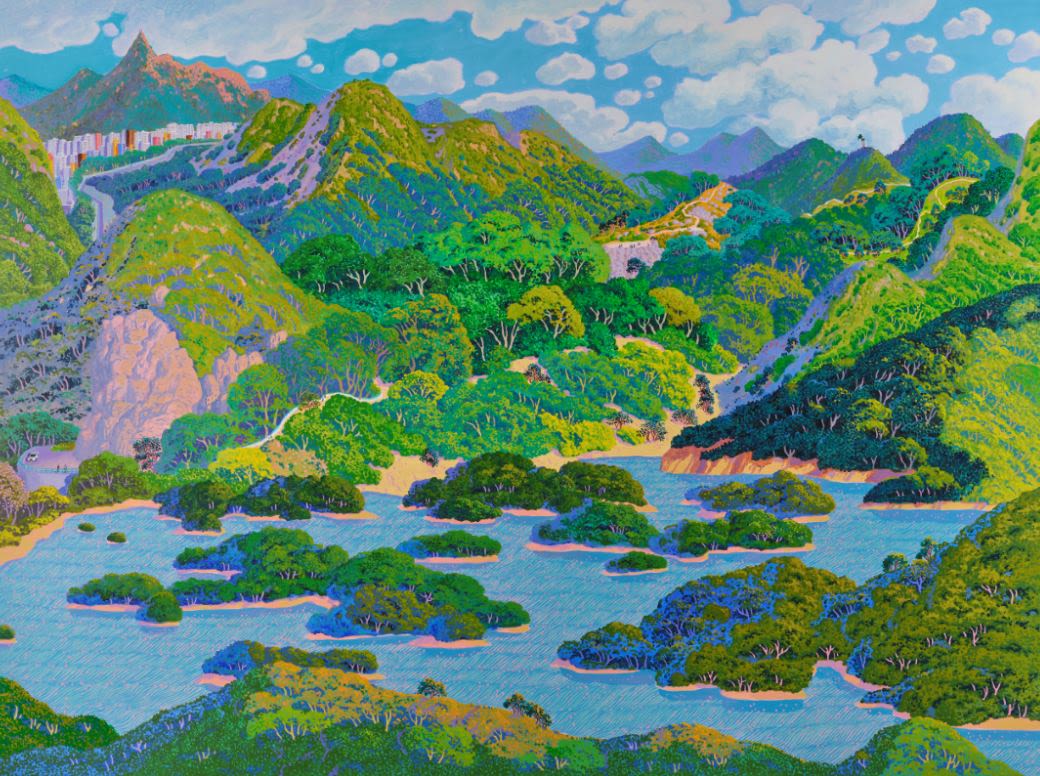
MacLehose Trail Section 10, 2022. Acrylic on canvas 150 x 200cm (59 x 79in). Price on request
MacLehose Trail Section 10, 2022. Acrylic on canvas 150 x 200cm (59 x 79in). Price on request


 Built with Shorthand