
Barbara Hepworth –
A Corner of Cornwall on Oxford Street
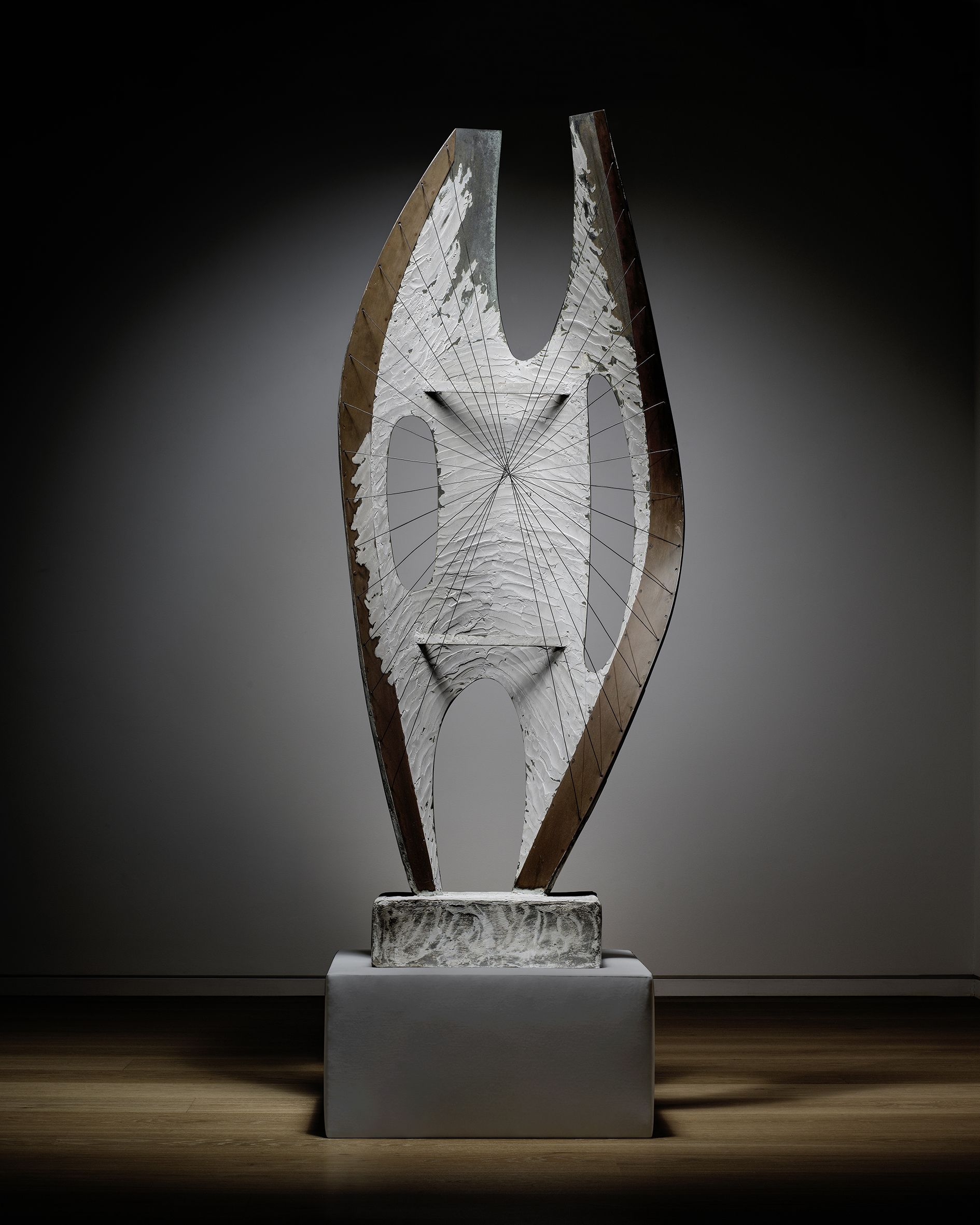

A commission by the John Lewis Partnership in 1963 saw Barbara Hepworth develop one of her emblematic stringed works Winged Figure I for the façade of the Oxford Street flagship store. As the original version of this work comes to auction, we look back at the conception of this work, from the studio tucked away in the back streets of St Ives, to its landmark home in the heart of London.
Walking to work along Oxford Street, one autumn morning in 1961, Sir Bernard Miller suddenly had a revelation. The Chairman of John Lewis, London’s famous department store, looked up at the shop’s pale Portland stone façade on its southwest corner and realised that was the perfect spot for an artwork.
He got to his office and promptly wrote a letter to Barbara Hepworth, who had agreed to work on a sculpture for the building. “I thought the chief impact of whatever we put on this site would be upon people walking from Oxford Circus,” he wrote. “It would be desirable, particularly having regard to the intervening lamp-post, to site the sculpture as high up on the building as its scale and nature would allow."
And so that was precisely where Hepworth’s Winged Figure – a monumental sculpture of a pair of wings opening like a vast clam-shell – would come to perch two years later. This autumn, some six decades on, Hepworth’s original work, Winged Figure I, on which the John Lewis work was based, comes to auction as the star lot of the Modern British & Irish Art auction at Bonhams, just a few hundred metres away on New Bond Street.

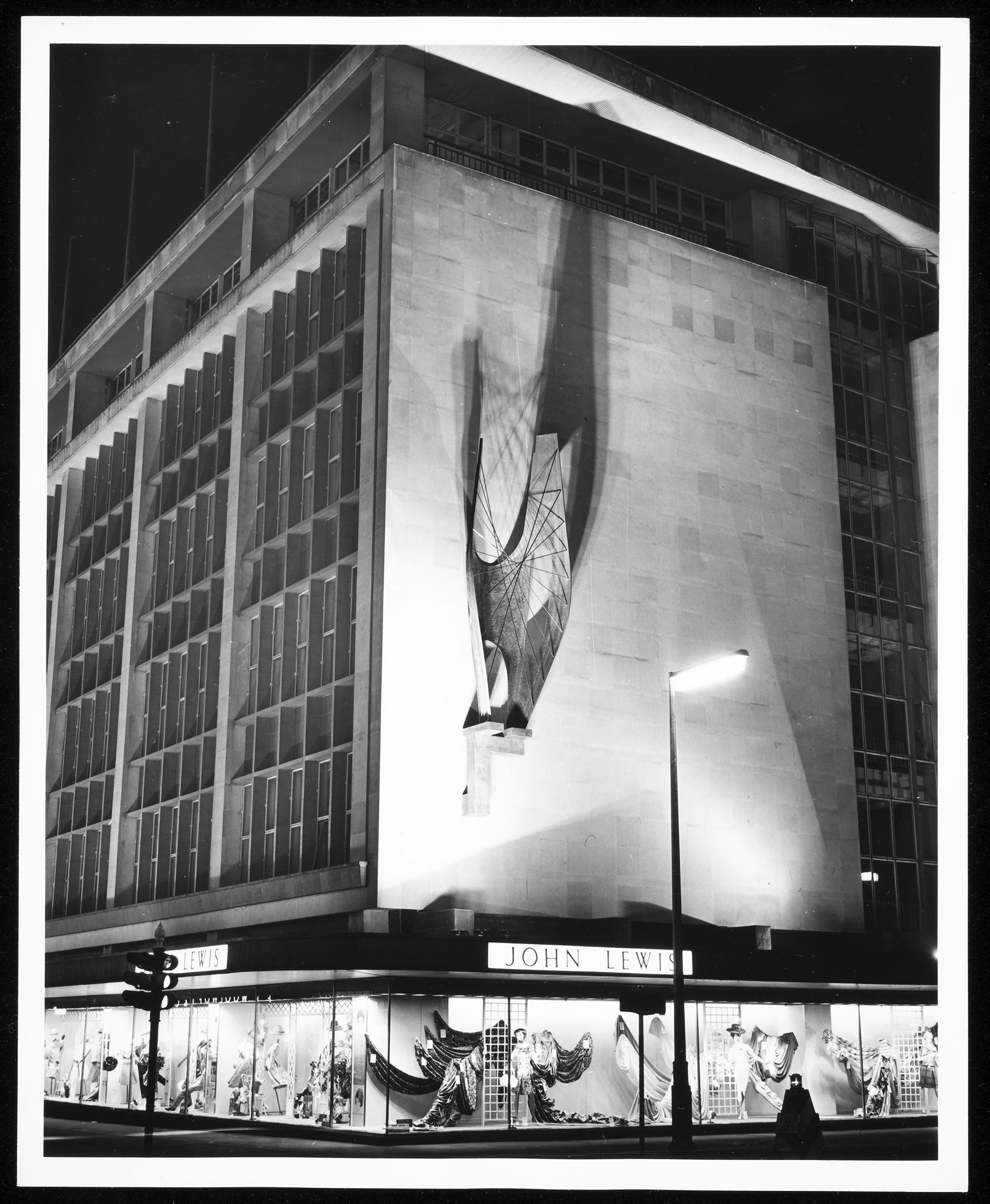
Barbara Hepworth's Winged Figure in situ at night, April 1963, © Bowness
Barbara Hepworth's Winged Figure in situ at night, April 1963, © Bowness

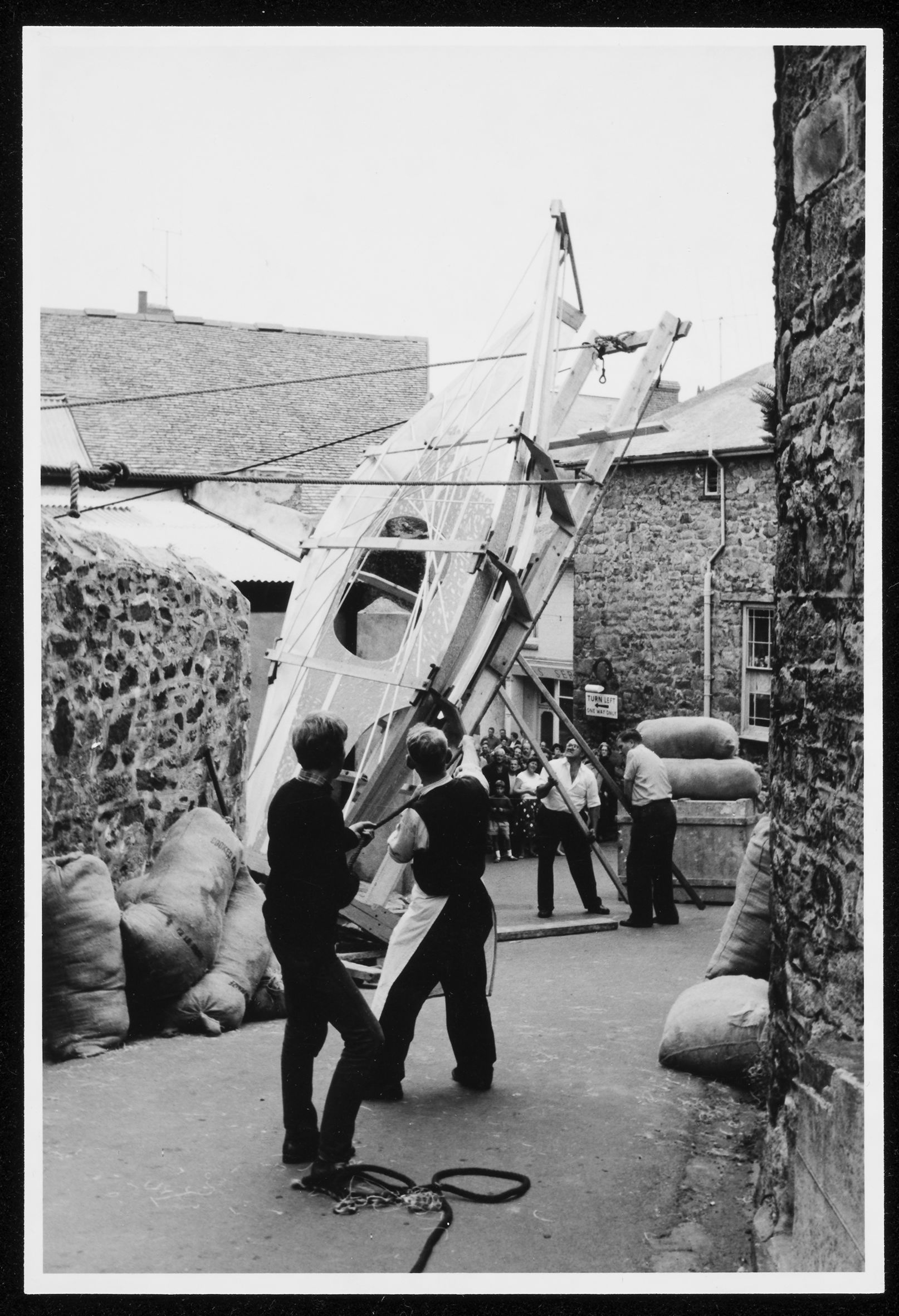
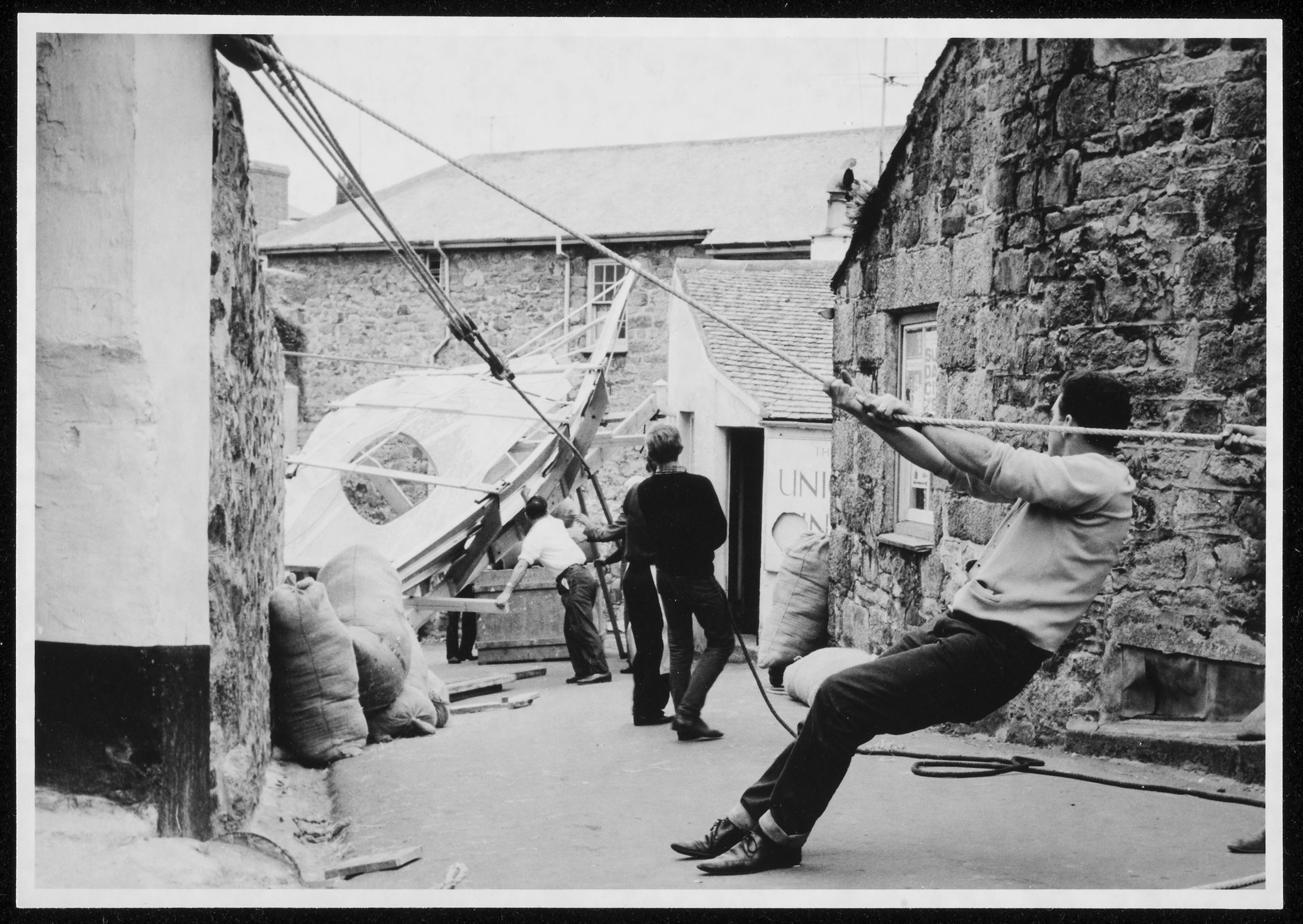
Barbara Hepworth's model of Winged Figure being loaded from the Palais de Danse workshop and being transported through the streets of St Ives, August 1962. Images Studio St Ives © Bowness
Barbara Hepworth's model of Winged Figure being loaded from the Palais de Danse workshop and being transported through the streets of St Ives, August 1962. Images Studio St Ives © Bowness
When Hepworth, who admired the socialist ethos of the John Lewis Partnership, received the Oxford Street commission, she was in her late 50s and already world famous. By this point, the Yorkshire-born modernist sculptor had been living in the Cornish coastal town of St Ives for some two decades and her work had become profoundly influenced by the natural world of the West Country.
Conceived in 1957, Winged Figure I was sculpted out of bronze, with copper-toned wings, incorporating hand-applied Isopon – a polyester resin – the whole form made taught by wires. The effect is of a mythic human-bird hybrid – as seen through the prism of 20th-century abstraction – reaching for the skies. And, in this original 1.6 metre form, with its whitewashed interior space, the composition also speaks of the creeks, coves, sea foam and surf of her beloved Cornish shoreline.
A similar cavernous coastal interior can be found in her bronze Sea Form (Porthmeor) from the following year; while the aeronautical theme is reflected in her brass sculpture Stringed Figure (Curlew) from 1956. Hepworth acknowledged the linkage between details in her art and aspects of the atmospheric landscape in which she lived. “The strings were the tension I felt between myself and the sea, the wind or the hills,” she remarked. Similarly, she was fascinated by aviation. “Man’s discovery of flight has radically altered the shape of our sculpture, just as it has altered our thinking.

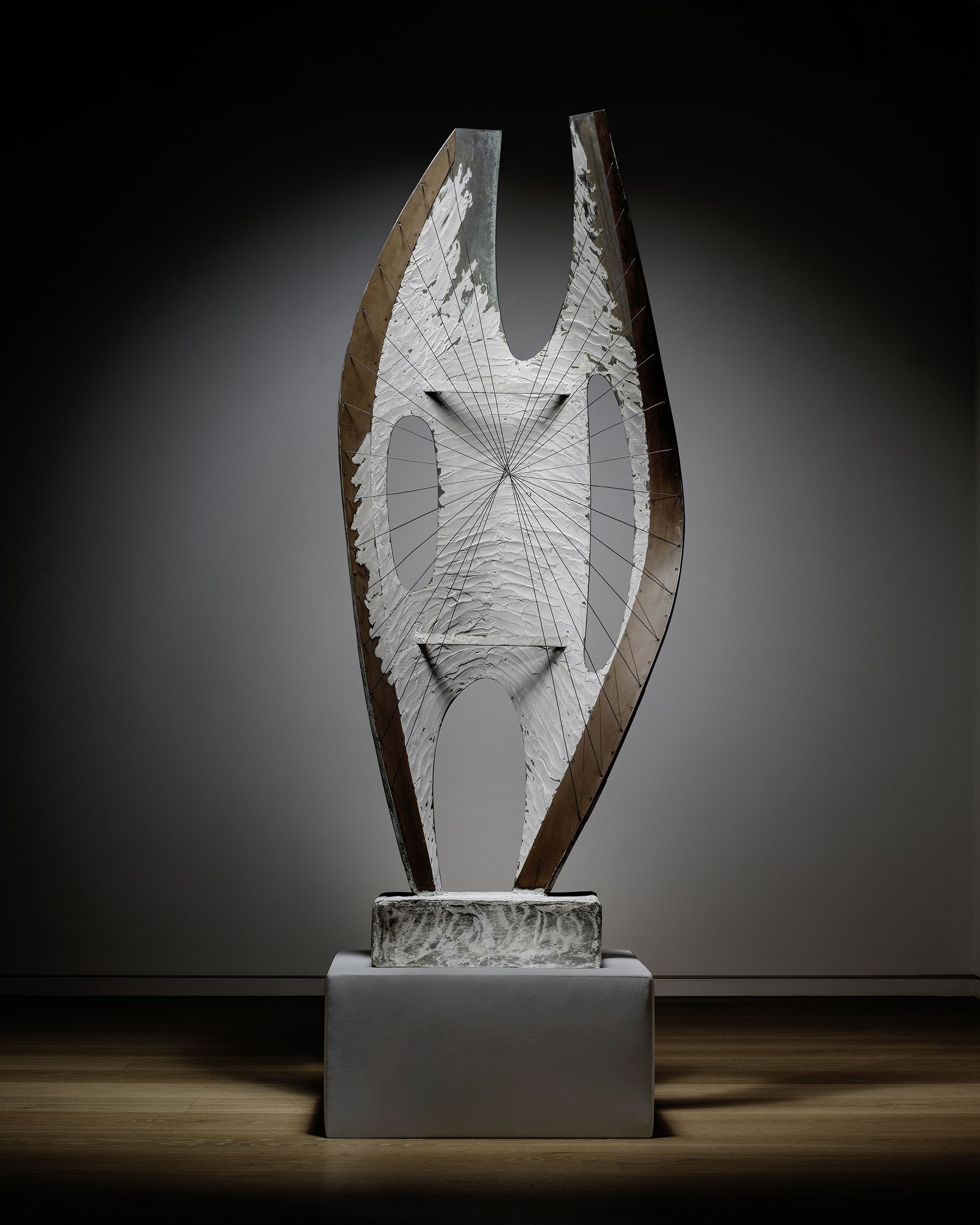
“I wanted to capture the greatest variety of light and shadow, from morning sun, afternoon reflected light and night floodlighting, so that visually the sculpture never remained static...”

For the department store, Hepworth adapted and enlarged the design of Winged Figure I into a soaring six-metre-high version, reimagined in aluminium. “I wanted to capture the greatest variety of light and shadow, from morning sun, afternoon reflected light and night floodlighting, so that visually the sculpture never remained static,” explained Hepworth.
A nocturnal photograph taken in 1963, shows the John Lewis work swirling in a film noir orchestration of spotlights and shadows, as if the sculpture is ascending from the metropolis to the heavens. Below, the sweep of its wings are mirrored in the swells of fabric on display in the shop’s window. It’s a snapshot of nature interacting with consumerism.
The original pre-war John Lewis store had been destroyed during an air raid on the 18th September 1940. In the post-war years it was rebuilt, with Hepworth’s sculpture, in part, a celebration of that renewal. The Winged Figure's design, noted Sir Bernard Miller, “does seem to me to have something of the idea of resurgence or aspiration in its vertical flow, and that it is fact an idea that has long been associated with the Partnership, which has used the Phoenix as a name for some of its Clubs and Societies upon the notion of the new building rising out of the ashes of the old.” The site had once been home to a pub called The Phoenix.

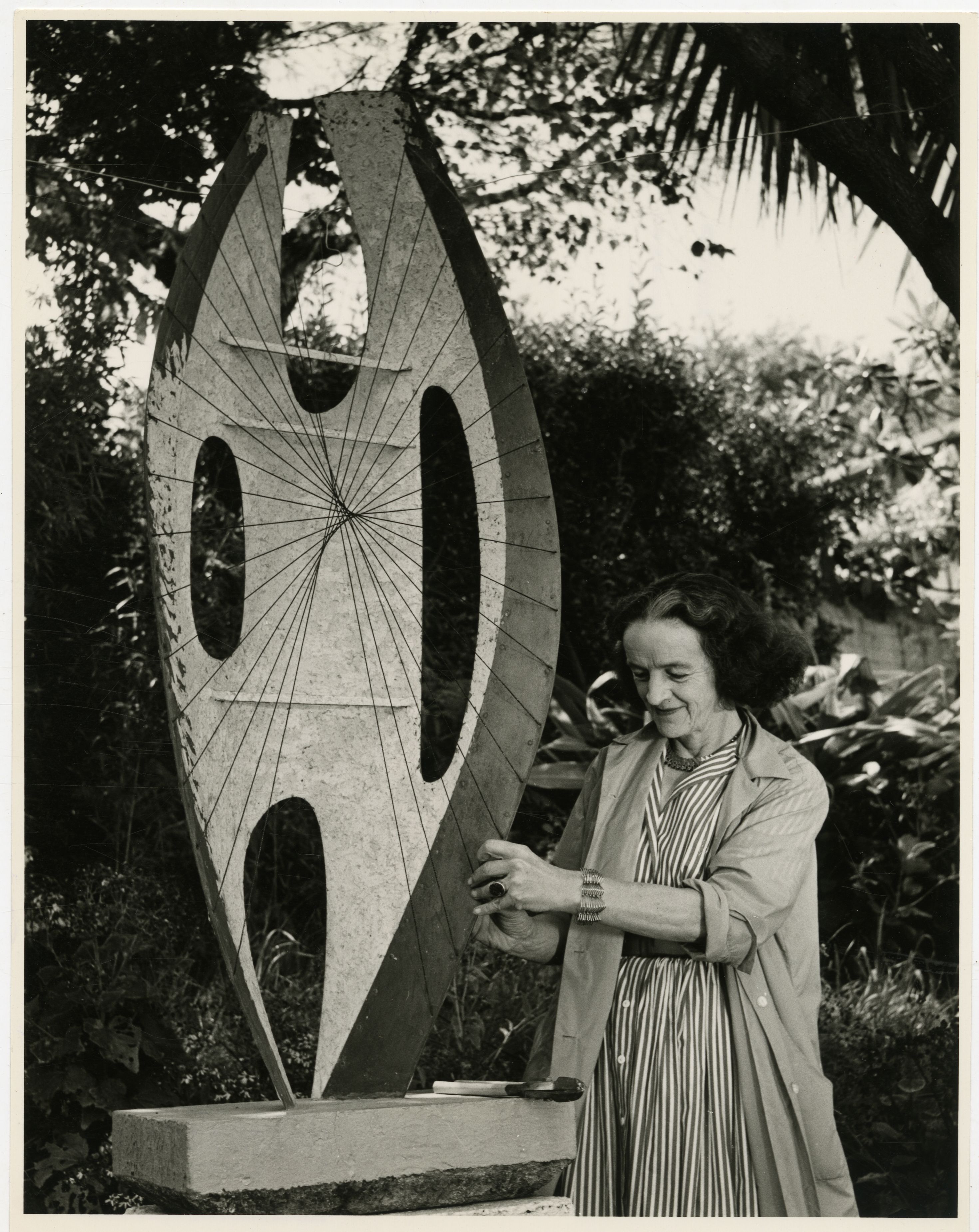
The British Travel and Holidays Association - Photographic Unit, Barbara Hepworth with Winged Figure I, 1962, Milano. Civico Archivio Fotografico, © Bowness.
The British Travel and Holidays Association - Photographic Unit, Barbara Hepworth with Winged Figure I, 1962, Milano. Civico Archivio Fotografico, © Bowness.
“The strings were the tension I felt between myself and the sea, the wind or the hills.”

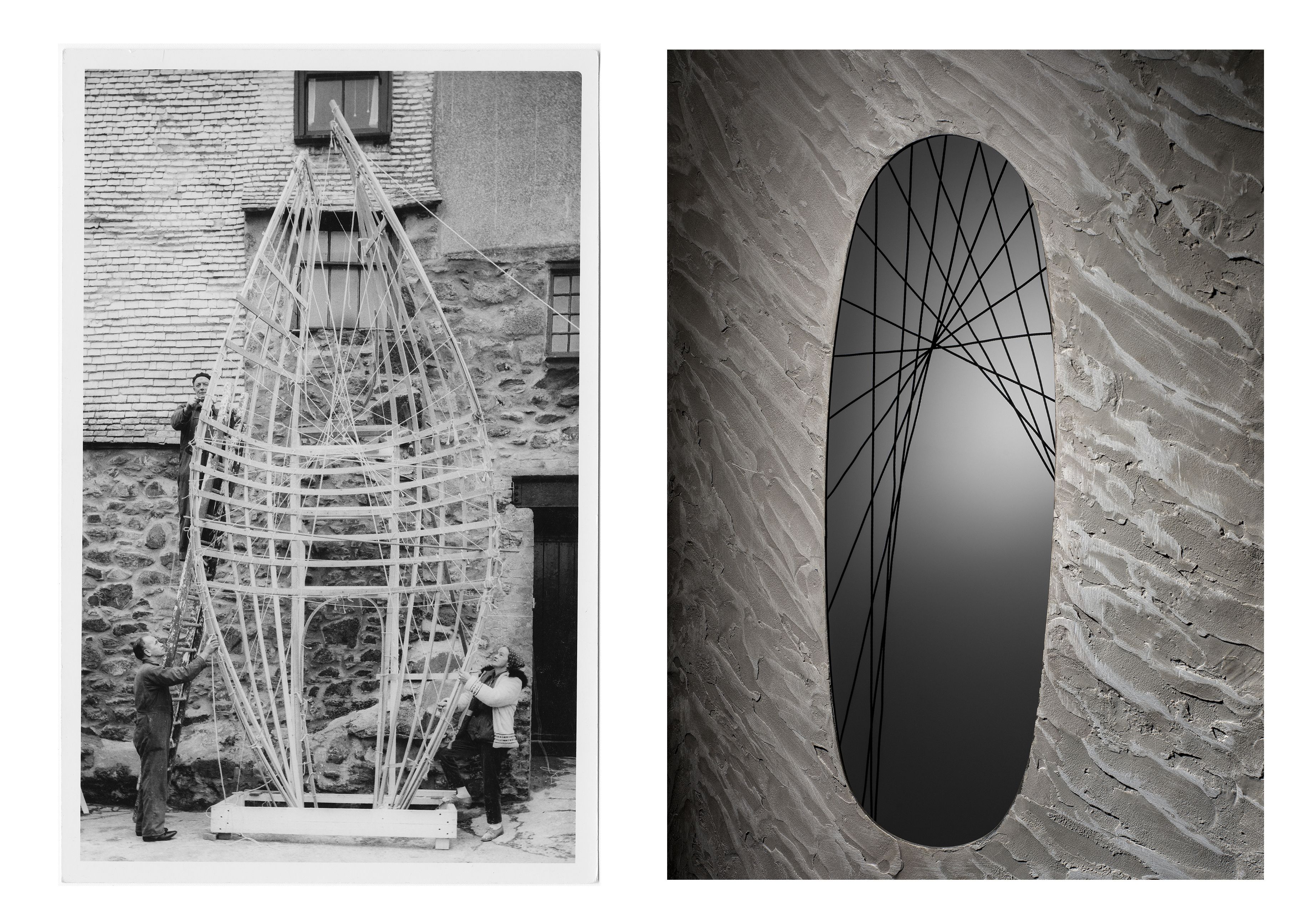
L-R: Barbara Hepworth and two assistants (Dicon Nance above, Norman Stocker below) at work on the armature, stage one, 1962, © Bowness; Dame Barbara Hepworth, Winged Figure I (detail). Conceived in 1957 and fabricated in 1963. Estimate £800,000-1,200,000.
L-R: Barbara Hepworth and two assistants (Dicon Nance above, Norman Stocker below) at work on the armature, stage one, 1962, © Bowness; Dame Barbara Hepworth, Winged Figure I (detail). Conceived in 1957 and fabricated in 1963. Estimate £800,000-1,200,000.
One of the marvellous aspects of such a public work, was that it immediately sparked conversations. “Works of art, particularly of modern art, are always the subject of differing opinions,” remarked an op-ed in The Gazette, the John Lewis Partnership magazine, when the sculpture was unveiled in the spring of 1963. “This is likely to be particularly true of a sculpture in pure form erected upon a popular site such as this. Many will like it and many will not. Nobody can ignore it.” Shoppers have pondered it ever since.
The work’s primary themes are light, flight, freedom and progress, which Hepworth understood were universal yearnings, as important in traffic-clogged central London as they are on the craggy headlands of the Celtic Sea. “I think one of our universal dreams is to move in air and water without the resistance of our human legs,” she observed. “If the Winged Figure in Oxford Street gives people a sense of being airborne in rain and sunlight and nightlight I will be very happy.”
Modern British and Irish Art
19 November 2025 | London, New Bond Street
Stay updated with our auctions Register with Bonhams to follow your favourite collecting categories and get email alerts when new auctions open for bidding. Subscribe here.
 Built with Shorthand