
Artist 101
Omar El-Nagdi
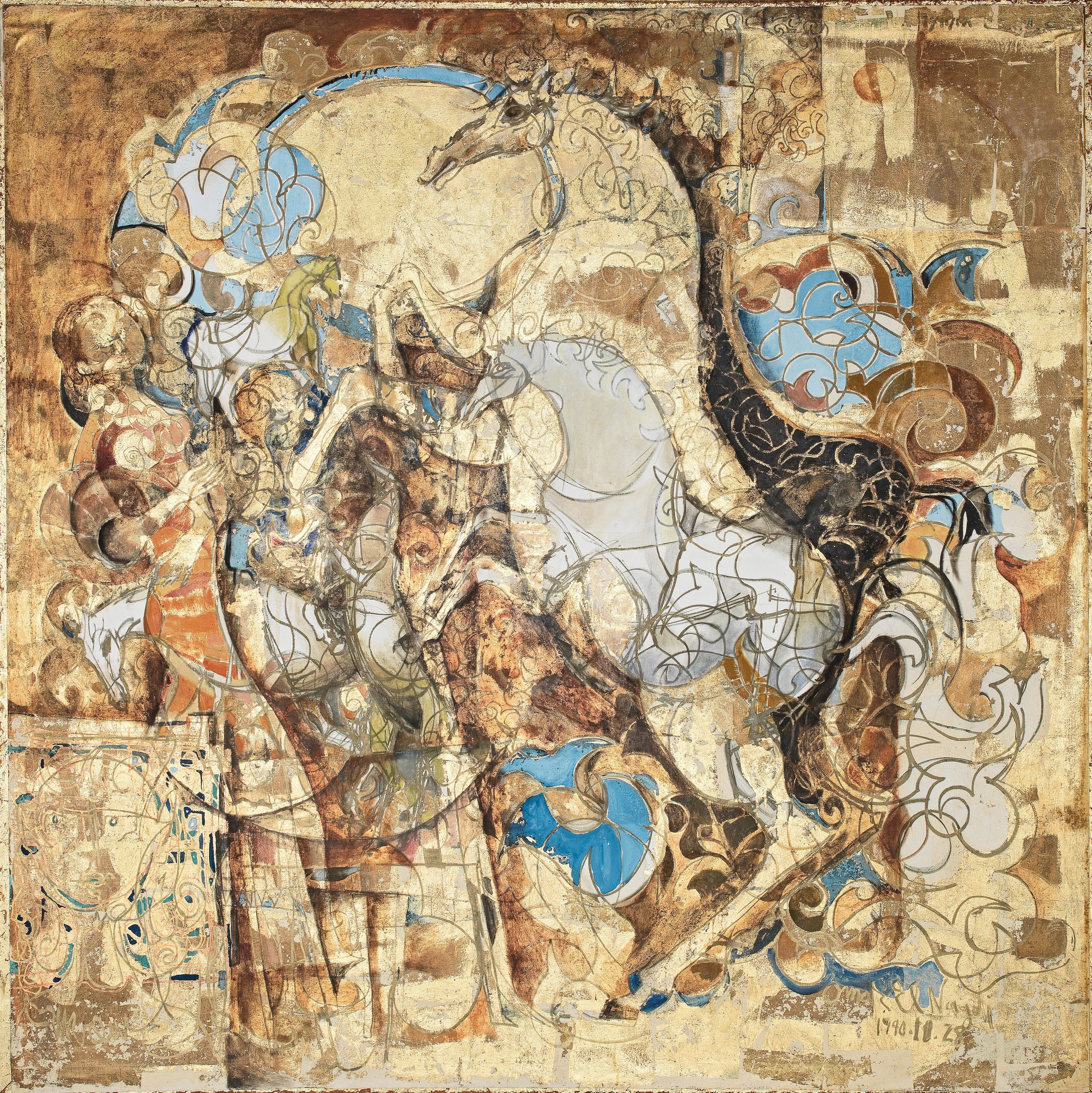

Omar El-Nagdi is internationally renowned as one of the greatest Egyptian artists of the modern era. A celebrated abstract expressionist and multifaceted contemporary master of calligraphy and painting, he became known as the ‘Egyptian Picasso’ before the age of 30.
While always sought-after, El-Nagdi’s art has surged in popularity in recent years, with works regularly selling for three to eight times their auction estimates. Here, we trace his long and illustrious career, illustrated by lots from our Modern and Contemporary Middle Eastern Art auction on 15 November in London, New Bond Street.
1.
Early life
Born in a working-class district of Cairo in 1931, El-Nagdi grew up spending two months every summer in the Egyptian countryside.
“There was a profound difference between living in tranquil countryside and living in that noisy working-class district,” he said in an interview with Nile television in 2012. “Each of those neighbourhoods had a different impact on my character.... My works are characterised by being lovely. They’re simple and beautiful. However, sometimes, I feel I have to show some toughness in my works. Only then, that part of me which was influenced by the working-class district functions properly.”
He began his art education in Cairo, studying at the Faculty of Fine Arts under the great Egyptian painter Ahmed Sabri, a pioneer of modern portraiture in the Middle East, and then at the Faculty of Applied Arts. He came first in his class at both faculties and in 1959 was awarded a scholarship to study ceramics in Moscow.

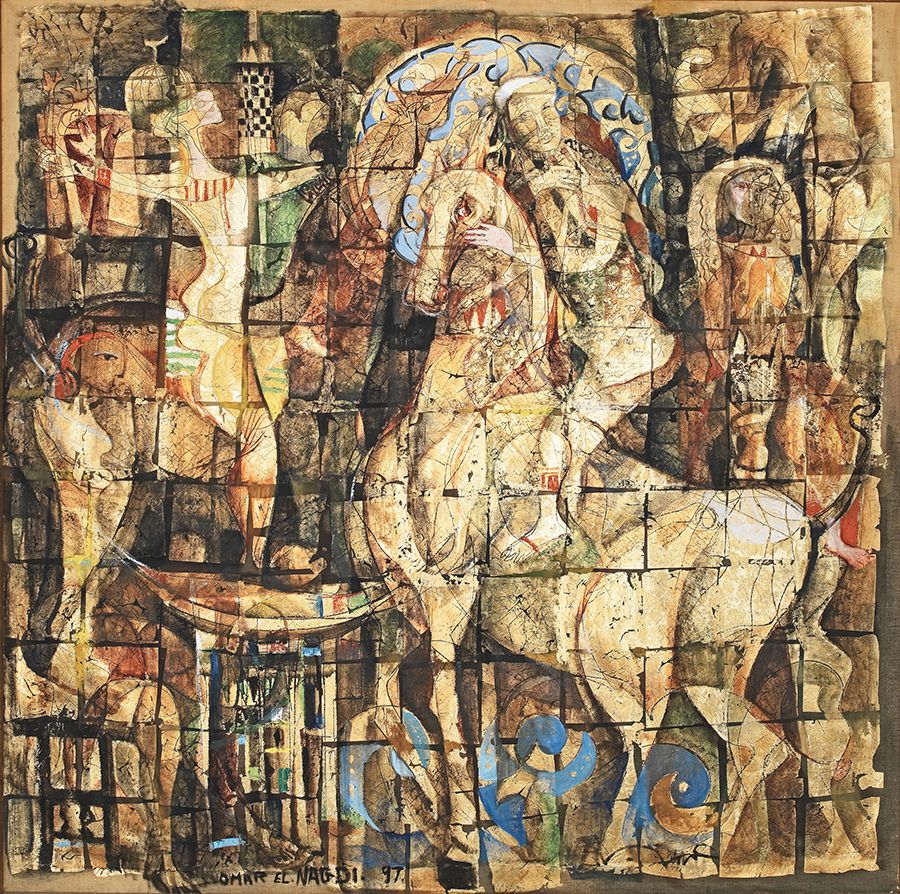
Omar El-Nagdi (Egypt, 1931-2019) Le Grand Cavalier. Estimate: £60,000 - £100,000
Omar El-Nagdi (Egypt, 1931-2019) Le Grand Cavalier. Estimate: £60,000 - £100,000
2.
‘The Egyptian Picasso’: European influences
The Cold War was escalating and, after a year, El-Nagdi left Russia to continue his training in Italy. He studied at both the Academy of Fine Arts in Venice and the Academy of Fine Arts in Ravenna, where he learned the art of the mosaic, before graduating from the English Ruskin Artistic Appreciation Institute in 1964. “To me, life is all about learning various types of arts, where there is diversity in materials and techniques,” he would say later. “I am constantly hungry to learn more things.”
In Venice, he had a serendipitous meeting with the Greek-Italian metaphysical painter Giorgio de Chirico, who sponsored El-Nagdi’s first international exhibition and became an influential mentor. He exhibited in shows alongside Pablo Picasso and Salvador Dalí in the 1960s, and found himself at the heart of the European avant-garde movement as his artwork—which often depicted the liveliness of Egyptian life and culture—lit a flame across the continent.
“El-Nagdi’s stylistic paintings of Egyptian daily life and festivities have been very sought-after amongst collectors across the region and beyond. The dynamism of his works, rendered through the complex composition of figures and decorative patterns, echo the social traditions and lavish festivities,” says Noor Soussi, Head of Sale for Modern and Contemporary Middle Eastern Art in London.
Before he was 30, he had earned the nickname ‘The Egyptian Picasso’ in the press but the artist himself later said that, in fact, Paul Cézanne, Paul Gauguin and Vincent van Gogh were the Western artists who had most influenced his work.
When he returned to Cairo, El-Nagdi became an active member of Egypt’s art scene, joining the Liberal Artists’ movement led by the Egyptian intellectual Taha Hussein and founding the Egyptian Mosaics Group in 1964.

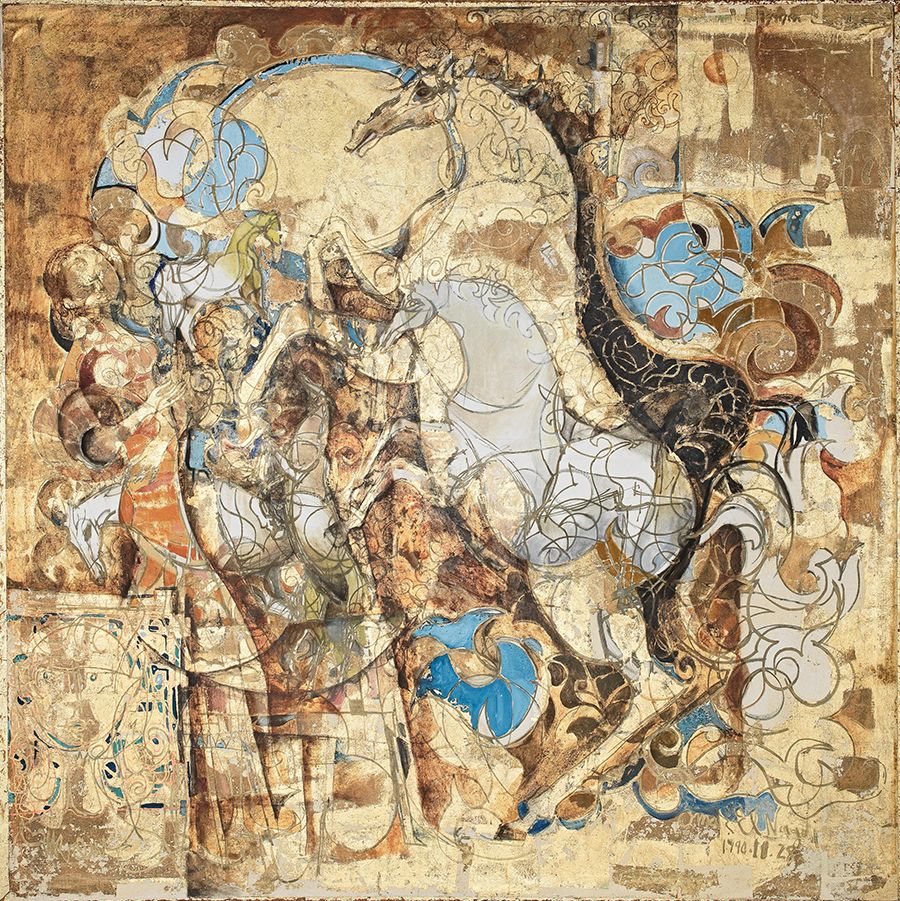
Omar El-Nagdi (Egypt, 1931-2019) Golden Horses. Estimate: £60,000 - £100,000
Omar El-Nagdi (Egypt, 1931-2019) Golden Horses. Estimate: £60,000 - £100,000
Stay updated with our Modern and Contemporary Middle Eastern Art. Sign up to receive your weekly newsletter of global auctions, stories and more from Bonhams and our sister companies. Subscribe now
3.
Hurufiyya and the art of lettering
El-Nagdi’s artistic practice spans drawing, painting, sculpture, mosaic, ceramics, screenprinting, music and documentary filmmaking, but he is arguably best-known for his calligraphy.
In the 1960s, El-Nagdi began producing meditative, Sufi-inspired works. Many of them dramatic, black-and-white calligraphy-based paintings in which letters of the Arabic alphabet—particularly the first letter Alef—are heavily and continuously repeated. This practice, known as Hurufiyya, liberates Arabic letters from their primary linguistic function and urges the viewer to ‘see’ what is painted in an entirely new light, explains Noor.
“It’s mystic; the use of black and white,” El-Nagdi said in an interview with the journalist Anna Wallace-Thompson in 2008. “Black is night. Black absorbs things and takes them into itself and hides them. White is lightness and the sun. Everything is clear and open: One takes in, one gives out.”
“El-Nagdi’s Hurrufieh compositions challenge, elevate and redefine the way viewers engage with calligraphy,” says our Head of Sale. “In Arabic calligraphy, the practice of repetitive inscribing individual letters bears a profound connection to the Sufi concept of Zikr, an essential component of Sufi spiritual practice. It entails the repetitive invocation of divine names or religious phrases to cultivate inner mindfulness.”

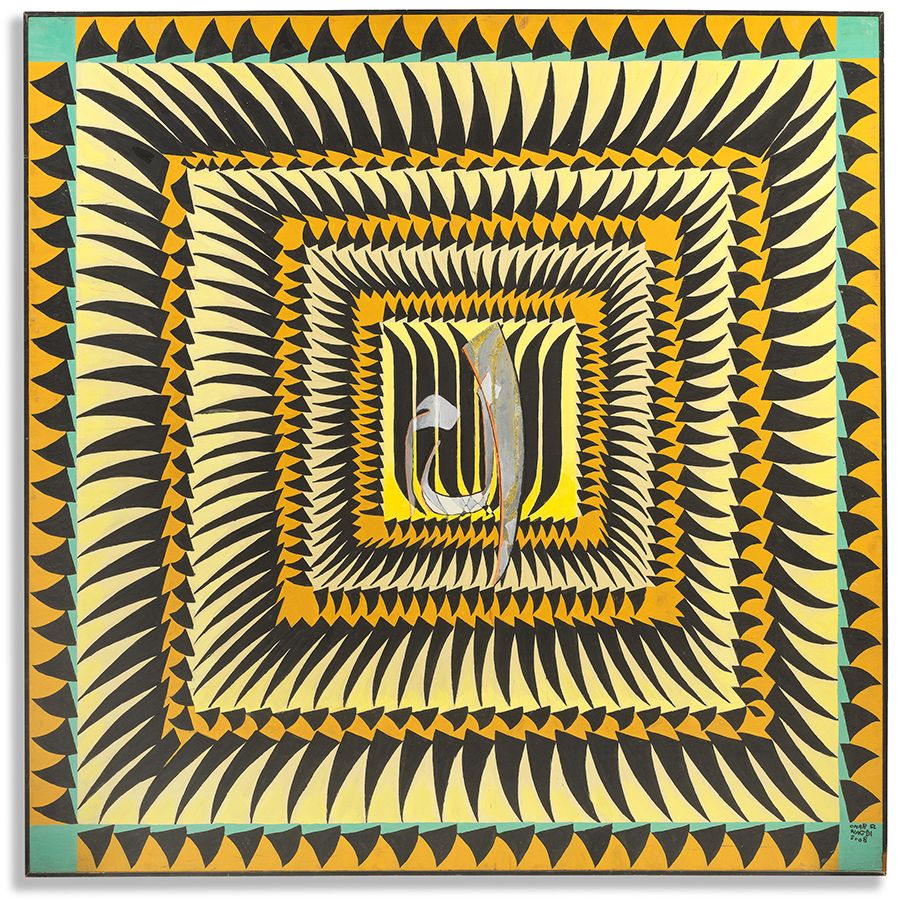
Omar El-Nagdi (Egypt, 1931-2019) Alef Lam Mim. Estimate: £40,000 - £60,000
Omar El-Nagdi (Egypt, 1931-2019) Alef Lam Mim. Estimate: £40,000 - £60,000
4.
Themes and inspirations
El-Nagdi explored many different themes in his work. In depicting the colourful, ordinary lives of Egyptians, calling attention to the mystic spiritualism of Sufism and the medieval political theology of traditional Islamic calligraphy, he asserts his Arab identity and reflects his Egyptian heritage and national pride.
His monumental 1992 masterpiece Sarajevo, which sold for $1.1 million in 2016, is often considered his most important and ambitious work. In it, he portrays the atrocities committed by Bosnian Serbs during the siege of Sarajevo, when thousands of Muslims were killed. Parallels have rightly been drawn between this seminal work, depicting the agonies suffered by El-Nagdi’s Muslim brothers, and Picasso’s famous Guernica and Francisco Goya’s renowned series, The Disasters of War.
More recently in 2011, El-Nagdi painted the 25 January Revolution in Egypt, portraying Egypt as “a giant that finally woke and stood up”. “I believe this revolution will mark a new age of progress and development,” he said at the time.
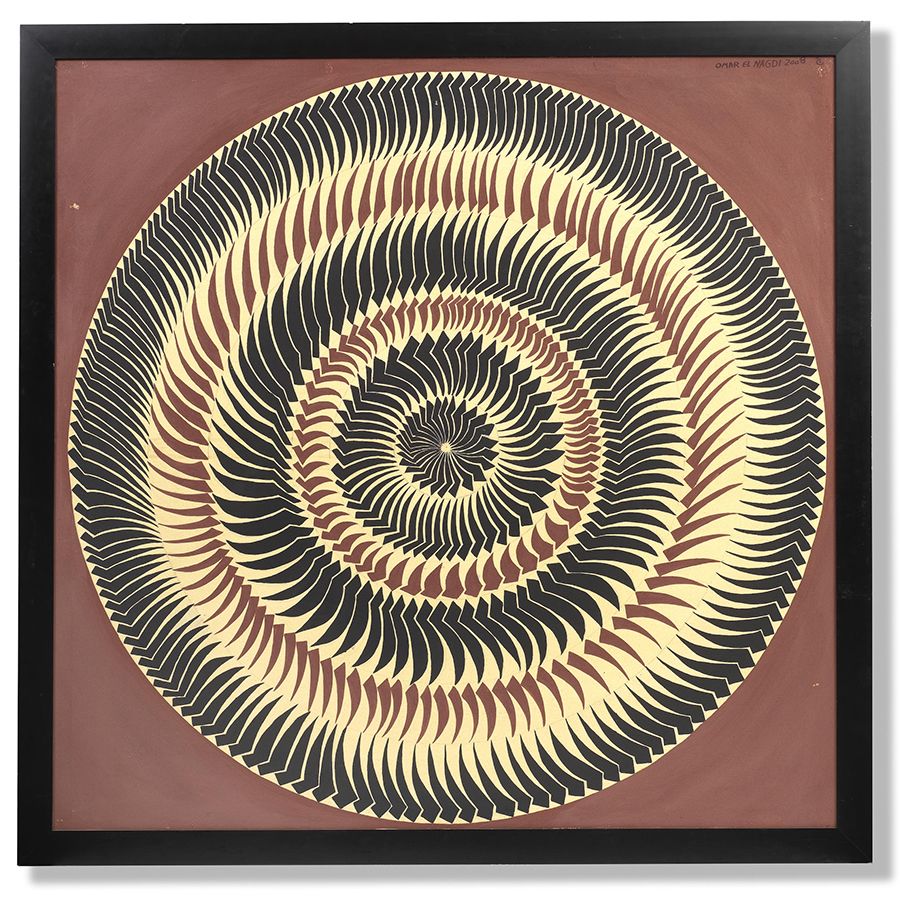
Omar El-Nagdi (Egypt, 1931-2019) Alif. Estimate: £30,000 - £50,000
Omar El-Nagdi (Egypt, 1931-2019) Alif. Estimate: £30,000 - £50,000
5.
Legacy
El-Nagdi died in 2019, at the age of 88. His works touched upon political and social matters that resonated not only with people in the Middle East, but all around the world. Speaking to Wallace-Thompson in 2008, he said: “I had no trouble establishing myself overseas... because my language is international. When I speak, I speak through the heart, and the heart is something that all of humanity shares. Because of this, I’m able to talk with others, no matter what their background. If you have an open heart, you can speak with anyone.”
As well as collecting first prizes in the Alexandria Biennale in 1966, 1968 and 1974, El-Nagdi participated in many international exhibitions throughout his lifetime. Highlights include the International Exhibition of Paris, the Kuwait Biennale and a solo exhibition at the Institut du Monde Arabe in Paris (two artworks from the show are offered in our upcoming auction), all in 1995.

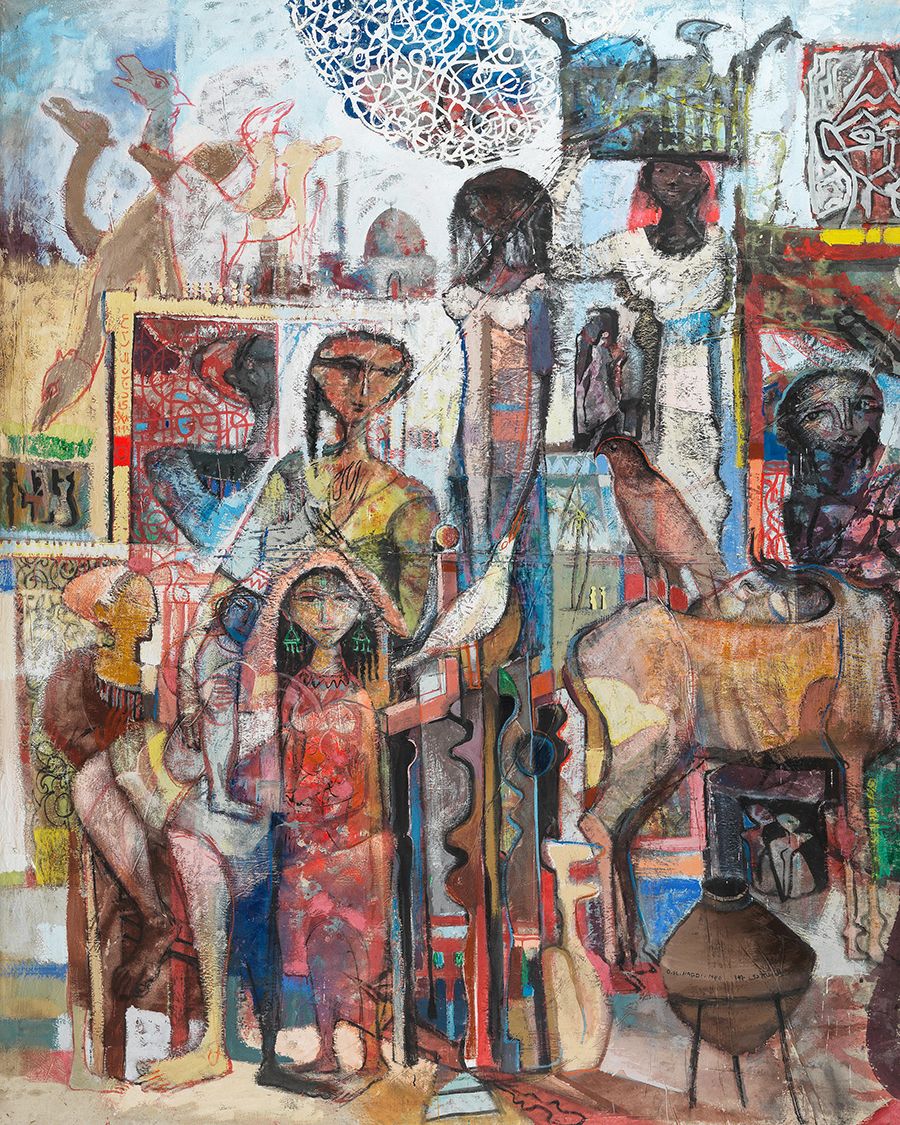
Omar El-Nagdi (Egypt, 1931-2019) Le Grand Marché. Sold for £52,562.50 inc. premium in June 2020, London, New Bond Street.
Omar El-Nagdi (Egypt, 1931-2019) Le Grand Marché. Sold for £52,562.50 inc. premium in June 2020, London, New Bond Street.
Collecting El-Nagdi’s Art
His work has been collected by major museums all over the world, including The Museum of Modern Art in Venice, the Museum of Modern Art in South Korea, the Congress Library in and the Museum of the White House in the USA, the National Library in Paris, The Museum of Pistoia in Italy and The Rasking Foundation in England, as well as the Museum of Modern Art in Cairo and the Museum of Fine Art in Alexandria.
“Every notable Middle Eastern art collector has at least one or two works by El-Nagdi,” says Noor. The market is growing, both in value and region—recent auctions have seen bids come from new bidders in the Gulf region. “One painting by El-Nagdi that Bonhams sold for £20,000 in 2018 just achieved over £330,000 at another auction house in April 2023.”
“El-Nagdi not only produced a lot of work in his extensive artistic career, but he was also a lovely and humble man who was loved and appreciated by many. His loss was very much felt. Now that he is a part of art history, we can truly comprehend the full extent of his artistic achievements and significance.”

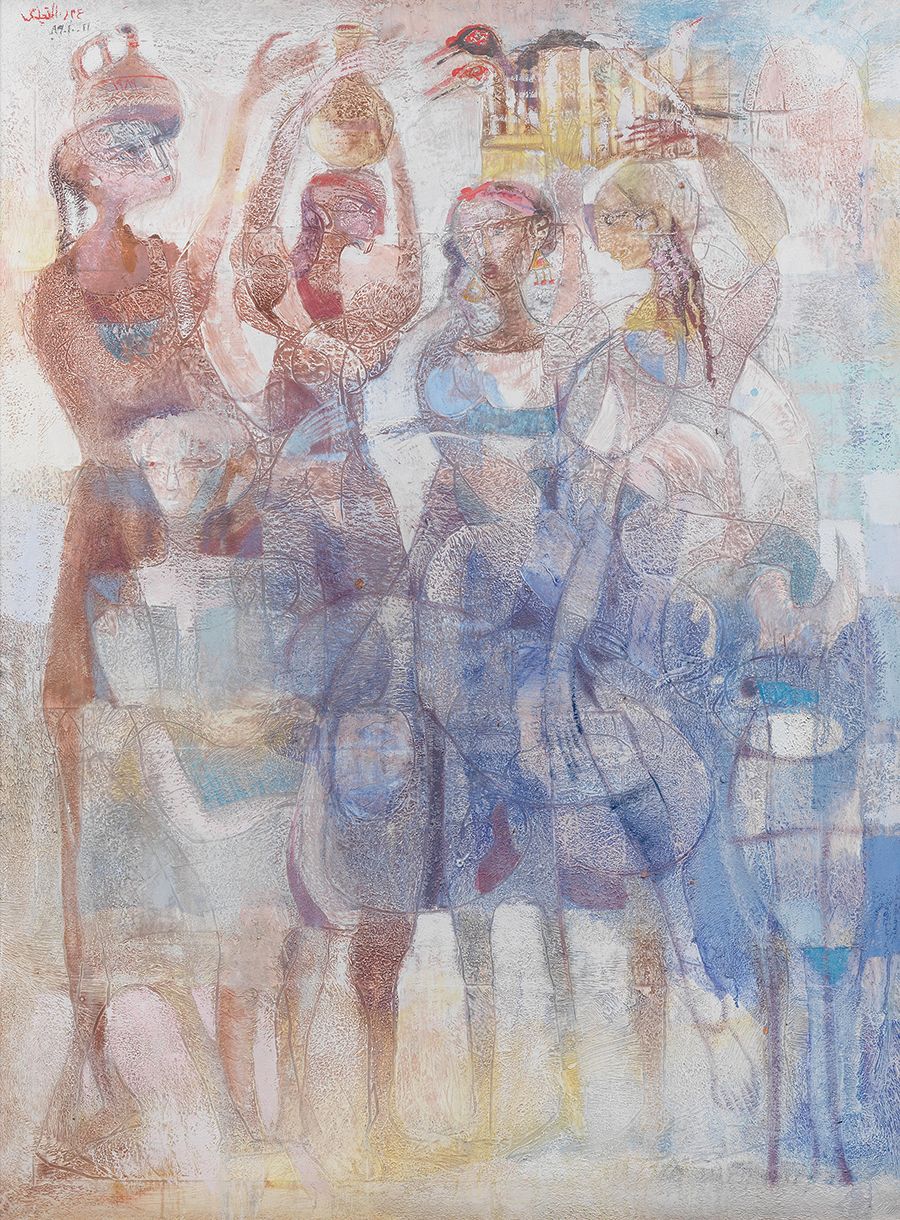
Omar El-Nagdi (Egypt, 1931-2019), Ella Al-Souk (To the Souk). Sold for £40,250 inc. premium in 2-12 August 2021, Online.
Omar El-Nagdi (Egypt, 1931-2019), Ella Al-Souk (To the Souk). Sold for £40,250 inc. premium in 2-12 August 2021, Online.
Register to bid in Modern and Contemporary Middle Eastern Art
Our upcoming auction on 15 November in London, New Bond Street, features artworks by artists including Shafic Abboud, Kadhim Hayder, Dia Azzawi, Omar El-Nagdi and others.
 Built with Shorthand