
Artist 101
5 Things to Know About Lucio Fontana
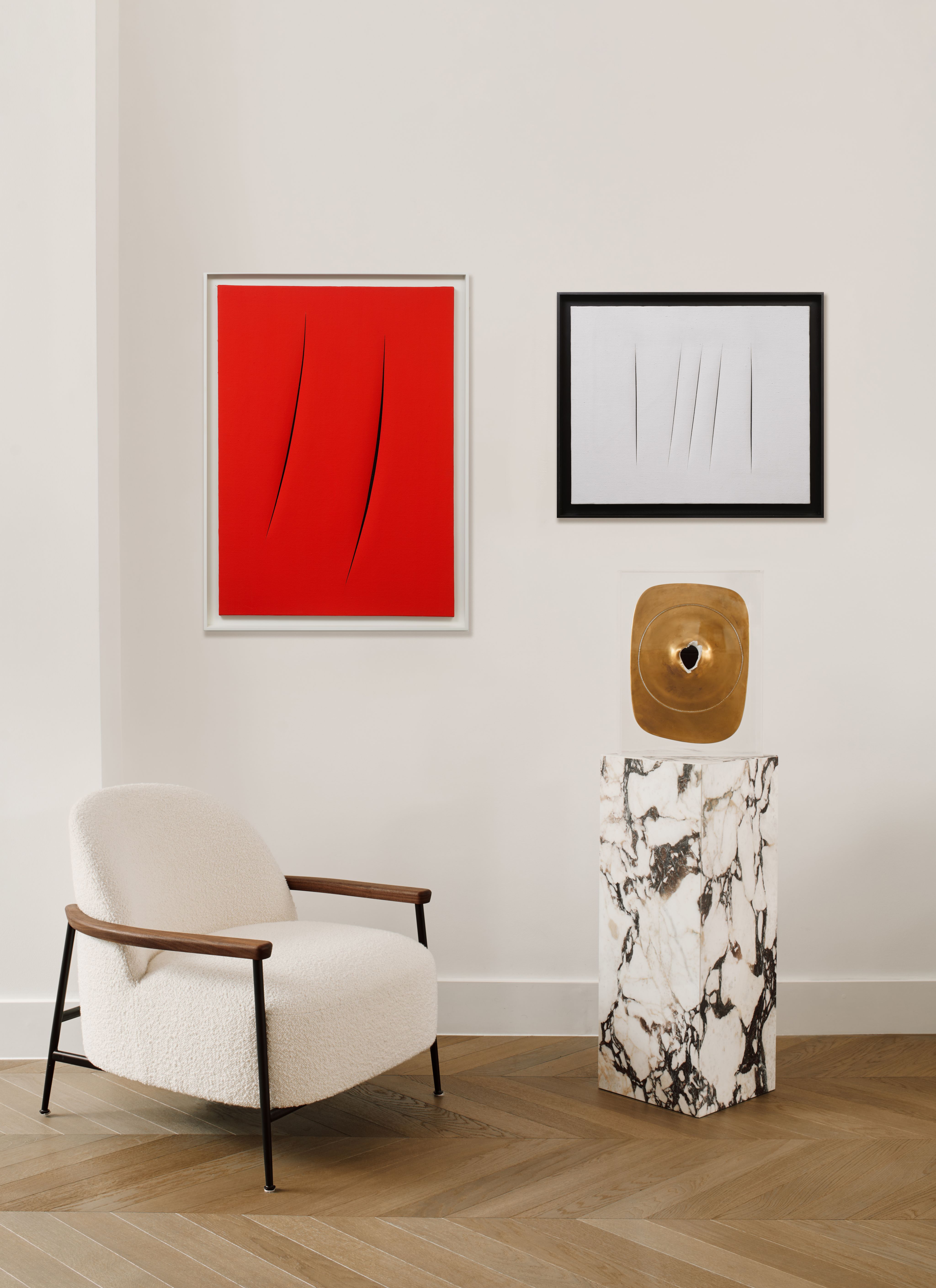

Few 20th century artists blurred – or slashed – the lines between painting, sculpture and performance like Lucio Fontana (1899-1968). The Argentinean-Italian painter, whose work is mostly synonymous with knife-slit canvases, founded the Spazialismo movement (Spatialism) and laid the foundation for a new kind of spatial and spiritual abstraction. Here, we explore the pioneer’s background, innovations and lasting impact on art today – illustrated with upcoming works from 20th Century Masters | A Private Collection: Fontana to Baselitz on 29 June in London, New Bond Street.
1.
Early Life & Career
Lucio Fontana was born in 1899 in Rosario de Santa Fé, Argentina, to Italian-born parents; his mother was an actress and his father was a sculptor and architect. In his formative years, he divided his time between Argentina and Italy. He began making sculptures at his father’s workshop, and later studied at the Accademia di Brera, Milan under Symbolist sculptor Adolfo Wildt, and exhibited his works at Il Milione gallery.
In 1940, he fled war-torn Europe and returned to Argentina where, in 1946, he founded the radical Altamira Academy. Along with a group of students, Fontana began writing the Manifesto Blanco (White Manifesto). Its strategy was ambitious, seeking to break away from artistic conventions by using advancements in technologies and science to to build a fourth dimension, ideas that would lay the foundations for Spazialismo.

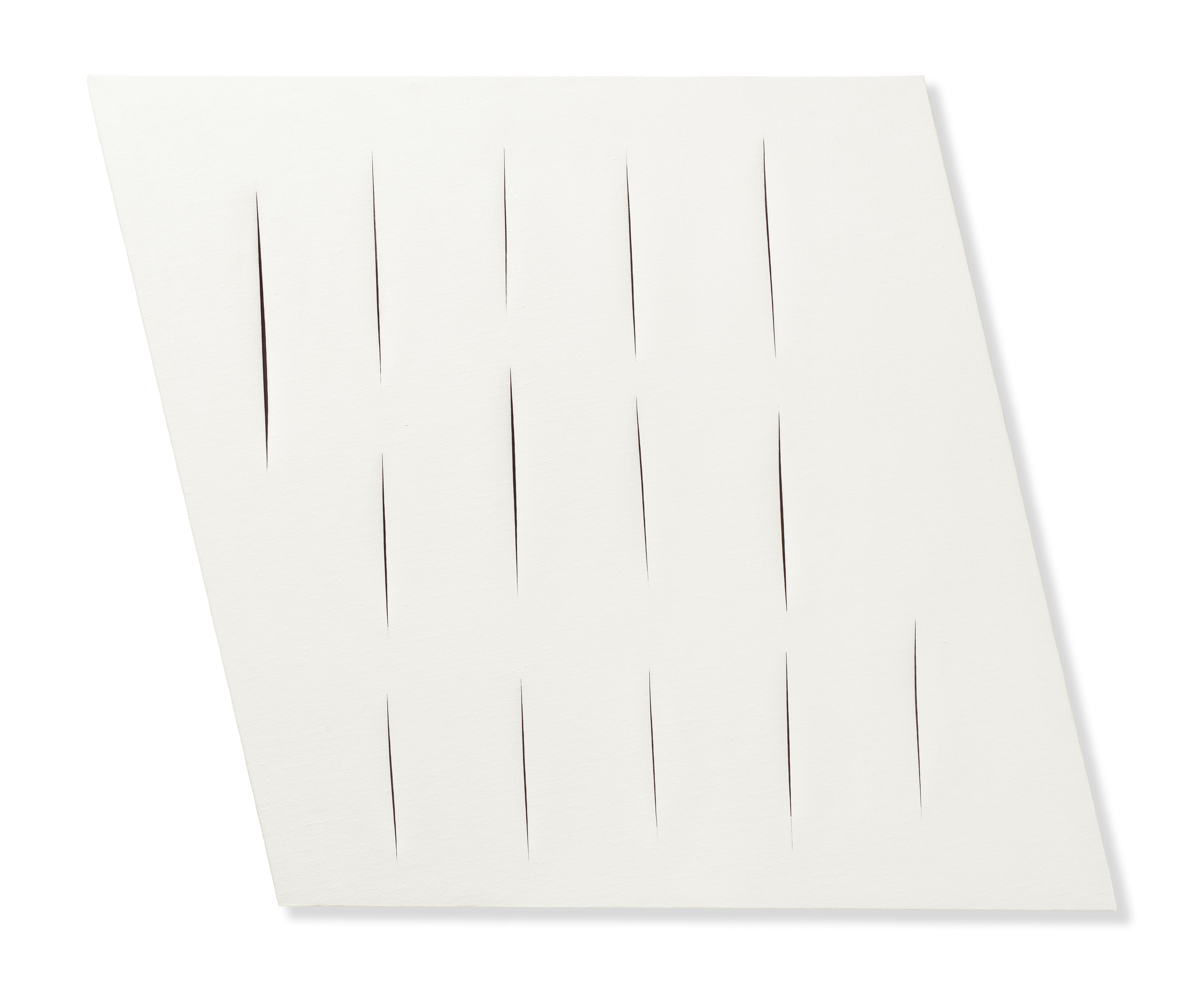
Lot 5. Lucio Fontana, Concetto spaziale, Attese, 1959. Estimate: £1,600,000 - £2,200,000.
Lot 5. Lucio Fontana, Concetto spaziale, Attese, 1959. Estimate: £1,600,000 - £2,200,000.
2.
Spatialism
Fontana was fascinated by space and believed in the making of art as a performative act. He felt that art itself must respond to modernity and the rapid technological and scientific innovations of the time. After World War II was over, Fontana returned to Italy in 1947, where he would live and work for the rest of his life.
Alongside a group of other young artists and critics, he began developing the first Spatialism manifesto; it imagined art as bigger than mere aesthetics, combining movement and space with sound and colour. These concepts were later followed by further texts outlining theoretical developments, such as the Manifesto Tecnico dello Spazialismo (Technical Manifesto of Spatialism), 1951. As he explained at a Milan Triennale talk the same year: ‘We have renounced the practice of familiar art forms and are working to develop a kind of art based on the unity of time and space… We think of art as a sum of physical elements: colour, sound, movement, time, and space, brought together in a physical and mental whole.’
Though he is best known for radical canvas-based works, Fontana also used innovative materials and exhibiting approaches, including television broadcasts, hanging neon works, ultraviolet light, fluorescent paints and his architectural Ambienti spaziali (Spatial Environments): self-contained rooms that immersed all who walked through.
During his career, Fontana was interested in the relationship between the artwork, visitor and environment, which led him to collaborate with some of the most significant Italian architects and studios of the time, including Gio Ponti, Carlo Scarpa, Luciano Baldessari, Nanda Vigo and Vittorio Gregotti.

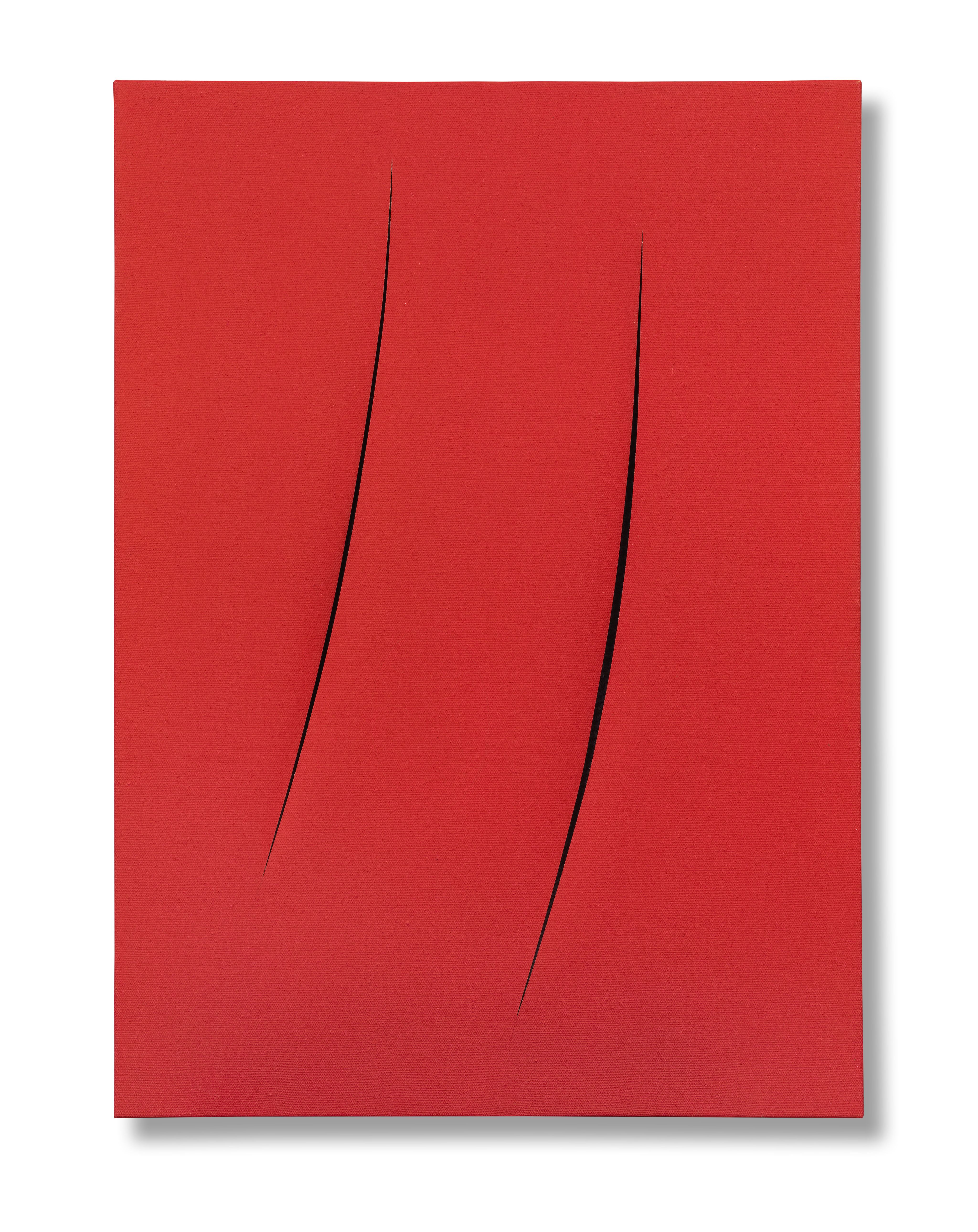
Lot 2. Lucio Fontana, Concetto spaziale, Attese, 1960. Estimate: £1,300,000 - £1,800,000.
Lot 2. Lucio Fontana, Concetto spaziale, Attese, 1960. Estimate: £1,300,000 - £1,800,000.
Own a similar artwork by Lucio Fontana? Submit it online for a free auction estimate.
3.
The Tagli (Slash) Series
Fontana explored these ideas with his Concetti spaziali (Spatial concepts) works (1949-1960), with which he would become synonymous. Here, monochromatic canvases – and later ceramics – are pierced, slashed and punctured with buchi (holes) and tagli (cuts); not as a means to destruct, but to discover a third dimension. He started his Tagli series in 1958. To achieve the tagli effect, Fontana would slit the painted canvas while it was still wet – reshaping the incisions by hand, and subsequently filling the space behind with black gauze. The intense black colour revealed through the cuts creates a void effect and a sense of infinite space beyond the canvas. For Fontana, it was less about the final result, and more about the journey to get there; for this, the artist became one of the early pioneers of performance art in Europe.

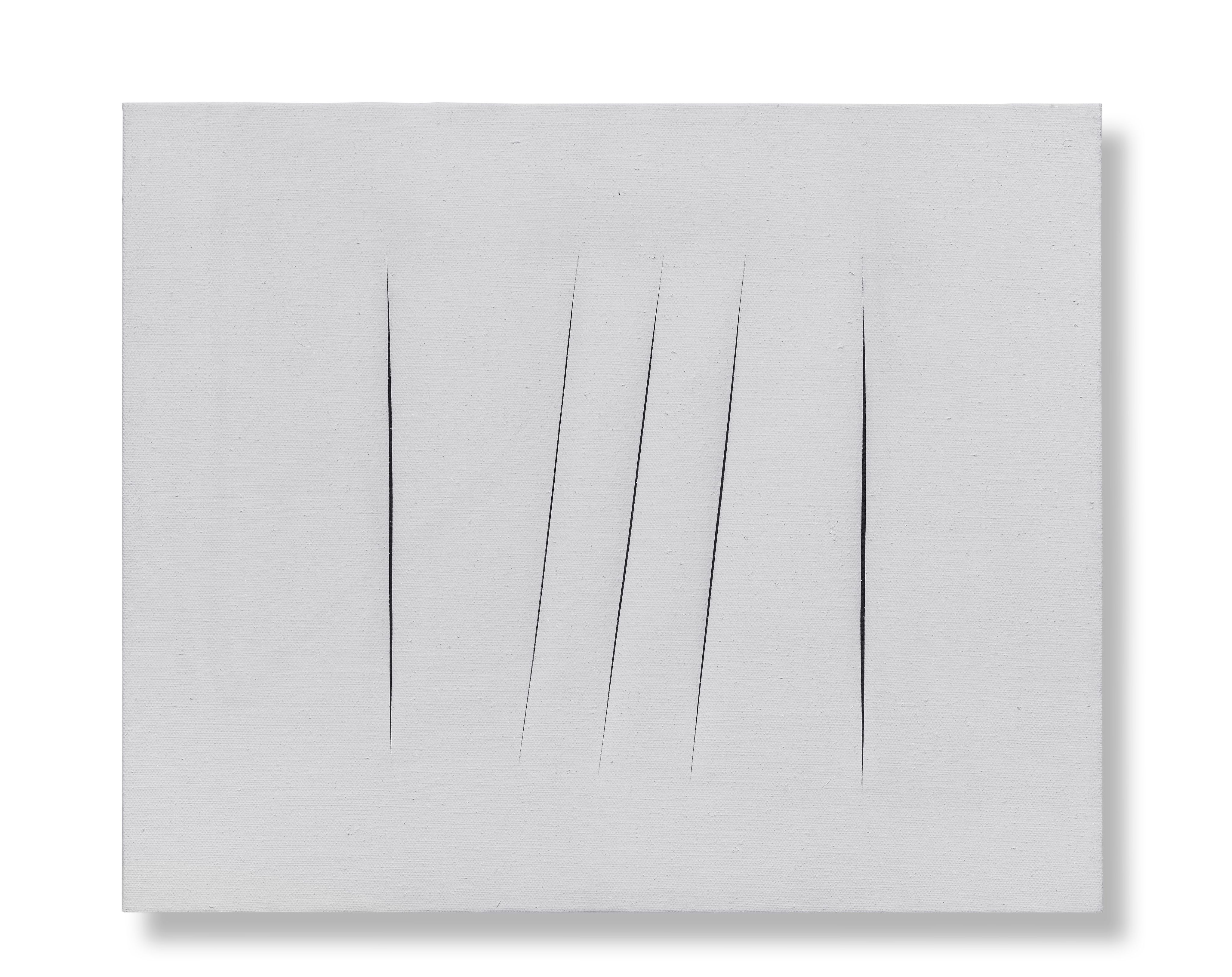
Lot 3. Lucio Fontana, Concetto spaziale, Attese, 1966. Estimate: £500,000 - £700,000.
Lot 3. Lucio Fontana, Concetto spaziale, Attese, 1966. Estimate: £500,000 - £700,000.
4.
The Work on the ‘Surface’ of the Canvas
Fontana’s exploration of new spiritual universes corresponded with actual discoveries in outer space, including the 1957 Russian Sputnik launch and the US Explorer soon after. These events fuelled Fontana’s imagination, and while astronauts left the surface of Earth to discover new dimensions, Fontana looked to the surfaces of his canvases to find the same. While previous chapters of art history had seen the pictorial surface host landscapes, figurative art, and more recently, abstract painting, a number of mid 20th century artists viewed surfaces as their primary subject. While Yves Klein (a friend of Fontana’s) burnt his canvases, and Günther Uecker stuck nails through his, Fontana found spirituality through his immaculate canvas voids and ceramics that resemble lunar landscapes. As revealed in its title, Fontana’s porcelain work Concetto Spaziale, Cratere resembles a crater, encapsulating his interest in outer space and scientific innovation. Created in 1968, this work looks forward to the Apollo 11 moon landing in 1969.

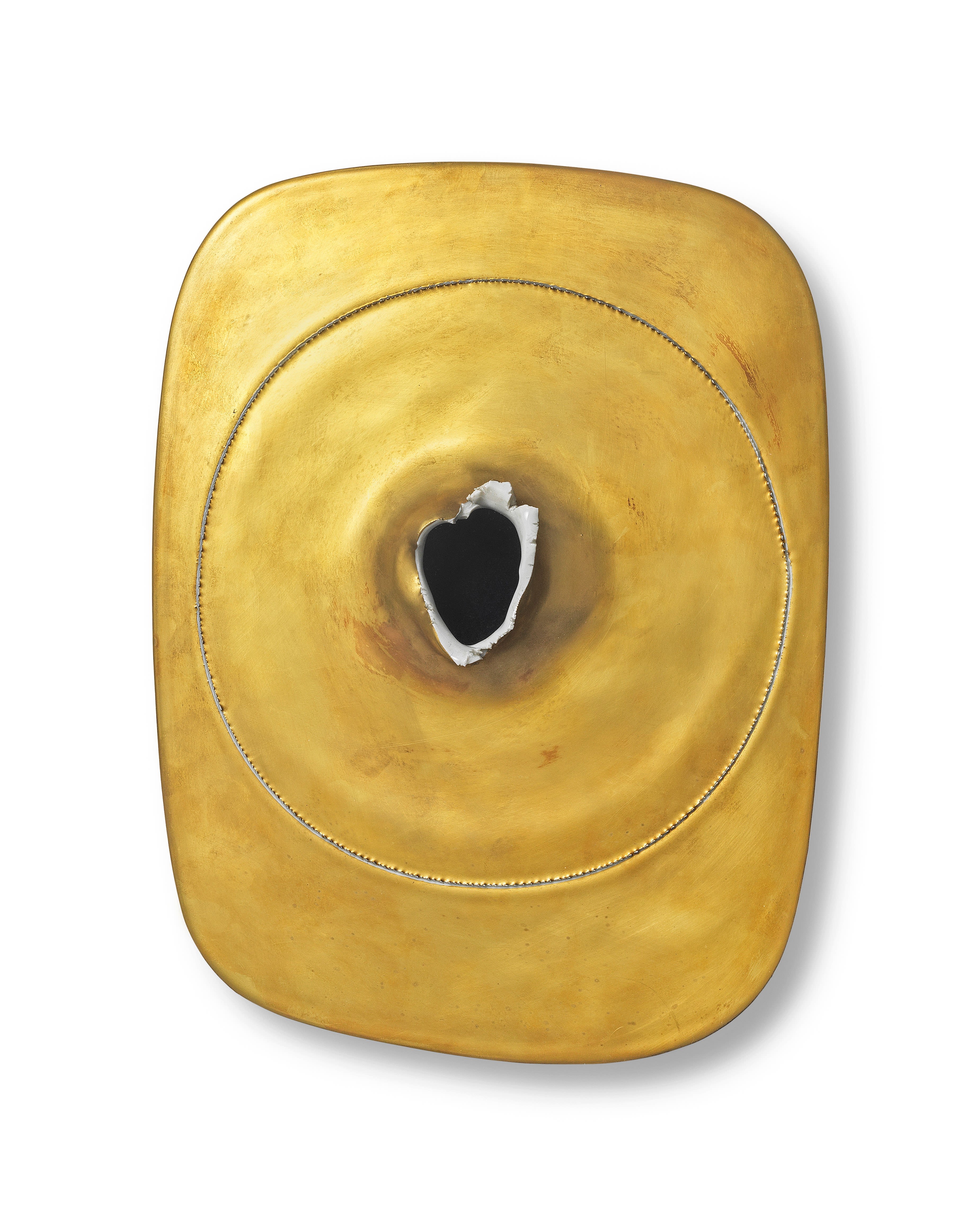
Lot 4. Lucio Fontana, Concetto Spaziale, Cratere, 1968. Estimate: £18,000 - £25,000.
Lot 4. Lucio Fontana, Concetto Spaziale, Cratere, 1968. Estimate: £18,000 - £25,000.
5.
Legacy and On the Market
Though he died more than 50 years ago, Fontana remains a pertinent force in art today, inspiring generations of creatives and subsequent groups, including the 1950s Gruppo T founded in Milan, and the German Group Zero, which centred on optical phenomena. The latter’s co-founder, Otto Piene, called Fontana ‘something like a spiritual father’ of the movement.
Fontana’s work can be found in more than 100 museums – from Tate Modern to MoMA – and his market remains robust, with hundreds of his works achieving more than $1 million at auction since 2000. Recent major exhibitions include the 2014 retrospective at the Musée d’Art Moderne de la Ville de Paris, which brought together more than 200 paintings and ceramics; a trailblazing show of the artist’s more ephemeral installations at Pirelli HangarBicocca, Milan in 2017, and the 2019 retrospective at the Metropolitan Museum of Art.
Bonhams has consistently demonstrated the strong market for Fontana’s works, notably auctioning his 1952 Concetto Spaziale for £770,500 inc. premium in 2014, which remains a record price for one of his works from that year. More recently, in December 2022, Bonhams Cornette de Saint Cyr sold both Concetto Spaziale, [Teatrino] for €214,575 inc. premium and a work from his famous edition, Concetto spaziale, natura, for €176,775 inc. premium.

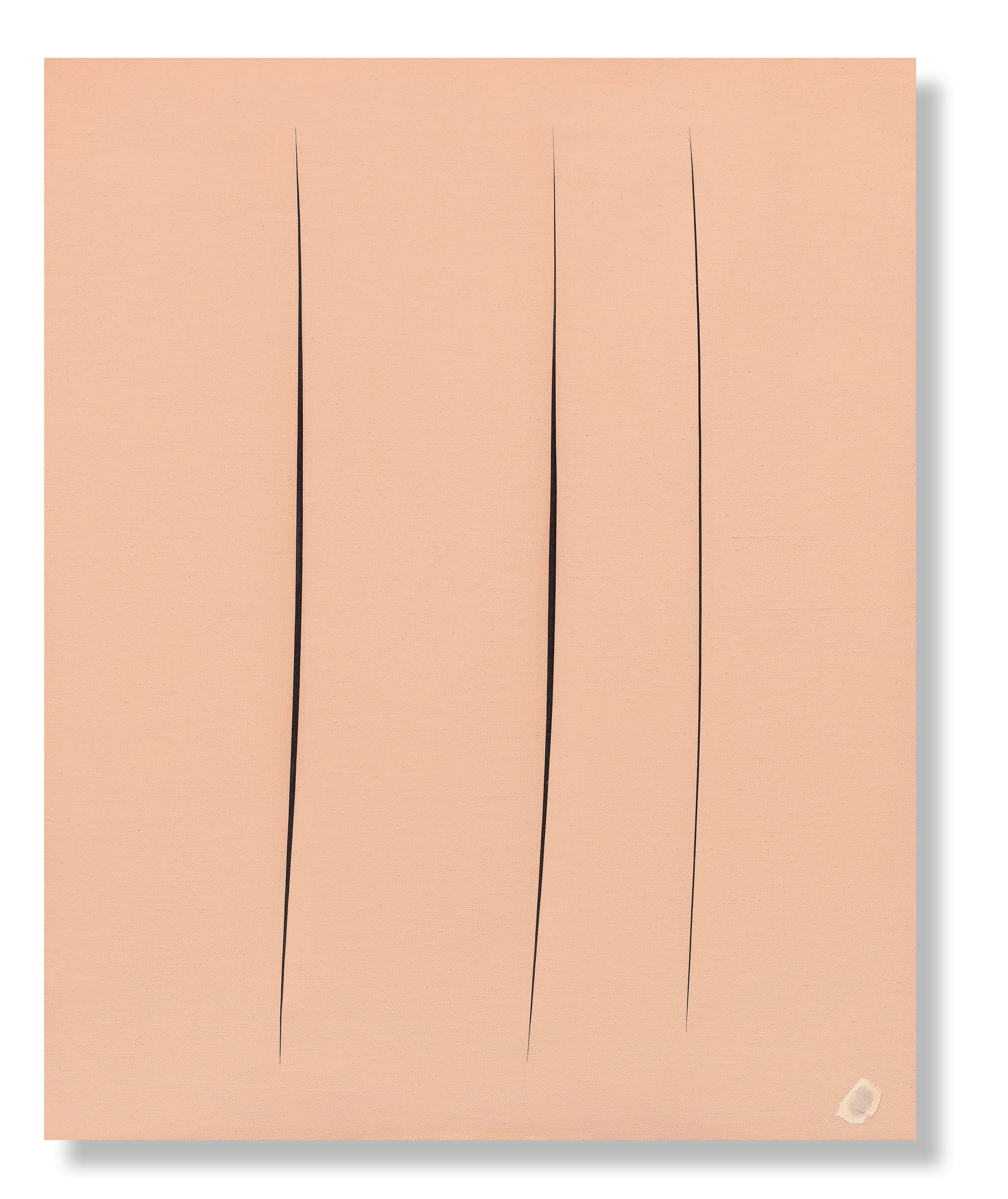
Lot 6. Lucio Fontana, Concetto spaziale, Attese, 1960. Estimate: £450,000 - £650,000.
Lot 6. Lucio Fontana, Concetto spaziale, Attese, 1960. Estimate: £450,000 - £650,000.
 Built with Shorthand