
A Closer Look
The Harvard World Map
A rare and magnificent Safavid “Mecca-Centred” World Map
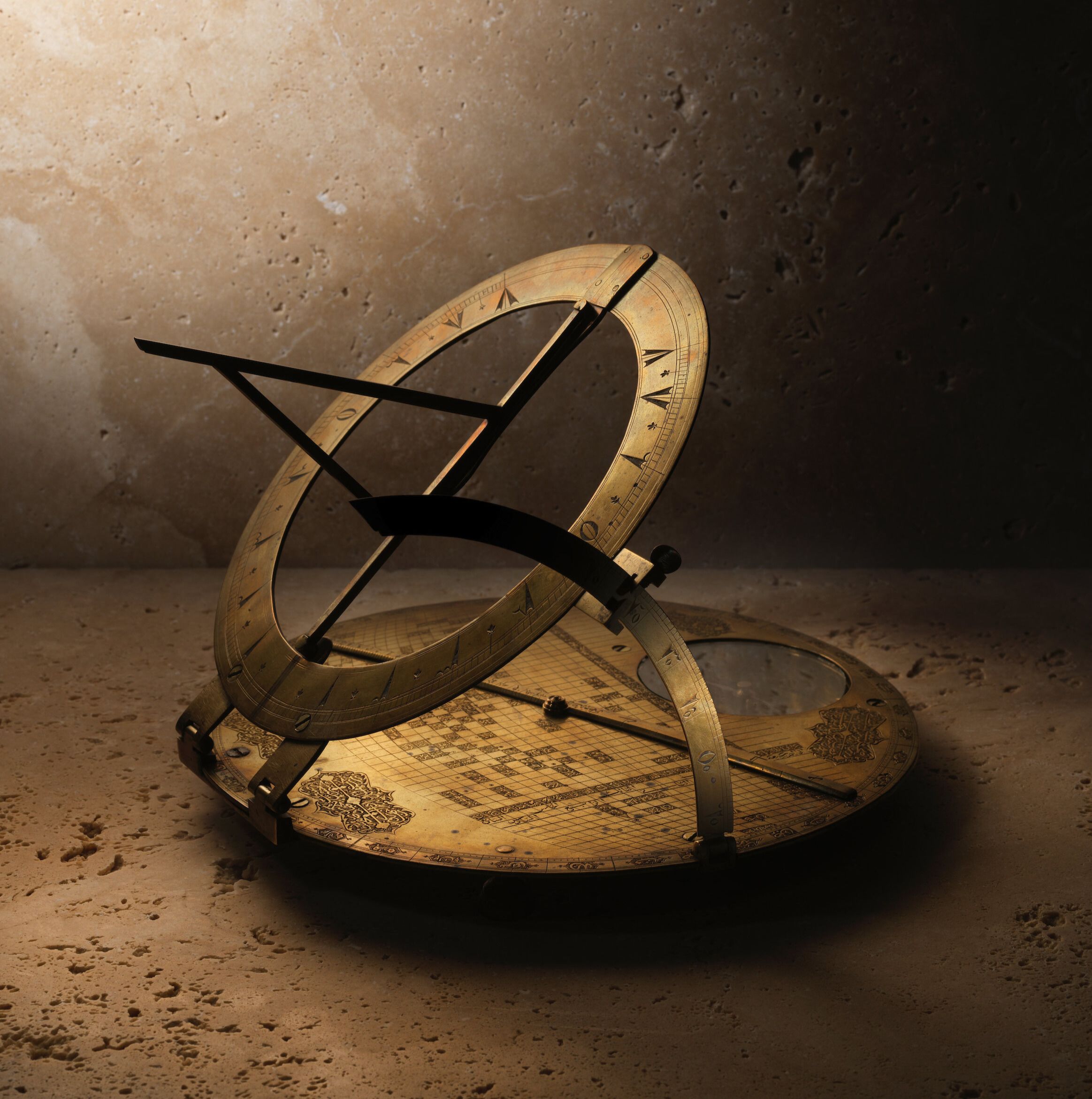

Take a closer look at the Harvard World Map, an extremely rare scientific instrument produced in late 17th-century Safavid Persia, which enables the user to accurately calculate both the distance and direction to Mecca from over one hundred locales marked on a beautifully engraved map.
It is the finest and most complete of only three known examples. The first example, when discovered in 1989, marked a turning point in our understanding of Islamic cartography.
The Harvard World Map was on loan at the Harvard Museum for over 15 years and is featured in numerous publications, including Professor David King’s comprehensive study In Synchrony with the Heavens, Studies in Astronomical Timekeeping and Instrumentation in Medieval and Islamic Civilisation. It will be offered in Islamic and Indian Art on 14 November in London, New Bond Street.
We spoke to Head of Islamic and Indian Art, Oliver White, about The Harvard World Map
The central pin represents the city of Mecca. The cities of the Islamic world are spaced out on an elliptical grid around it.
When the diametric ruler is rotated to pass through the city where the user is located, the distance to Mecca is shown on the rule. The Qibla (bearing to Mecca) is shown at the edge of the circular base plate.
Four inscriptions, engraved in elegant Nastaliq calligraphy provide instructions for the user, as well as details of the patron and maker of the piece.
“Through the beauty of his craft Husayn has created a world on this page, Through the auspiciousness of the fortune of Sayf al-Dawlah, who holds the light of the world.”
“If you align the local latitude with the plate for the hours, The shadow of the gnomon will be your guide for establishing the hour.”
“This expanse which depicts the Earth and Sky, turns its face to the south pole like the flight of the Indigo bird.”
“If you place the diametrical rule at the latitude and longitude of a city, You will be shown the qibla and the distance of the town from the qibla.”
This lot is one of the most important Islamic scientific instrument to ever come to market and will be going under the hammer on 14 November with an estimate of £1,500,000 - £2,000,000.
Visit the sale page or contact oliver.white@bonhams.com to find out more.
Register to bid in Islamic and Indian Art
Our Islamic and Indian Art auction taking place in London on 14 November includes highlights such as a gilt-copper hilted steel sword from the armoury of Tipu Sultan and a rare Safavid oil painting depicting a lady in European dress.
 Built with Shorthand