
A Closer Look At
Léonard Tsuguharu Foujita's
Sahara, les enfants du desert
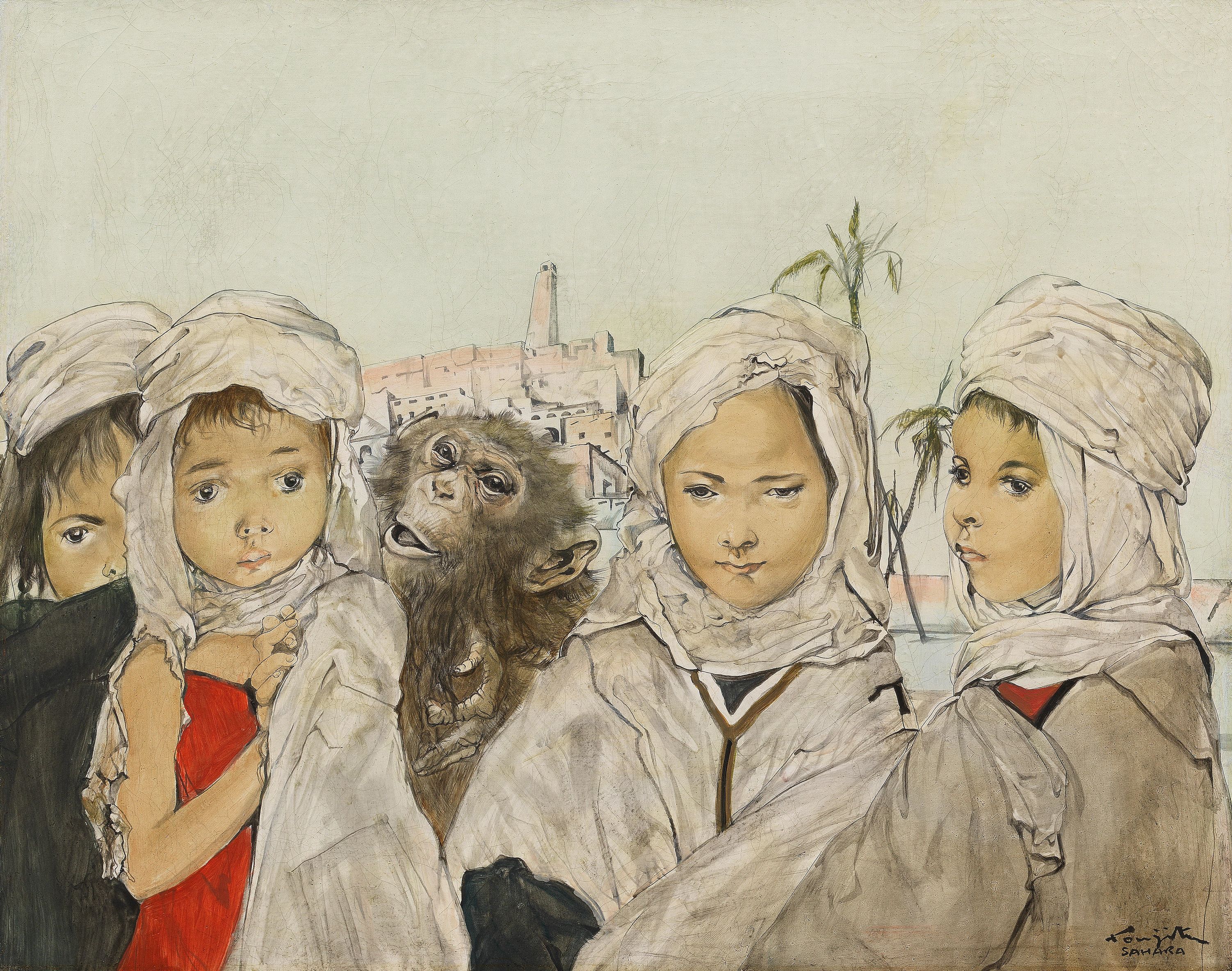

Sahara, les enfants du desert by Léonard Tsuguharu Foujita was painted at a pivotal time in the artist's life, when he was exploring new continents, renewing earlier painting themes and techniques, and asserting his singular, celebrated vision.
Ahead of our Impressionist & Modern Art auction on 6 December, we take a closer look at this captivating work, which marked the beginning of a transformative decade in Foujita's personal and artistic trajectory.
Beginnings
Born in Tokyo in 1886 and trained at the Tokyo School of Fine Arts in 1905, Léonard Tsuguharu Foujita first arrived in Paris in 1913, where he became closely acquainted with many of the preeminent artists of the 20th century, including Amedeo Modigliani, Pablo Picasso, and Chaïm Soutine. Alongside them he rapidly became a leading member of the École de Paris, a term coined by the art critic André Warnod in 1925 and referring to the group of avant-garde artists who led the visual arts scene in Paris from 1905 through the 1920s.
Foujita enjoyed early and ample success and recognition in Paris during the interwar years, what would be his first period in the city of lights. He exhibited his works at Galerie Chéron and Galerie Paul Pétridès in the 1920s and 1930s. In 1930, Foujita concluded his first incandescent episode in Paris, and embarked on a succession of global travels, including time in his native Japan, where he accepted a controversial commission from the emperor to act as the official artist of the war effort.
After nearly two decades abroad, Foujita yearned for the avant-garde crucible of Paris; he returned in February 1950 accompanied by his new wife, Kimiyo, and began the second phase of his work in the French capital.
Paris, Part Deux
Foujita's style and subject matter took a distinctive turn during the 1950s, returning to his meticulously detailed technique, and his focus shifting from sensual nudes to quotidian life and a world of children and young girls. Although Foujita had no children of his own, the artist enjoyed depicting their qualities of purity and playfulness.
Shortly after his return to Paris, Foujita's friend, the gallerist Paul Pétridès, eagerly promoted Foujita's new Parisian Renaissance and organized an extensive exhibition in 1950 highlighting 50 paintings; this solo show was consistently followed by an exhibition every two years until 1964. In June 1952, Galerie Paul Pétridès presented a dazzling array of ten watercolours and 40 oils by Foujita, including Sahara, les enfants du desert.
This enchanting painting, like Foujita's figural paintings inspired by Medieval and Renaissance masterworks, defies temporal constraints, and is rendered as a fairytale scene rather than a specific document of his observations of Algiers and its surrounding environs.

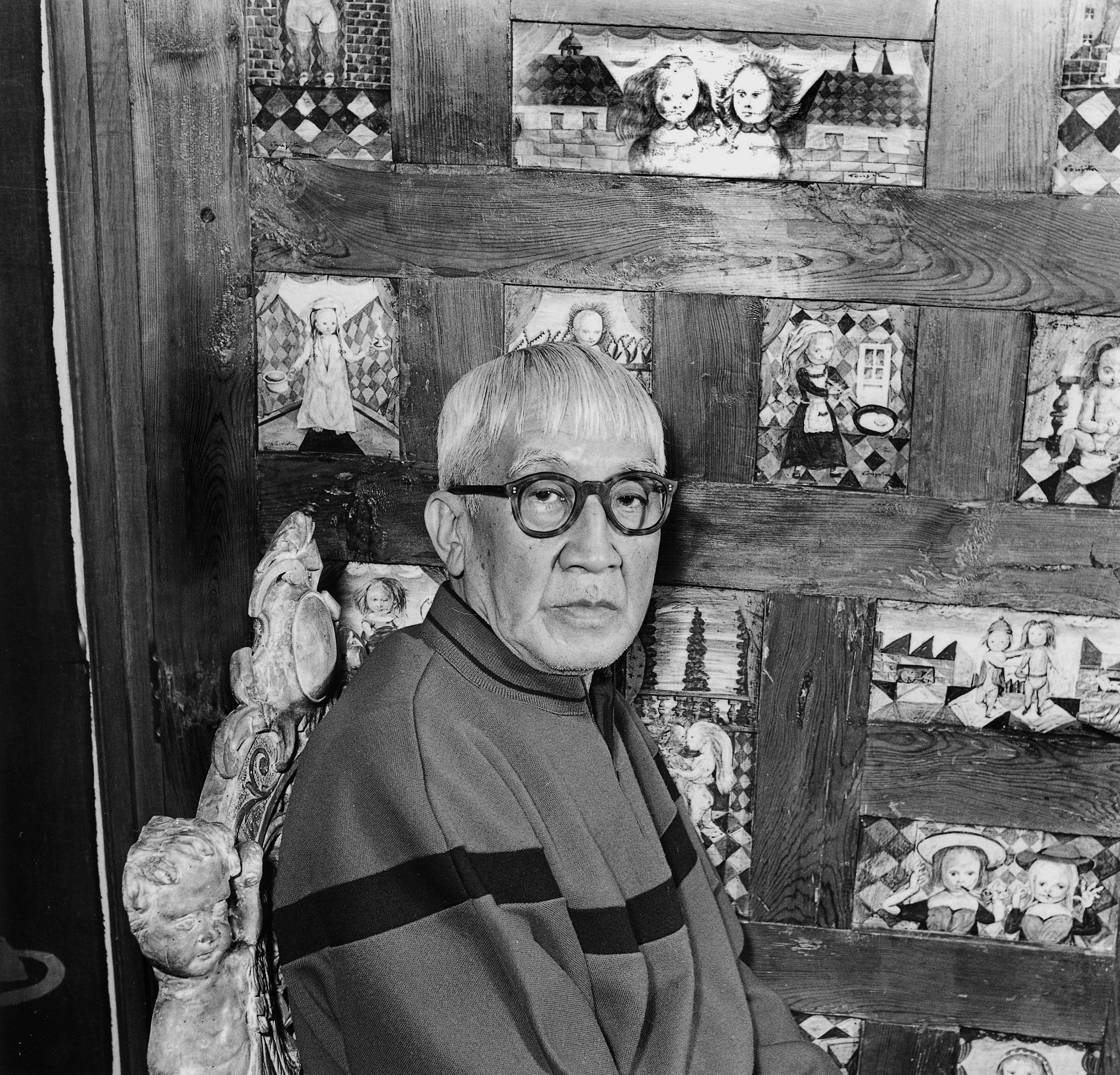
Léonard Tsuguharu Foujita
Léonard Tsuguharu Foujita

Lot 14. Léonard Tsuguharu Foujita, Sahara, les enfants du desert. Estimate: $350,000 - $550,000
Lot 14. Léonard Tsuguharu Foujita, Sahara, les enfants du desert. Estimate: $350,000 - $550,000
"In reaction to such violent times, I prefer imagining very soft and childish subject matters."
Here, he has employed the customary white ground that he had developed years earlier which lends not only a restrained, pearlescent luminosity to the work, but also augments the nonspecific, the theatrical, and the fantastical by dislocating the primary subject matter in space and time.
Foujita's blending of cultures is signified in the color of the canvas itself, which recalls both Japanese prints which had a significant impact on European artists of the 19th and 20th centuries, but also of dainty porcelain produced in France.
Four children in the foreground are bedecked in white, black, and red indigenous garb, joined by a jolly chimpanzee in the center of their grouping. Foujita has modeled the children's faces with the utmost delicacy, in keeping with his refined technique.
The background is composed of an oasis of palm trees and water and the suggestion of a clay-colored North African fort or townscape, complete with a minaret projecting above the blocky shapes. There is a deft balance in the scene between spontaneous narrative action and the stillness of detailed portraiture.
Register to bid in Impressionist & Modern Art before 6 December and follow @bonhams_impressionists on Instagram for more exciting news.


 Built with Shorthand