
A Closer Look
The Five Forefathers of the Sakya Order of
Tibetan Buddhism
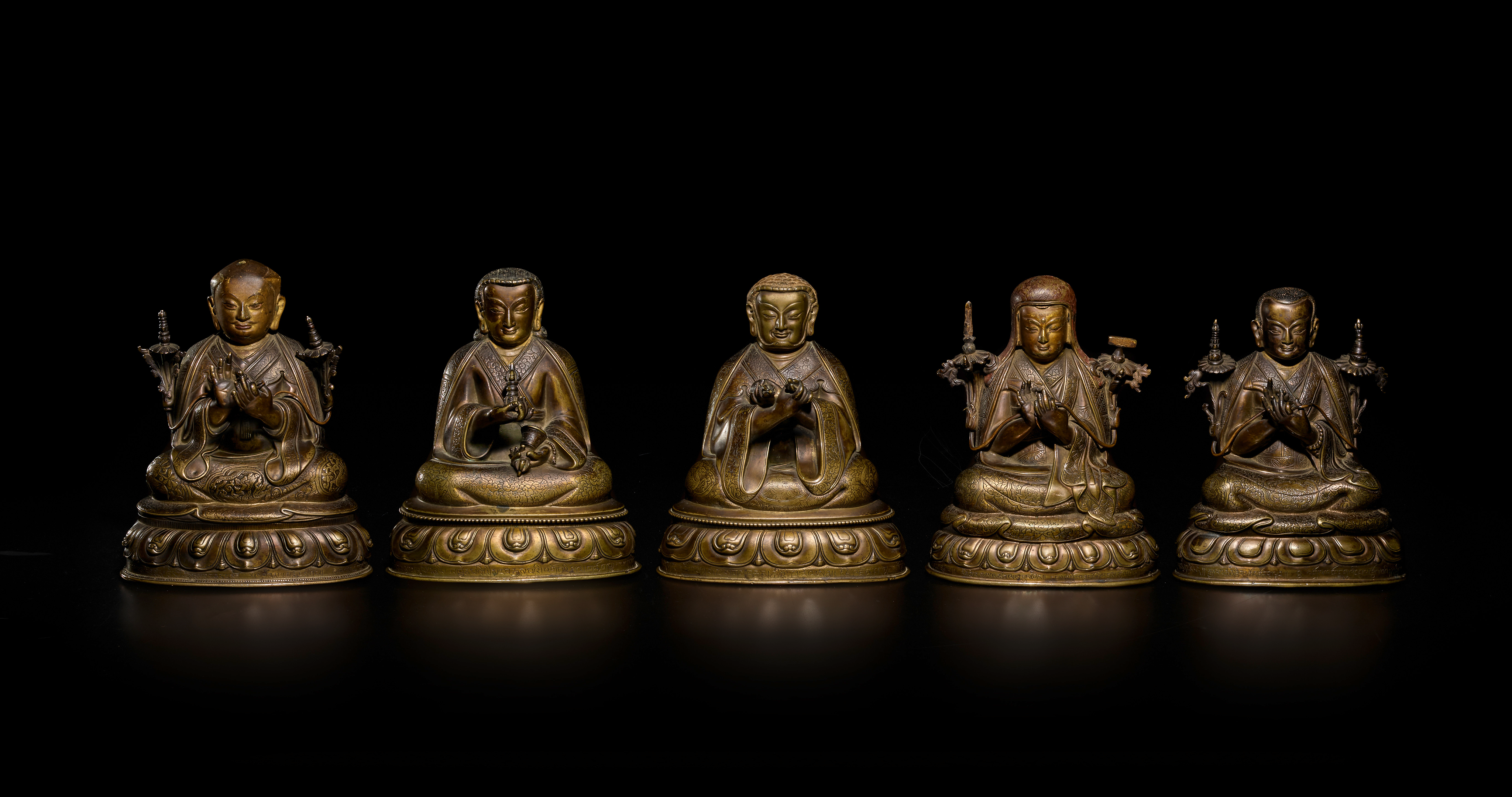

On March 21, in Indian, Himalayan & Southeast Asian Art, Bonhams is proud to offer a group of inscribed portrait bronzes commemorating the five forefathers of the Sakya order. This rare sculptural set is likely the only one of its kind outside Tibet.
The five Sakya masters became known as the Five Superiors after their monarchical rulership in Tibet during the 14th century. This legendary appointment, and subsequent power held within Tibet, established the Sakya Order as the greatest of its time.
Here, we take a closer look at this rare set of copper alloy portraits.

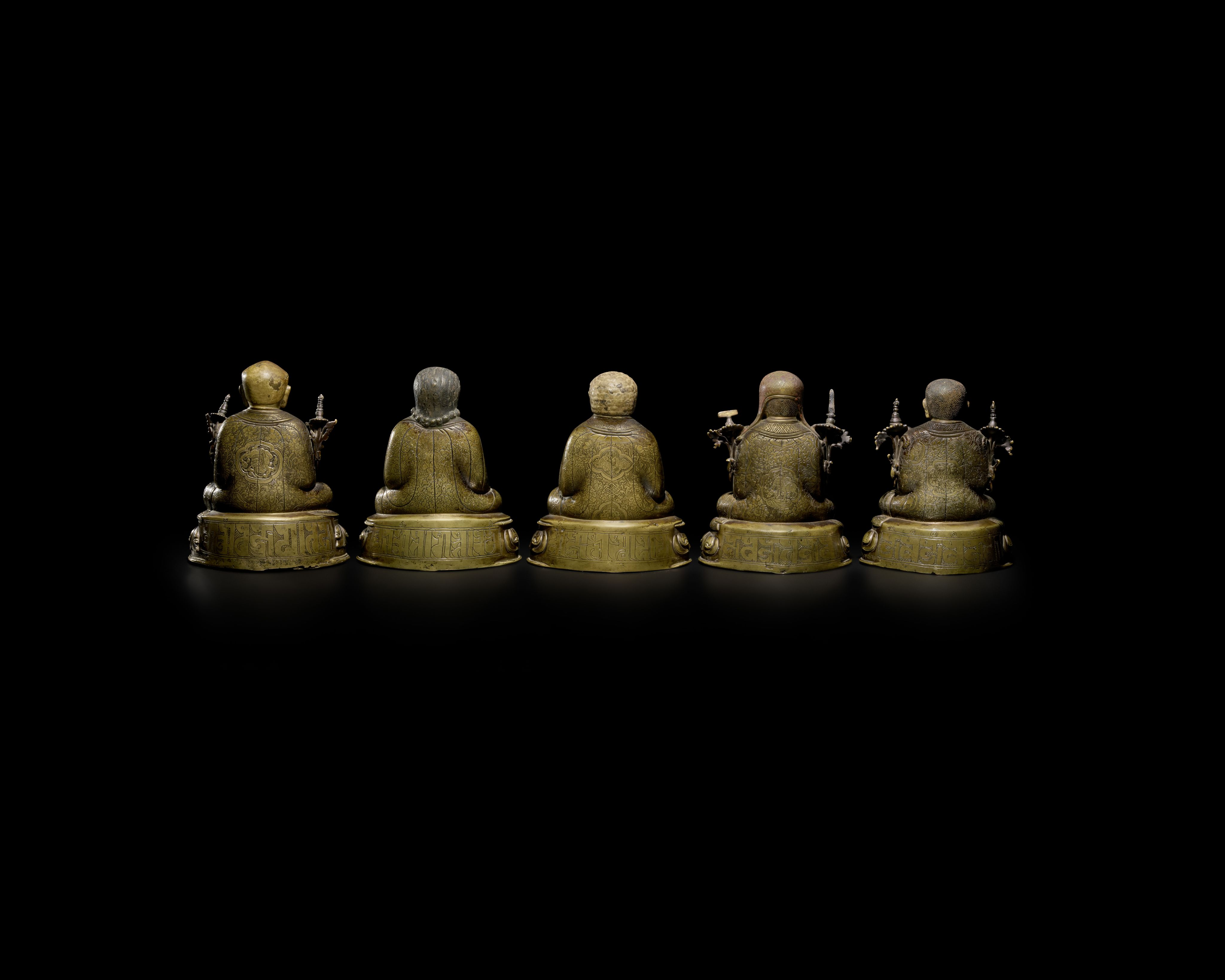
Finely modelled, cast, and engraved, the set likely originates from Central Tibet during a peak of artistic achievement in the 15th and 16th centuries. The portraits are of a particular stylistic subset of Tibetan bronze sculpture, characterized by a burnished, non-gilded, and heavily patterned surface rendered by crosshatching a negative silhouette around relief designs.
The mannered quality elicits an authoritative air to each of these founders, each modelled with their own distinctive facial features and robes. While they are stylistically held together by the warm patina, heavy engraving and inscriptions around each of the base in a manner closely associated with Central Tibet, these were not made by the same hand. The depth of the engraving varies, the use of pigments along the face varies, the petals of the lotus bases vary, and the styling of the cartouches vary.
Nevertheless, they were clearly made in connection with one another, in a thoughtfully reverent yet regional style, all in consideration of their descending family lineage, both noble and divine. As a set, they represent the power of the lineage as the forefathers of a successful order in Tibet which rests on their sacred achievements in faith and their larger secular power within and outside of Tibet.
Meet the Forefathers


Sachen Kunga Nyingpo (1092-1158)
Initiating this successive line was the son of Khön Konchog Gyalpo, and the first of the patriarchs, Sachen Kunga Nyingpo. His hands held in the teaching mudra, a reference to the first teachings of Shakyamuni, illustrate his initiative as the first of the Sakya patriarchs.
The gentle candor of his face, suggestive of his attuned meditative faculties, also hints at his noble rank, with his articulated features of arched eyebrows and defined moustache all set on evenly layered gilding across the face.
This inheritance of noble Buddhist ancestry is further delineated in the deeply carved cartouches of the robes. The magical creatures of celestial dragon at front and the terrestrial snow-lion at back, often associated with directionality in Tibetan culture, are in opposition pairing both his heaven-bound and earth-bound status. Along the knees sit more docile creatures of the deer and hare, both which are closely associated with the initial teachings of Shakyamuni Buddha at Deer Park in Sarnath.
Sonam Tsemo (1142-82)
Sonam Tsemo, the second of the Sakya patriarchs, held the throne for only a short three years, passing the responsibility to his younger brother so that he could devote his life to study and retreat. His life as a retreatant is suggested by his long-matted hair which curls around his forehead and at the ends.
Of the five patriarchs of this set, his robes bear no cartouche. Instead, the pleated garment is lightly engraved in scrolling motifs, mostly of floral patterns, interspersed with fruit and a single flaming jewel between his shoulders. The simplicity of the robes and mudra, with his hands holding the implements mirroring the deity associated with purification, Vajrasattva, resonate with his own deep commitment to study.
Jetsun Dragpa Gyaltsen (1147-1216)
Sonam Tsemo’s younger brother, Jetsun Drakpa Gyeltsen, was the third of the Sakya patriarchs. His full sleeved garment is adorned with four of the eight auspicious symbols, early Indic symbols deriving from royal ceremonies. Flanked on either shoulder are cartouches carrying phoenixes, symbols closely associated with embroidered brocade depicted on imperial robes, and coupled with the deer etched on either knee, carry connotations of peace.
Recognized here for his commitment to the continuation of the lineage, he is presented adorned in robes of divine imperial status. His hands crossed at the chest with vajra and ghanta, bear associations to the primordial Buddha, Vajradhara, a deity who expresses the quintessence of Buddhahood.
Sakya Pandita Kunga Gyaltsen (1182-1251)
Sakya Pandita’s renown training as a monastic with the Kashmiri teacher Sakyasribhadra, modelled on the educational Indian monastic model, made his teachings and writings widely influential within Tibetan literature. His scholarly achievements are reflected in this portrait, his accoutrements of sword and book emblematic of his ability to transmit teachings of fathomless wisdom as an emanation of the deity, Manjushri.
The distinguished red pandita hat detailed with feathered engravings on his head tell of his learned accomplishments as a Buddhist master, his contemplative face and third eye, an insignia of his enlightened accomplishments. Cartouches of phoenixes, hares, deer, and lion interspersed within dense floral motifs pattern the robe evoking his broader influence amongst the Mongolian court, having been appointed Viceroy of Tibet by Khoden Khan in 1249.
Drogon Chogyal Pagpa Lodro Gyaltsen (1235-80)
Sakya Pandita’s nephew and the fifth of the Sakya patriarchs, Drogon Choegyal Pagpa, having traveled with his uncle to the Mongol court of Khoden Khan in 1244, remained in Mongolia even after his uncle’s death.
In 1253, he was invited by Khubilai Khan to initiate Tibetan Buddhist empowerments for the Khan, holding significant authority within the Mongol court.
His robes show the most celestial manifestations of cartouches compared to the others featuring hares, lions, dragon and several mythical birds, and his face with wavy eyebrows and pursed lips, reveals the most intent expression of all the patriarchs.
This rare collection of Portrait Bronzes is coming under the hammer on 21 March. Browse the sale and register to bid now or contact mark.rasmussen@bonhams.com for more information.
 Built with Shorthand